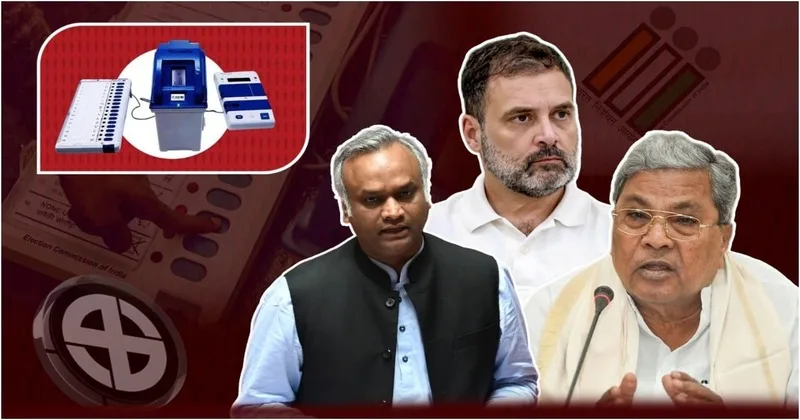
BENGALURU: A statewide survey has revealed that an overwhelming 83.61 per cent of voters in Karnataka express confidence in Electronic Voting Machines (EVMs), offering a significant data point in the ongoing national debate over the credibility of electronic voting. The findings have attracted particular attention as the highest level of trust in EVMs has been recorded in Kalaburagi district, the home turf of IT and BT Minister Priyank Kharge, who has often voiced scepticism about the use of EVMs.
Congress’ own survey in Karnataka completely exposes Rahul Gandhi’s entire “vote chori” narrative.
This study was commissioned by the Office of the Chief Electoral Officer of Karnataka through the Karnataka Monitoring and Evaluation Authority (KMEA), an independent body under… pic.twitter.com/4GB8x7ndJt
— Amit Malviya (@amitmalviya) January 2, 2026
The survey was conducted by the Karnataka Monitoring and Evaluation Authority (KMEA), which operates under the Department of Planning and Statistics. It aimed to assess public perception of the reliability, accuracy, and security of EVMs used in elections. According to sources, the survey report was formally submitted in August 2025, but its findings have only now become public.
As per the survey, more than four out of five voters across Karnataka said they trust EVMs and consider them a reliable method for conducting elections. Kalaburagi district topped the list with 94.8 per cent of respondents expressing confidence in EVMs. Chief Minister Siddaramaiah’s home district of Mysuru followed closely, with 88.59 per cent of voters stating that they trust electronic voting machines. Respondents in these districts also gave positive feedback on the accuracy and efficiency of the voting process.
The survey findings are being viewed as politically significant, particularly amid repeated allegations by sections of the opposition of EVM tampering and electoral manipulation. In recent years, EVM credibility has been a recurring flashpoint in electoral politics, especially after closely fought elections.
Priyank Kharge questions survey credibility
Reacting to the survey, IT and BT Minister Priyank Kharge raised serious questions about its credibility and the agency that conducted it. He maintained that the survey was not commissioned or approved by the Karnataka government and urged caution in interpreting its conclusions.
“First of all, this is not a survey ordered by the state government. The Election Commission had made a request to the State Election Commission. For conducting the survey, assistance was sought from an NGO run by Balakrishnan or Balasubramanian,” Kharge said.
He further alleged that the individual associated with the NGO had close links with the central government. “If my information is correct, Balakrishnan is an author who has written a book for the Prime Minister and works very closely with the Prime Minister’s Office. What kind of outcome do you expect from such a survey?” Kharge asked, casting doubt on the exercise’s neutrality.
Kharge’s remarks underscore the ongoing divide within political circles over EVMs, even as official agencies and technical experts have repeatedly asserted the system’s robustness.
BJP hits back, targets Rahul Gandhi
The Bharatiya Janata Party (BJP) was quick to seize upon the survey findings to launch a counter-offensive against Congress leader Rahul Gandhi, who has consistently raised concerns about EVMs and alleged “vote theft” in elections.
BJP national spokesperson Shehzad Poonawalla said the Karnataka survey exposed what he termed the “habitual excuses” of the Congress leadership. “Every time Congress loses an election, Rahul Gandhi questions EVMs and the Election Commission. Whenever he makes such allegations, facts emerge to prove that his claims are baseless,” Poonawalla said.
He argued that the high level of public trust in EVMs, including in Congress-dominated or Congress-ruled regions, demonstrates that ordinary voters have faith in the electoral system. “People of Karnataka consider EVMs safe and reliable. Surveys like these reflect ground reality and expose the false narrative being built around EVMs,” he added.
The BJP also noted that the survey results contradict the narrative that EVM scepticism is widespread among voters, suggesting that doubts are largely confined to political rhetoric.