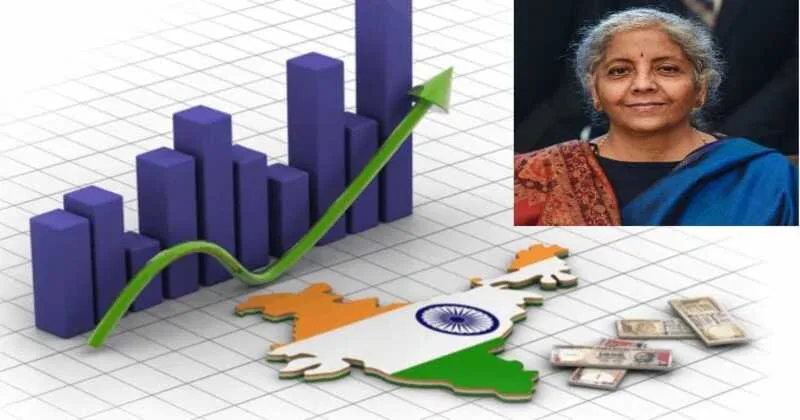
New Delhi: India has officially overtaken Japan to become the world’s fourth-largest economy, according to the central government’s year-end economic review report. With a gross domestic product (GDP) of $4.18 trillion, India now ranks just behind the United States, China, and Germany in the global economic order. The report projects that India is on course to surpass Germany as well within the next two-and-a-half to three years, further consolidating its rise among the world’s largest economies.
The review also offers an ambitious long-term outlook, estimating that India’s GDP will expand to $7.3 trillion by 2030, driven by sustained high growth, structural reforms, and macroeconomic stability. India’s economic expansion over the past decade has been particularly striking. In 2015, the country’s GDP stood at $2.1 trillion. It rose to $2.8 trillion in 2019, before contracting to $2.6 trillion in 2020 following the outbreak of the COVID-19 pandemic. However, India staged a rapid recovery after the pandemic-induced slowdown. GDP rebounded to $3.1 trillion in 2021, climbed further to $3.9 trillion in 2024, and crossed the $4 trillion mark this year, underlining the resilience of the economy. The report estimates that India will achieve the landmark $5 trillion economy target by 2028, a goal that has been central to the government’s long-term economic vision.
Previous projections by the International Monetary Fund (IMF) had already indicated this trajectory. According to IMF estimates, India’s GDP was expected to reach $4.51 trillion in 2026, marginally higher than Japan’s projected $4.46 trillion, effectively confirming India’s ascent in global rankings. Earlier, in 2022, India had overtaken the United Kingdom to become the world’s fifth-largest economy. At present, the United States remains the world’s largest economy with a GDP of nearly $30 trillion, while China occupies the second position with an estimated $19.23 trillion economy. India has also retained its position as the fastest-growing major economy in the world. GDP growth stood at 8.2 per cent in the second quarter of the current financial year (2025–26), and the economy is expected to grow by 7.3 per cent over the full financial year. These figures underscore India’s strong domestic demand and investment momentum even amid global economic uncertainty. Notably, India’s economic advance has continued despite external pressures, including the 50 per cent tariff imposed by US President Donald Trump. The government attributes India’s sustained growth to several favourable domestic factors such as GST tax relaxations, stable crude oil prices, higher capital expenditure by both the central and state governments, low inflation, and a relatively benign interest rate environment.
Government prepares narrow GST adjustments on select items
As part of its reform agenda, the government introduced ‘GST 2.0’ as a Deepawali relief measure by reducing the tax burden on a wide range of products and services. Building on this, the GST Council is now expected to announce another round of tax relief, this time targeting two specific products.
The GST Council last met in September, when it undertook a major rationalisation of tax slabs. During that meeting, the 12 per cent and 28 per cent slabs were effectively dismantled, with most products and services shifted to the 5 per cent or 18 per cent slabs. GST was completely removed on certain essential items. At the same time, luxury goods and products considered harmful or discouraging consumption, such as cigarettes, were shifted to a newly created special 40 per cent slab.
While the date of the next GST Council meeting has not yet been announced, the government has indicated that taxes will be reduced on water and air purifiers used for domestic purposes. In view of worsening air quality across several parts of the country, GST on these products, currently levied at 18 per cent, is proposed to be cut to 5 per cent. This reduction is expected to bring down retail prices by 10 to 15 per cent, making such devices more affordable and encouraging wider adoption. The GST Council, chaired by Union Finance Minister Nirmala Sitharaman and comprising finance ministers from all states, has the authority to determine GST rates. The council typically meets every quarter, with its 56th meeting held on September 3. Together, these developments highlight both India’s accelerating economic rise and the government’s continued reliance on tax reforms and consumption-driven measures to sustain growth.