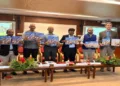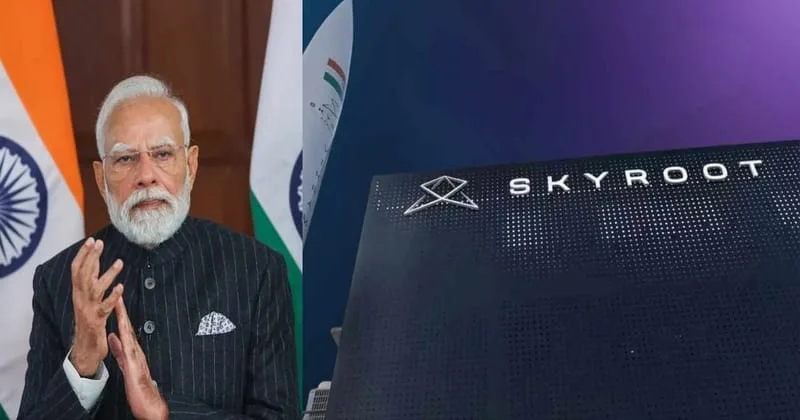
New Delhi: India’s private space sector has reached a historic milestone. The inauguration of Skyroot Aerospace’s Infinity Campus by Prime Minister Narendra Modi signals more than a ribbon-cutting ceremony; it marks the country’s first major leap into mass-scale, high-tech rocket production. For decades, space programs worldwide have struggled with a fundamental bottleneck: the time and cost required to build launch vehicles. Skyroot aims to eliminate that constraint, positioning India to compete with global space powers and capture a significant share of the commercial launch market.
INDIA’S ROCKET FACTORY: SKYROOT 'INFINITY' GOES ONLINE 🏭🚀
🇮🇳INDIA'S "SPACEX MOMENT" HAS ARRIVED.
Elon Musk built a factory to mass-produce rockets. Skyroot just did the same for India.
PM Modi inaugurated Skyroot’s Infinity Campus. It’s not just a building; it’s a… pic.twitter.com/KJcvTWxgJB
— The Sacred Scroll (@SacredScroll) December 29, 2025
Traditionally, rockets have been handcrafted with painstaking precision, akin to assembling luxury sports cars, meticulous but slow and expensive. Skyroot is transforming this approach. The Infinity Campus, spread over 60,000 square feet, is designed as a fully integrated facility for design, manufacturing, testing, and integration. Using advanced industrial methods, including 3D-printed engines and all-carbon-fiber rocket structures, the company plans to produce one orbital-class rocket every 30 days. This production pace is unprecedented for India and rivals leading global launch providers.
This approach is not just about speed; it’s about scalability. By applying modern manufacturing principles similar to automotive mass production, Skyroot reduces both the cost and lead time for launches. This industrialization represents India’s “SpaceX moment”, a private company moving beyond prototypes and laboratory tests to reliable, repeatable production.
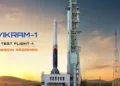
Strategically, Skyroot’s advances have major global implications. China has been aggressively expanding its commercial launch industry through companies like Galactic Energy and iSpace, offering lower-cost launches that challenge Western dominance. Skyroot’s Vikram-1 rocket is India’s answer: a technologically advanced, cost-effective alternative capable of competing on both quality and price. Its all-carbon-fiber structure, combined with 3D-printed engines, exemplifies how India is leapfrogging traditional methods to create high-performance, modern rockets.
Lift-off for Infinity🚀
The Honourable Prime Minister Shri @narendramodi has given wings to our dreams: Inaugurating our brand new Infinity Campus and unveiling our flight-ready Vikram-1 orbital launch vehicle.
This moment brings both inspiration and responsibility as we build… pic.twitter.com/4dIOLFRi9Y
— Skyroot Aerospace (@SkyrootA) November 28, 2025
Beyond the commercial sector, the implications for national security are significant. In scenarios involving anti-satellite (ASAT) strikes or satellite losses, the ability to rapidly replace orbital assets is crucial. A factory capable of producing over a dozen launchers annually gives India a strategic replenishment advantage, ensuring continuity of satellite-based services critical to communication, navigation, and defense. Centralizing production, testing, and integration under one roof also reduces dependence on external suppliers, mitigating risks from supply chain disruptions.
The Infinity Campus also marks a cultural and industrial shift. India is moving from being a research-focused space player to an industrialized space power, where private startups are not only designing and testing rockets but also building a sustainable, high-volume manufacturing ecosystem. This development signals the emergence of India as a serious contender in the global space economy, capable of challenging both Western and Chinese launch providers.
Skyroot’s achievement demonstrates that the future of space is no longer confined to government agencies. With the Infinity Campus, India is no longer just observing the space race, it is building, launching, and shaping it. The Skyroot era has begun, and the world is watching.