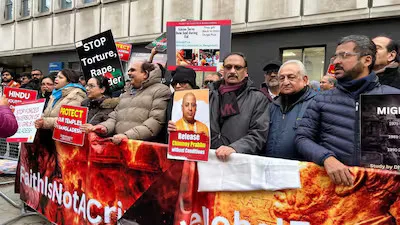
A protest organised by the Bangladesh Hindu Association along with members of the Indian diaspora outside the Bangladesh High Commission in London was disrupted on December 27, after Khalistani extremist groups intruded into the gathering, triggering tension and a brief scuffle.
The protest was aimed at drawing international attention to the brutal lynching of Dipu Chandra Das, a young Hindu factory worker in Bangladesh, and the broader pattern of violence and intimidation faced by Hindu minorities in the country. The incident has sparked global outrage and renewed concerns over the safety of religious minorities in Bangladesh.
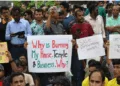
Visuals from the protest showed Hindus holding placards condemning the killing and demanding accountability, before the situation escalated due to the sudden appearance of pro-Khalistan elements at the site.
The arrival of Khalistani extremist groups at the precise location and time of the protest points to prior planning and mobilisation rather than coincidence. The presence of these groups at a demonstration focused exclusively on Bangladesh’s minority rights raised immediate red flags within security circles.
According to reports, Khalistani groups have no direct link to Bangladesh’s internal communal violence. Their intervention was therefore seen as a deliberate attempt to disrupt, intimidate, and hijack the narrative surrounding Hindu persecution in Bangladesh.
“The objective was not confrontation with protesters alone, but the derailment of the issue itself,” a source said, adding that the timing and coordination strongly suggested an external hand.
The disruption in London comes against the backdrop of growing concerns over Pakistan’s Inter-Services Intelligence expanding its influence in Bangladesh’s political and security environment. Earlier reports by CNN-News18 highlighted how the ISI’s “long shadow” is increasingly visible through efforts aimed at radicalisation, ideological influence, and narrative manipulation.
Following the collapse of the Sheikh Hasina government in August 2024, Islamabad moved swiftly to engage the Muhammad Yunus-led interim administration. Intelligence inputs indicate that during this period, Islamist organisations such as Jamaat-e-Islami and newly formed platforms like Inquilab Mancha have been used to amplify extremist messaging and suppress minority voices within Bangladesh.
The ISI is operating a dual-track strategy. Inside Bangladesh, Islamist networks are being encouraged to fuel anti-India sentiment while marginalising narratives related to Hindu victimhood. Outside Bangladesh, particularly in Western capitals, Khalistani proxies are allegedly being deployed to target Hindu and India-aligned voices.
The London incident, reports say, fits squarely into this pattern. By disrupting a peaceful protest outside a diplomatic mission, the intention was to prevent the internationalisation of the issue of Hindu killings and instead divert attention towards an anti-India narrative.
“The real target was the narrative, not just the protesters,” a source explained. “The aim is to shift global discourse away from Bangladesh’s internal communal violence and project India as the destabilising force.”
The use of Khalistani groups, which already operate in parts of the UK and other Western countries, allows the narrative to be reframed quickly, overshadowing concerns about human rights violations in Bangladesh with unrelated political agendas.
Members of the Hindu diaspora expressed concern that peaceful demonstrations highlighting human rights abuses are increasingly being targeted and derailed. Organisers of the London protest said their sole objective was to seek justice for victims like Dipu Chandra Das and to ensure international scrutiny of violence against minorities in Bangladesh.
They warned that such disruptions not only silence victims but also embolden extremist elements by allowing impunity and misinformation to thrive.
Intelligence sources maintain that the London disruption should not be viewed as an isolated episode but as part of a larger, coordinated effort to control global narratives around South Asian communal violence. As scrutiny of minority persecution in Bangladesh grows, attempts to derail discussions through proxy actors are also intensifying.