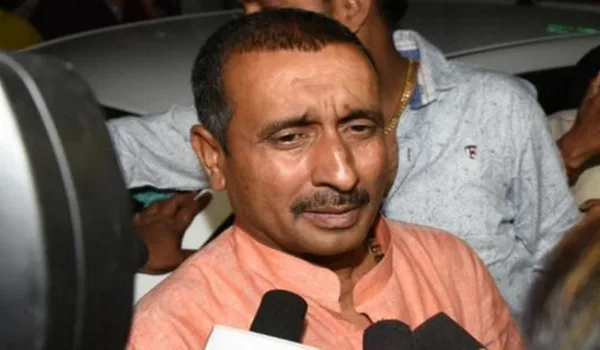
The Supreme Court is set to hear on December 29 the Central Bureau of Investigation’s challenge to the Delhi High Court order that suspended the life imprisonment of former BJP MLA Kuldeep Singh Sengar in the 2017 Unnao rape case and granted him bail during the pendency of his appeal.
A three-judge bench headed by Chief Justice of India Surya Kant, along with Justice JK Maheshwari and Justice Augustine George Masih, has agreed to take up the matter on December 29, signalling close judicial scrutiny of the controversial order that has reignited debate around victim protection and the interpretation of special criminal statutes.
The CBI approached the Supreme Court through a Special Leave Petition after the Delhi High Court earlier this week suspended Sengar’s life sentence while hearing his appeal against conviction. The High Court had reasoned that the aggravated offence provisions under Section 5(c) of the Protection of Children from Sexual Offences Act and Section 376(2) of the Indian Penal Code were not attracted in the case.
According to the High Court, Sengar could not be treated as a “public servant” for the purpose of invoking aggravated charges under POCSO, a conclusion that formed the basis for suspending his sentence.
Challenging this interpretation, the CBI has argued that the High Court failed to adopt a victim-centric approach in a case involving the rape of a minor. The agency contended that the ruling significantly weakens the protective framework of the POCSO Act, which was enacted as a special welfare legislation to safeguard children from sexual offences.
The CBI submitted that excluding an elected MLA from the ambit of “public servant” defeats the legislative intent of treating abuse of authority as an aggravating factor. It stressed that POCSO must be interpreted purposively to strengthen safeguards for minors rather than narrowed through technical readings.
The investigative agency further argued that the High Court overlooked settled legal principles governing suspension of sentences in cases involving life imprisonment. It asserted that prolonged incarceration, by itself, cannot be a ground to suspend sentence in heinous crimes such as the rape of a minor.
Citing multiple Supreme Court precedents, the CBI told the apex court that suspension of sentence in life imprisonment cases is an exception and can be granted only in rare and compelling circumstances. According to the agency, no such exceptional circumstances existed in Sengar’s case.
Raising serious concerns over the survivor’s safety, the CBI warned that Sengar’s release poses a grave threat given his past conduct, political influence, and the history of intimidation faced by the victim and her family.
The agency argued that granting bail to a powerful convict in a case involving sexual violence against a child undermines public confidence in the criminal justice system and sends a disturbing message to survivors of such crimes.
Kuldeep Singh Sengar was convicted in 2019 by a special CBI court for raping a minor girl in Unnao district of Uttar Pradesh and was sentenced to life imprisonment. The case had triggered nationwide outrage, with the survivor and her family alleging sustained harassment, intimidation, and threats.
In 2020, Sengar was also sentenced to 10 years’ rigorous imprisonment in a separate case relating to the custodial death of the survivor’s father. Multiple connected cases, including allegations of intimidation and attempts to derail the investigation, were transferred to the CBI on the directions of the Supreme Court.