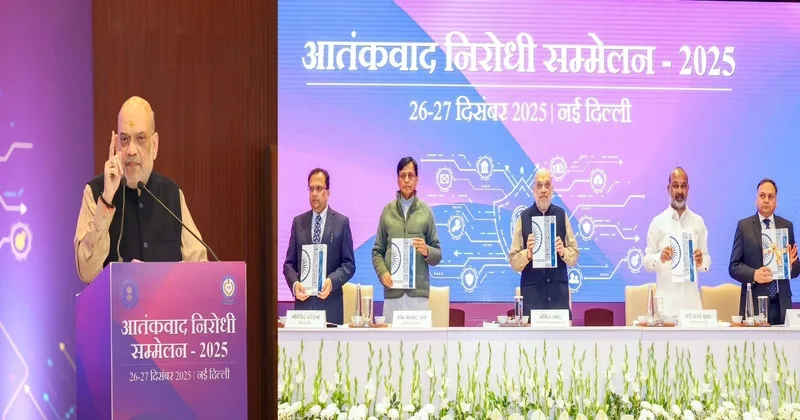
NEW DELHI: Union Home Minister Amit Shah on December 26 outlined a comprehensive national strategy to combat organised crime and terrorism, declaring that the Modi government is preparing to launch a “360-degree strike” that integrates intelligence, technology, inter-agency coordination, and cooperative federalism.
Addressing the Anti-Terrorism Conference 2025, organised by the National Investigation Agency (NIA), Shah revealed for the first time that the Red Fort blast on November 10 involved the use of 40 kilograms of explosives, resulting in the death of at least 15 people. He underlined that such incidents are not isolated law-and-order challenges but complex terror-linked conspiracies demanding a unified national response.
Inaugurated the Anti-Terrorism Conference 2025 in New Delhi. These conferences have played a crucial role in shaping the building blocks of the security grid built under Modi Ji’s vision of zero tolerance for terror.
Thinking ahead is critical to thwarting terror, and advanced… pic.twitter.com/tJVUEqa42F
— Amit Shah (@AmitShah) December 26, 2025
“Cases like the Pahalgam terror attack and the Delhi Red Fort blast are not examples of routine policing. These are outstanding instances of watertight investigation,” Shah said, adding that India’s security agencies are now equipped to deal with evolving terror tactics through a coordinated, intelligence-driven approach.
Pahalgam Attack and Operation Sindoor
Referring to the Pahalgam terror attack in Jammu and Kashmir’s Baisaran Valley earlier this year, Shah said the objective of the terrorists was to disrupt communal harmony and destabilise the country. The attack was followed by Operation Sindoor, a decisive security response aimed at neutralising terror networks and restoring stability in the region.
Pahalgam and Delhi blast cases are not examples of routine policing, but outstanding instances of watertight investigation: Shah.
Terrorists wanted to disrupt communal harmony in the country through Baisaran Valley terror attack: Home Minister Amit Shah
We are bringing an… pic.twitter.com/MXGApBVW4E
— Press Trust of India (@PTI_News) December 26, 2025
“The intention behind such attacks is not just loss of life but psychological warfare—creating fear, mistrust, and division,” the Home Minister said, stressing that India’s response would be firm, swift, and uncompromising.
Organised Crime–Terror Nexus
A key focus of Shah’s address was the growing nexus between organised crime syndicates and terrorist organisations. He explained that criminal networks initially engage in activities such as extortion, ransom, and smuggling, but once their leaders flee abroad, they often establish links with terror outfits.
“These criminal leaders, after settling abroad, come into contact with terrorist organisations and begin using proceeds from crime to fund terrorism in India,” Shah said. This convergence, he noted, poses a serious internal security threat and requires dismantling the financial and logistical backbone of such networks.
New National Databases Unveiled
As part of the 360-degree strategy, Shah announced the launch of two major national databases:
- Organised Crime Network Database
- Weapons Database for Lost, Looted, and Recovered Arms
These databases, developed for use by state police forces and central agencies, are intended to become core assets of India’s zero-terror policy. Shah said the success of the initiative would depend on real-time data sharing and uniform adoption across states.
“Technology developed in silos and data collected in silos are like a gun without bullets,” he remarked, emphasising that seamless data integration is critical for effective counter-terror operations.
‘Duty to Share’ Over ‘Need to Know’
In a significant shift in security doctrine, the Home Minister urged agencies to move from a ‘Need to Know’ mindset to a ‘Duty to Share’ approach. He called upon states to work closely with the NIA, CBI, Intelligence Bureau (IB), and other central agencies to eliminate organised crime networks within their jurisdictions.
Shah also directed the Directors General of Police (DGPs) of all states to implement a common Anti-Terrorism Squad (ATS) structure at the earliest, ensuring uniform standards, coordination, and operational efficiency nationwide.
Highlighting the need for technological standardisation, Shah said the Ministry of Home Affairs, NIA, and IB should work together to develop a national-level framework for security technology and data systems, while extending support to states for capacity building.
He noted that a new standard of coordination has already emerged through platforms such as the DGP Conference, Security Strategy Conference, N-CORD meetings, and the Anti-Terrorism Conference, which must be viewed as interconnected pillars of India’s internal security architecture.
“We cannot view these four platforms in isolation. Running through them as a common thread is the Anti-Terrorism Conference,” Shah said.
Concluding his address, the Home Minister made it clear that India is entering a new phase of counter-terrorism—one that is proactive, integrated, and relentless.
“In the coming days, the country will bring a plan to launch a 360-degree assault on organised crime,” Shah said, reiterating that the database-driven approach and inter-agency cooperation would define India’s security strategy in the years ahead.