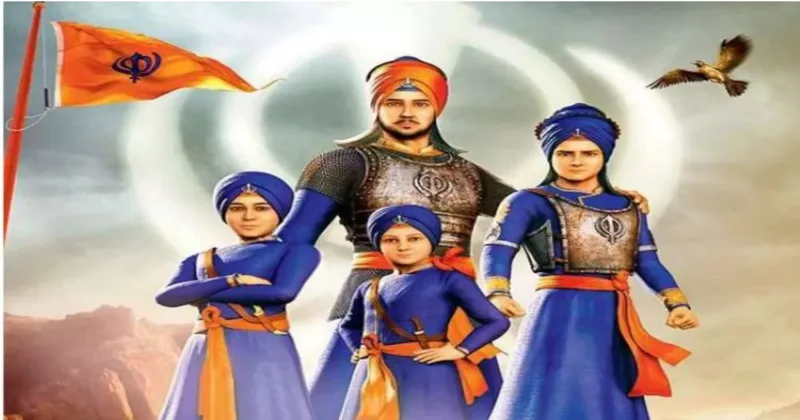
India’s history is not merely a compilation of dates and wars; it is a living tradition of human courage, moral steadfastness, and inner strength. Veer Bal Diwas, observed every year on December 26, is an immortal chapter of this tradition. The day is dedicated to the extraordinary sacrifice of the younger Sahibzadas—Sahibzada Zorawar Singh and Sahibzada Fateh Singh—sons of the tenth Sikh Guru, Guru Gobind Singh. At the tender ages of just nine and six, these child heroes displayed such courage for faith, truth, and self-respect that their sacrifice continues to illuminate the conscience of India even today.
History
It was the year 1705. Mughal oppression had reached its peak, and the family of Guru Gobind Singh Ji was forced to endure extremely harsh circumstances. The elder Sahibzadas—Ajit Singh and Jujhar Singh—attained martyrdom on the battlefield. The younger Sahibzadas, meanwhile, were captured along with their grandmother, Mata Gujri. They were threatened, tempted, and relentlessly pressured to abandon their faith. This pressure intensified under the orders of the Mughal governor Wazir Khan. Yet those children responded with remarkable calm and resolve, making it clear that faith is not a matter of compromise. As a result, they were bricked alive into a wall. This was not merely a historical incident, but the highest test of the human soul—where the body was subjected to cruelty, but the spirit remained unshaken. As it is often said, “Courage does not mean the absence of fear, but the strength to stand by the truth despite fear.” In that very moment, childhood shaped history and proved that age may be small, but consciousness and courage can be infinite.
Gen Z and Mental Health
In 2022, the Government of India declared December 26 as Veer Bal Diwas so that children and youth across the country could learn about these sacrifices. This day is not only about remembrance, but also a call to commitment—to place truth, ethics, and self-respect at the centre of our lives. Today, this message is especially relevant for Gen Z, a generation grappling with serious mental health challenges. Recent studies indicate that nearly one in five young Indians between the ages of 15 and 29 shows symptoms of anxiety, depression, or emotional distress, and the National Mental Health Survey highlights a significant prevalence of mental disorders in the 18–29 age group. UNICEF reports further reveal that a large number of Indian youth frequently experience anxiety, loneliness, and insecurity about the future, yet hesitate to seek help. In such times, the story of Veer Bal Diwas serves both as a mirror and as a lamp—a mirror because it makes us aware of our vulnerabilities, and a lamp because it shows the path of inner strength.
A New Meaning of Bravery
The lives of the Sahibzadas teach Gen Z that self-respect is not derived from external approval, but from inner conviction. Even under extreme pressure, they did not compromise on their values; for today’s youth, this stands as a powerful response to peer pressure and the culture of constant comparison. Their story reminds us that the greatness of life lies not in its length, but in its depth and purpose, and that mental resilience is not bound by age. When life is surrounded by questions, values themselves become the answers—an idea that is profoundly relevant to mental health today. Mental well-being is not just about managing stress; it is about the ability to live a value-driven life. When a person remains connected to their values, even failure cannot break them. In today’s world, bravery is not limited to the battlefield; it is equally required in the inner terrain of the mind—rising again after academic failure, speaking openly about mental pain, asking for help, letting go of harmful habits, and standing by the truth. Veer Bal Diwas 2025 reassures young people that they are not alone; they inherit a legacy that offers mental strength, self-respect, and a sense of purpose. Let us, on this Veer Bal Diwas, resolve to prioritise our own mental health and that of our peers, to listen to one another, to understand one another, and to learn to live with courage—because when values are strong, the mind too becomes strong.