

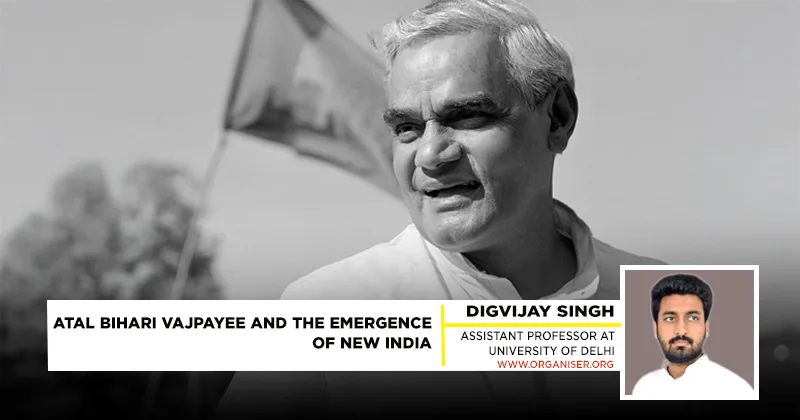
Atal Bihari Vajpayee guarded a space in Indian public life that few leaders before or after him have managed to inhabit with such ease. He was at once a poet and a practitioner, a conciliator with conviction, an ideologue who understood the compulsions of governance. In an era when political discourse was often shrill or transactional, Vajpayee brought to the highest office a tone of civility, reflection, and restraint. His words carried weight not because they were loud, but because they were measured, textured, and grounded in experience.
As an orator, Vajpayee possessed a rare command over language. His speeches were not mere performances; they were carefully constructed arguments that blended emotion with reason. He could invoke history without sounding archaic and nationalism without lapsing into belligerence. Parliament, even when sharply divided, often paused to listen when he rose to speak. That ability to persuade rather than provoke became a defining feature of his leadership and lent legitimacy to decisions that reshaped India’s strategic and economic trajectory.
Vajpayee’s political journey mirrored the evolution of the Bharatiya Janata Party itself. From the margins of national politics to the centre of power, he was instrumental in transforming the BJP from a cadre-based movement into a party capable of governing a diverse and plural republic. His leadership softened ideological edges without erasing them. What emerged was a form of cultural nationalism that sought accommodation with India’s social diversity rather than confrontation with it. This calibrated approach helped the party find resonance among the middle classes and working populations who aspired to stability, dignity, and opportunity.
Governance under Vajpayee was marked by a quiet decisiveness. The Pokhran nuclear tests of 1998 announced India’s arrival as a strategic power unwilling to outsource its security calculus. The decision was neither impulsive nor theatrical. It reflected a long-held consensus across political lines that India required a credible deterrent. Vajpayee’s statesmanship lay in pairing this assertion of sovereignty with diplomatic engagement, ensuring that India’s strategic confidence did not translate into isolation.
That balance was tested during the 1999 Kargil conflict. Faced with a grave breach of territorial integrity, Vajpayee’s government demonstrated resolve without abandoning restraint. Military operations were conducted with clarity of purpose, while diplomatic channels were mobilised to reinforce India’s position globally. The episode reaffirmed civilian supremacy, institutional discipline, and strategic maturity, attributes that remain benchmarks for crisis management.
Beyond security, Vajpayee understood that national strength is ultimately built through economic and physical infrastructure. The launch of the Golden Quadrilateral was more than a highway project; it was a statement about integration. By stitching together the country’s major economic centres, the programme reduced distances both literal and metaphorical. Markets became more accessible, supply chains more efficient, and regions more connected to the national growth story.
Equally consequential was the reform of the telecommunications sector. The policy shifts of the late 1990s dismantled monopolistic constraints and encouraged competition. The result was a communications revolution that democratised access, lowered costs, and laid the groundwork for India’s digital future.
Vajpayee’s tenure was also notable for its emphasis on stability. Coalition politics, often dismissed as inherently fragile, acquired under him a sense of direction and discipline. He governed not through domination but through consensus, recognising that democratic legitimacy in a plural society rests on accommodation. Widely regarded as incorruptible, he embodied a public ethic that valued integrity over expediency and discretion over spectacle.
The phrase India Shining captured an emerging confidence during Vajpayee’s years in office. It reflected a sense that India was beginning to align its political aspirations with economic capabilities and technological advancements. Space research, information technology, and scientific institutions received renewed attention, reinforcing the belief that development and national pride were complementary ideas.
As India today aspires to become a developed nation by 2047, the continuities with Vajpayee’s vision are unmistakable. The emphasis on infrastructure, strategic autonomy, technological capacity, and governance-driven development did not originate in a vacuum. They are part of a longer arc that Vajpayee helped bend toward ambition tempered by prudence.
Atal Bihari Vajpayee’s enduring relevance lies not in nostalgia but in method. He demonstrated that political conviction need not exclude courtesy, that nationalism can coexist with dialogue, and that reform is most sustainable when it carries society along rather than dragging it forward.