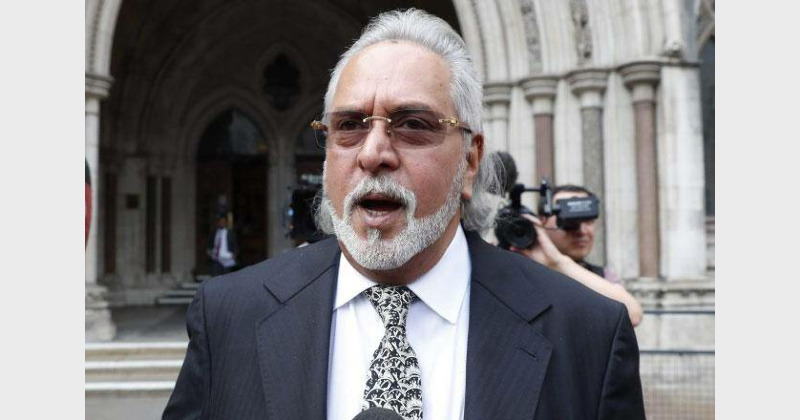
The Bombay High Court on December 23, took a firm stand against fugitive businessman Vijay Mallya, telling him that his legal challenges against being declared a Fugitive Economic Offender (FEO) would not be entertained unless he first returns to India and places himself under the jurisdiction of Indian courts.
A division bench comprising Chief Justice Shree Chandrashekhar and Justice Gautam Ankhad made the observation while hearing two petitions filed by Mallya, one challenging the January 2019 order declaring him a fugitive economic offender under the Prevention of Money Laundering Act (PMLA), and the other questioning the constitutional validity of the Fugitive Economic Offenders Act, 2018.
During the hearing, the bench directly questioned Mallya’s counsel, senior advocate Amit Desai, on whether the businessman intended to return to India. The court made it clear that it was not inclined to hear Mallya’s plea against the FEO Act as long as he remained outside the country.
“Come back to India first,” the court told Mallya’s counsel, indicating that a person who has been declared a fugitive cannot seek constitutional remedies while deliberately avoiding the reach of Indian law.
Mallya, now 70, has been living in the United Kingdom since March 2016. He is wanted in India in connection with multiple cases of bank fraud and money laundering linked to the collapse of Kingfisher Airlines.
The High Court also took note of the fact that Mallya had filed two separate petitions, one against the FEO declaration and another against the law itself. The bench said it would not allow both petitions to proceed simultaneously.
The judges asked Mallya’s counsel to clearly state which petition he intended to pursue and which one he was willing to withdraw. The matter has now been listed for further hearing on February 12, by which time Mallya must inform the court of his decision.
Solicitor General Tushar Mehta, appearing for the Enforcement Directorate (ED), strongly opposed Mallya’s petitions. He argued that the very objective of the Fugitive Economic Offenders Act would be defeated if individuals who flee the country are allowed to challenge laws and proceedings while staying abroad.
Mehta told the court that the Act was specifically enacted to prevent economic offenders from evading Indian courts and misusing the legal system by operating through lawyers from foreign jurisdictions.
“A fugitive cannot be permitted to question the validity of a statute while refusing to submit himself to the process of law,” the Solicitor General argued, adding that extradition proceedings against Mallya were at an advanced stage in the United Kingdom.
In response, Mallya’s counsel submitted that the businessman’s financial liabilities had been substantially addressed. Desai informed the court that assets worth nearly ₹14,000 crore had been attached and that around ₹6,000 crore had already been recovered by banks that had lent money to Kingfisher Airlines.
However, the bench was unconvinced. The judges pointedly asked how criminal liability could be “washed away” merely through recovery of money when the accused had not appeared before Indian courts to face trial.
The court’s remarks indicated a clear distinction between civil recovery of dues and criminal accountability, underscoring that repayment or attachment of assets does not absolve an accused of facing prosecution.
In January 2019, a special court under the PMLA declared Vijay Mallya a Fugitive Economic Offender. The declaration came after Mallya repeatedly failed to return to India despite summons and warrants issued by Indian courts.
The ED has accused Mallya of defaulting on loans worth thousands of crores taken by Kingfisher Airlines from a consortium of Indian banks and of laundering money through complex financial transactions. The FEO tag allows authorities to confiscate properties of such offenders and bars them from accessing Indian courts for civil relief.
Mallya’s extradition has been a long-running legal battle in the United Kingdom. Indian authorities have maintained that they have complied with all legal requirements, while Mallya has exhausted multiple layers of legal appeal in British courts.
The ED informed the Bombay High Court that the extradition process has reached an advanced stage, strengthening India’s case for bringing the fugitive businessman back to face trial.