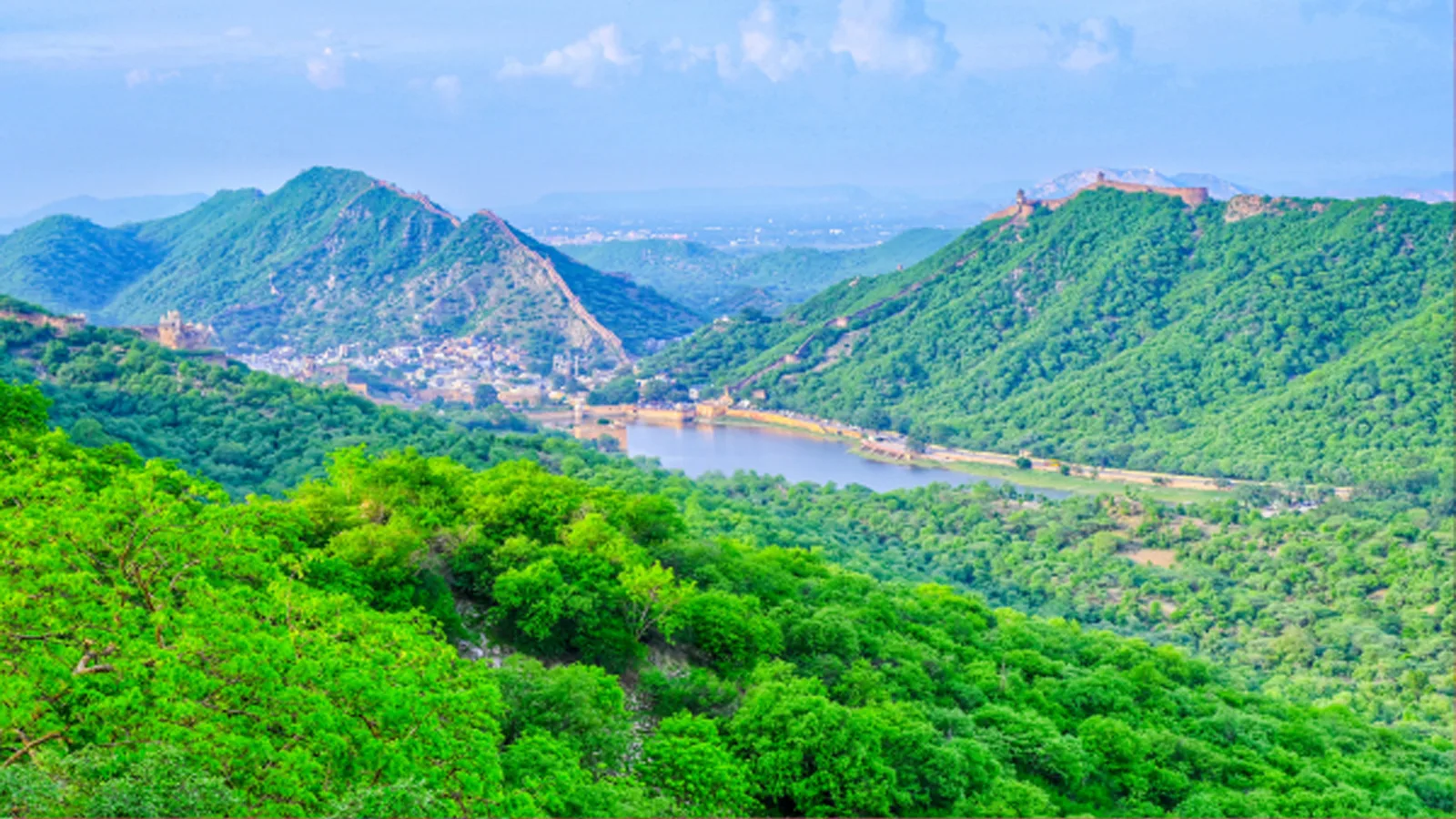
The Aravalli Range is not just another hill system on India’s map; it is among the oldest mountain ranges on Earth, predating even the Himalayas by billions of years. Geological studies estimate the Aravallis to be nearly 2.5 billion years old, originating in the Precambrian era, long before the Indian subcontinent collided with the Eurasian plate to form the Himalayas. Stretching roughly 670-700 kilometres, the range runs from Gujarat through Rajasthan and Haryana to Delhi, with Guru Shikhar in Mount Abu, rising to 1,722 metres, standing as its highest peak.
Ecologically, the Aravallis serve as a natural shield against desertification, preventing the Thar Desert from advancing eastwards into fertile regions of Haryana, Delhi, and western Uttar Pradesh. Without this barrier, dust storms, arid winds, and shifting sands could dramatically alter climatic patterns in the National Capital Region and beyond. The range also plays a critical role in groundwater recharge, as its fractured rock systems and soil composition allow rainwater to percolate underground, sustaining wells, stepwells, and aquifers that support millions of people. Several rivers, including the Chambal, Sabarmati, and Luni, originate from or are sustained by the Aravalli system, and beyond hydrology, the hills host diverse flora and fauna, forming wildlife corridors and forest ecosystems that are vital for biodiversity conservation.
What triggered the legal and political debate around Aravallis?
The latest controversy stems from a Supreme Court judgment dated November 20, 2025, which adopted a uniform, operational definition of the Aravalli Hills and Aravalli Range, as proposed by the Ministry of Environment, Forest and Climate Change. The ruling sought to resolve decades-old inconsistencies in how different states defined the Aravallis, an inconsistency that had allowed illegal mining, encroachments, and environmental degradation to flourish. Historically, this confusion traces back to a 1992 Supreme Court ban on mining in the Aravalli Hills. While the ban was clear in intent, the absence of a uniform definition meant that states interpreted the term “Aravalli Hills” differently. Rajasthan adopted a formal definition in 2006, based on a 2002 committee report and earlier geological classifications, but Haryana, Delhi, and Gujarat followed varying criteria or none at all. This patchwork approach weakened enforcement mechanisms and created loopholes that were systematically exploited by mining mafias.
Recognising these long-standing gaps, the Supreme Court in May 2024 directed the Centre to evolve a standard definition, leading to the constitution of a high-level committee headed by the Secretary of the MoEFCC, with representatives from state forest departments and institutions such as the Forest Survey of India, the Geological Survey of India, and the Central Empowered Committee. The recommendations of this committee were ultimately accepted by the court in November 2025, giving them legal sanctity.
What exactly is the SC’s new definition of Aravalli hills and range?
At the heart of the controversy lies a technical but crucial distinction embedded in the Supreme Court-approved definition. According to the ruling, an Aravalli Hill is any landform located in the designated Aravalli districts that rises 100 metres or more above the local relief, which is the surrounding baseline level determined by the lowest contour line encircling it.
Importantly, this definition does not isolate the summit alone but includes the entire hill system, its peak, slopes, and all connected landforms, irrespective of gradient. Building on this, the Aravalli Range is defined as two or more such Aravalli Hills located within 500 metres of each other, measured from the outermost boundary of their lowest contour lines, with the land between these hills, including valleys and smaller hillocks, also included within the range. This operational definition is grounded in the globally accepted Richard Murphy landform classification, which has long been used by geologists to distinguish hills and mountains based on elevation relative to local relief rather than absolute height above sea level.
Opposition leaders, including Sonia Gandhi and Jairam Ramesh, have claimed that the 100-metre criterion effectively strips protection from nearly 90 percent of the Aravalli Hills, opening them up to mining and real estate exploitation. These claims have been widely circulated under hashtags like #SaveAravalli and amplified through alarmist narratives portraying bulldozers poised to roll into the hills.
However, this interpretation fundamentally misunderstands the definition itself. The 100-metre rule does not mean protecting only the topmost 100 metres of a hill; instead, it refers to any landform whose total elevation rises 100 metres above the surrounding terrain. Once a hill qualifies under this criterion, the entire ecological unit, including its slopes and foothills is protected, irrespective of the individual height of different segments of that landform.
Moreover, when two such hills lie within 500 metres of each other, the entire intervening landscape is treated as part of the Aravalli Range, thereby extending protection to valleys, smaller hillocks, and ecological corridors. Far from fragmenting protection, this approach expands conservation to a landscape level, recognising the ecological interconnectedness of the terrain.
Why did SC reject a blanket mining ban across entire Aravalli Range?
While environmentalists have often advocated for a total and permanent mining ban across the entire Aravalli Range, the Supreme Court adopted a more nuanced and pragmatic approach. The court explicitly observed that a blanket ban could inadvertently fuel illegal mining, as past experiences have shown that unregulated operations often thrive in conditions of ambiguity and enforcement gaps. Instead, the court ordered the preparation of a Management Plan for Sustainable Mining through the Indian Council of Forestry Research and Education.
This plan is intended to identify no-go zones requiring absolute protection, demarcate ecologically sensitive areas along with wildlife habitats and corridors, specify limited zones where mining may be permitted under strict sustainability norms, and mandate comprehensive post-mining rehabilitation and restoration measures. Crucially, the court made it clear that no new mining leases would be permitted until this management plan is finalised, thereby creating an immediate and effective protective shield for the region.
How much of the Aravalli Region is actually open to mining today?
Contrary to claims of widespread dilution of environmental safeguards, available data points to an overwhelming emphasis on conservation. The Aravalli Range spans approximately 1.44 lakh square kilometres, yet only about 278 square kilometres, or roughly 0.19 percent of the total area, is currently available for mining activities. No mining is permitted in Delhi, irrespective of location within the range.
In addition, protected areas such as national parks, wildlife sanctuaries, tiger reserves including Sariska, wetlands, reserved forests, monuments, and CAMPA plantation sites remain entirely off-limits. Preliminary district-level studies conducted with the Survey of India further reinforce this picture, showing that in Rajasthan’s Rajsamand and Udaipur districts between 97 and 99 percent of the area remains protected, in Haryana’s Mahendragarh district around 75 percent is protected, and in Gujarat’s Sabarkantha district nearly 89 percent falls outside permissible mining zones. These figures directly contradict the narrative that the Supreme Court ruling opens the floodgates for mining across the Aravallis.
The Ministry of Environment, Forest and Climate Change and Union Environment Minister Bhupender Yadav have strongly rebutted what they describe as “alarmist misinterpretations” of the Supreme Court judgment. In public statements and interviews, the minister has emphasised that the Supreme Court itself praised initiatives such as the Green Aravalli Wall Project, that the revised definition actually strengthens enforcement by eliminating ambiguity across states, and that over 90 percent of the Aravalli landscape remains protected, with even stricter scrutiny envisaged in the future. Yadav has repeatedly clarified that illegal mining, rather than scientific regulation, poses the biggest threat to the Aravallis, and to counter this menace the government has deployed drones, CCTV surveillance systems, weighbridges, and district-level task forces to monitor and curb illegal activities in vulnerable zones.
How does this judgment align with India’s international and national commitments?
India has been a signatory to the United Nations Convention to Combat Desertification since 1996, and the Aravalli protection framework aligns closely with these international commitments by directly addressing land degradation, desertification, and climate resilience.
At the national level, initiatives such as the Aravalli Green Wall Project aim to increase green cover, restore degraded landscapes, and enhance ecological connectivity across the region. The Supreme Court’s emphasis on scientific mapping, standardised definitions, and sustainable planning reinforces these long-term environmental goals rather than undermining them, ensuring continuity between judicial intervention and policy objectives.
One of the most significant outcomes of the judgment is its push towards uniformity and cooperation among states in environmental governance. India’s environmental regulation has often suffered due to fragmented jurisdiction and inconsistent policies across state boundaries.
By mandating a common definition and a centrally coordinated management plan, the Supreme Court has nudged states towards collaborative stewardship of a shared ecological heritage. This approach mirrors successful models such as the Saranda Forest management framework in Jharkhand, where detailed ecological assessments have balanced conservation imperatives with controlled economic activity.
A close reading of the judgment, supported by available data and policy frameworks, suggests that the narrative of an impending ecological apocalypse is overstated. The Supreme Court’s ruling does not dismantle existing protections; instead, it codifies and expands them through scientific clarity and legal uniformity. By treating the Aravallis as a continuous geological and ecological system rather than a collection of isolated hilltops, the judgment arguably provides stronger and more comprehensive safeguards than ever before.
As the Management Plan for Sustainable Mining gradually takes shape, it will provide granular, district-wise guidance on permissible activities, restoration priorities, and conservation strategies across the Aravalli region. Until this plan is finalised, the freeze on new mining leases ensures that the hills remain shielded from immediate harm.
Ultimately, the future of the Aravalli Range will depend not only on court orders or technical definitions but on effective implementation, vigilant monitoring, and informed public discourse. Beyond political rhetoric, the judgment offers a framework in which development and ecology are not adversaries but carefully balanced partners.
Can science and law together save the Aravallis?
The recent Supreme Court intervention marks a decisive step towards resolving decades of ambiguity surrounding the Aravalli Hills. By embracing a uniform, globally accepted definition and mandating comprehensive planning, the court has laid the groundwork for sustainable and accountable environmental governance.
Far from opening the doors to destruction, the ruling, if implemented sincerely and consistently, could ensure that the Aravallis continue to protect India’s climate stability, water security, and biodiversity for generations to come.