Thirty-seven thousand years ago, long before the first settlements rose in Manipur’s valleys, the Chirang River had carved its path through the Imphal basin. Its waters laid down layer after layer of fine silt, a silent sediment that would one day seal an evolutionary secret. Inside these ancient deposits, a team of scientists dig something almost impossible, a bamboo stem so exquisitely preserved that even its thorn scars remained visible. For a plant that is known to decay rapidly.
This fossil, now identified as Chimonobambusa manipurensis, represents Asia’s earliest evidence of thorny bamboo. This scientific finding provides a window into a vanished ecosystem and helps explain how bamboo evolved its defences and how Northeast India served as a refuge during the Ice Age.
A Rare Fossil in the Silt of Time
Bamboo rarely fossilises. Its hollow culms and fibrous tissues decompose rapidly, leaving little trace in the geological record. Still in the silt rich layers of the Chirang River, Researchers from the Birbal Sahni Institute of Palaeosciences (BSIP), an autonomous institution under India’s Department of Science and Technology, surveyed this region when they noticed a bamboo stem with unfamiliar markings. The sediment had acted like a natural vault by sealing in an ancient botanical memory.
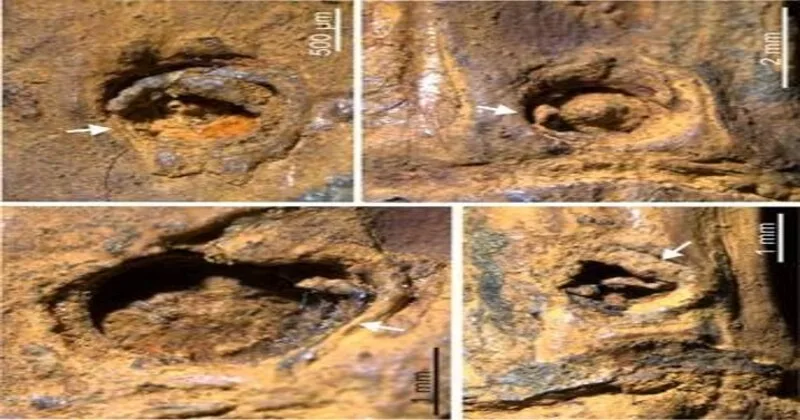
Closer examination revealed that some thorn scar patterns on the fossil surface were formed so delicately that they almost never survive fossilisation. Under a microscope, these marks stood out like quiet signatures from the past, indicating that the plant once bore thorns. As the scientists studied its morphology, the nodes, buds and defensive structures, they realised that they were handling a relic from a time when thorns were an essential survival tool.
The fossil’s preservation was so rare that it allowed researchers to reconstruct details of the plant’s defensive traits. Thorn scars marked its nodes. A preserved bud captured in the fossil matrix, revealed structural affinities with modern bamboo species. Using comparative analysis, the team assigned this fossil to the genus Chimonobambusa, by aligning it closely with present day species like Bambusa bambos and Chimonobambusa callosa. This identification of the fossil firmly within the evolutionary narrative of Asian bamboo.
Defence Written in Stone
The survival of thorn scars in a 37,000-year-old fossil is more than a scientific curiosity; it is evidence that thorniness, a key defence mechanism against herbivores, had evolved in Asian bamboo long before humans cultivated or studied it.
In prehistoric landscapes, giant herbivores roamed freely, creating intense pressure on plants to adapt. Thorns served as an effective deterrent. The Chirang fossil demonstrates that such adaptations were present during the late Pleistocene and that bamboo in this region had already evolved sophisticated physical defences.
This insight is vital because the evolution of bamboo has long been difficult to trace. With scarce fossil records, scientists relied mainly on comparing living species. This discovery provides direct evidence of an evolutionary timestamp, demonstrating that thorny bamboo was part of Asia’s ecological fabric during the Ice Age.
Northeast India a Sanctuary During the Ice Age
One of the most significant implications of the fossil lies not in the bamboo itself, but in what it reveals about the region’s climate history. During the last Ice Age, global climates cooled and dried dramatically. Europe lost their bamboo populations entirely. But this fossil shows that bamboo thrived in Northeast India during the same period.
Why?
The answer lies in the unique geography of the Indo-Burma biodiversity hotspot, within which the Imphal Valley lies. Whereas glaciation and climate changes changed vegetation across continents, Northeast India remained relatively warm and humid. This protected environment served as a biological refuge, a haven where bamboo along with countless other species survived the climatic turmoil that wiped it from other regions.
This fossil is a silent testimonial to survival. It confirms that the Indo-Burma region played a crucial role as a paleoclimatic refuge, enabling bamboo lineages to persist when global conditions turned hostile. This strengthens the ecological importance of the region and marks it not only as a present day biodiversity hotspot but also as an ancient cradle of resilience.
Discovery of Scientific and Cultural Value
In many Asian cultures, bamboo is a symbol of resilience, flexibility and endurance. This fossil embodies all three qualities, literally and metaphorically. It endured tens of thousands of years under silt, emerging only now to rewrite part of the continent’s botanical history.
The study by H. Bhatia, P. Kumari, N.H. Singh and G. Srivastava documented the morphology of the fossil and compares it with its contemporary species. Their findings present a reconstruction of a plant that existed in a different world and one has a deep evolutionary tie with today’s bamboo forests. This finding will also contribute to the fields of paleoclimatic science, biogeography and the study of species resilience. It presents concrete evidence of how a microclimate region can safeguard biodiversity during global stress events a lesson relevant to today’s warming world. The study was published in the Review of Palaeobotany and Palynology.
In India, especially for the Northeast, this finding is a matter of scientific pride. It highlights the looked palaeobotanical richness of the region and underlines its status as a living museum of plant evolution. In such discoveries, the world shows interest in climate refugia, which also makes our understanding of how ecosystems persist through extreme changes.
Stem That Bridges Past and Present
This 37,000-year-old fossil of thorny bamboo is not merely a remnant from the distant past; it is a narrative link that bridges the landscape of the past with today’s ecosystems. It teaches us that survival often depends on small adaptations, such as thorns, and on protective habitats that safeguard life through cycles of hardship.
From this fragile bamboo stem lodged in silt, scientists have pieced together a story of adaptation, climate refuge and evolutionary continuity. What seemed like a simple fossil has emerged as the milestone for Asia’s botanical record, deepening our understanding of how species endure and how landscapes shape life across millennia.