NEW DELHI: Defence exports are not a simple commercial transaction between two nations. Defence exports are strategic messages that convey trust, technology and political intent. A country that purchases military hardware actually commences a long-term relationship, focuses on training, support and operational synchronization. The defence exports have changed the boundaries of a country strategy.
India’s entry into the defence exports sector to overcome this backdrop was essential. The current state of the global defence market is complex one due to imposed sanctions, geo-political tensions and supply chain disruptions. It is here that stability and substance appear to be more valued than statements and slogans in defence partnerships among nations.
This change, reflected in the export of Indian defence products after 2014, is visible. Without too many promotions and ideological statements, Modi government has started to establish its position as a trustworthy supplier. The increasing Indian defence exports are gradually being built on the foundations of their credibility.
Defence Expenditure
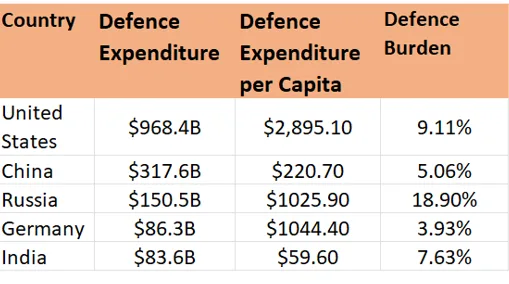
In defence spending, the gap between major powers is substantial. The US takes a major lead of $968.4 billion due to its worldwide military presence. Then comes China in second position with $317.6 billion, which is almost four times bigger than that of India, which is at $83.6 billion. Despite this big difference, India is among the top five defence spenders in the world. Its functioning with an altogether smaller budget compared to either China or the US, but is dealing with a tough region. The gap between these major powers starts with Germany, then Russia and finally India.
Defence Expenditure per Capita
When it comes to defence expenditure per capita, there is a completely different order of things. The United States spends approximately $2,900 per capita, with Germany and Russia each spending more than $1,000. China’s defence expenditure per capita stands relatively low at $221 due to its massive population base. India’s expenditure at only $59.6 ranks lowest among all countries and indicates how it can sustain defence preparedness and the deterrent effect even at a drastically lower expenditure level than the developed countries.
Defence Burden
Defence efforts are measured as a percentage of GDP, focuses on the prioritisation of a nation over and above the overall wealth of the nation itself. Russia spends a 18.9 per cent of its GDP on defence, indicating its high security challenges, followed by America spending over 9 per cent, then India with a defence spending of 7.63 per cent, greater than the Chinese defence spending of 5.06 per cent and the German defence spending of 3.93 per cent, suggesting strong relative efforts by Indian government on this front despite of its lower defence spending per capita to meet strategic requirements.
Export Inflection Point
Defence exports from India had been negligible for several decades, owing to the restrictive policies and procurements that had been focussed and geared only towards the domestic market. That chapter of slowness is now closed. Defence exports in FY 2024-25 amounted to Rs 23,622 crore.
It is the institutional shift that matters more than the headline number. The exports of defence hardware are no longer handled on an ad hoc basis. A robust export order system has replaced the ad hoc clearance system. Electronic licensing deals with the facilitation of clearance and harmonised categories of exports.
India has now begun exporting defence equipment and parts to 80 countries, indicating direct geographic diversification and increased acceptance of these systems. Exports have continued to grow at a steady pace despite international economic uncertainties, indicating that these sales are driven by necessity rather than pressure. This tipping point marks the moment when Indian defence exports shift from the fringes to the mainstream.
Factors that triggered the increase in exports
The success of Indian defence exports lies in their ability to operate across platforms that have been tested and can be maintained and modified for various operational environments. Rather than encouraging developments still in their laboratory stages, Indian defence exports are based on products that can operate in real-world environments.
The Tejas is one example of this evolution. In addition to its importance as a native fighter, it has matured as a production-ready system within operational squadrons. The OEMs that are interested are not looking at a prototype, but at a ready-made system that has maintenance cycles and upgrade cycles well available at present. The fact that it’s the Tejas that requires consideration attests to its capability as well as that of its home country.
The BrahMos is in a class of its own in terms of India’s export offerings. This missile is not being sold as a commodity but as a system for strategic defence. Headquarters locations, ranging from 60 to 100 kilometers, are within the capabilities of only a handful of high-impact missiles sold across the world. Exporting the system shows that strategic trust is at play, as the sale includes more than just the hardware component.
Another key domain is naval platforms. There are export takers for the Indian built patrol vessels and offshore support ships because they meet specific requirements, for securing the coast, surveillance and the need to protect the economic zone. The export items are not highly complex or specialized vessels. Their attraction lies in their ruggedness, simplicity and general adaptability, particularly among navies that lack depth in their logistical organisations.
Radars, electronic systems and ammunition round out the exports. These are usually non-newsworthy exports but are essential components of contemporary warfare. Indo-exported radars and electronic systems have found customers because they offer superior testability. Ammunition exports indicate the credibility of manufacturing consistency and quality control.
These examples showcase a carefully considered approach to exports. What India exports are functional systems, not technology with promise. Customers from other countries are assured of purchasing systems that have undergone rigorous testing and can be maintained with minimal disruption.
Defence Exports as Strategic Diplomacy
Defence exports tend to enhance political trust as a natural corollary. When countries begin to operate Indian systems, begin to interact with Indian training facilities, maintenance structures and procedures.
The export solution of India focuses on long-term partnership. Training, spare parts and maintenance support are basic factors of military partnership. India’s approach differs from transactional export solutions, emphasizing more on sustenance.
Another particular aspect of these S&WTs for India is restraint. Indian foreign policies do not lay down political or operation-related conditions for supplying weapons and military equipment. This certainly makes Indian weapons a coveted choice for countries seeking strategic non-alignment. The Indian S&WTs, through a broader framework of South-South cooperation, have been identified as partnership instruments rather than leverage instruments.
World Market and strategic outcome
India finds itself as a growing nation in the international Defence market. On one side there are expensive Western sellers with more secure Terms of Trade and then there are the cheaper sellers who might not be reliable or could be tied to political motives in the international Defence market.
India has a balanced offering with competitive prices coupled with democratic reliability. Indian technology may not be at the forefront, but its performance is certainly not constrained by strategic considerations. It is interesting to see that India has been successful at exporting its arms without resorting to hard sell.
Defence exports are transforming the geopolitical tone of the Indian military. A credible supply chain enhances strategic independence. Defence partnerships are currently beginning to support the strategic role of the Indian military as a stabiliser rather than a disruptor.
The process of transforming itself into an exporter is ongoing, and the direction is quite clear. India is no longer just a buyer of security, it is now a maker of security quietly, credibly and effectively.