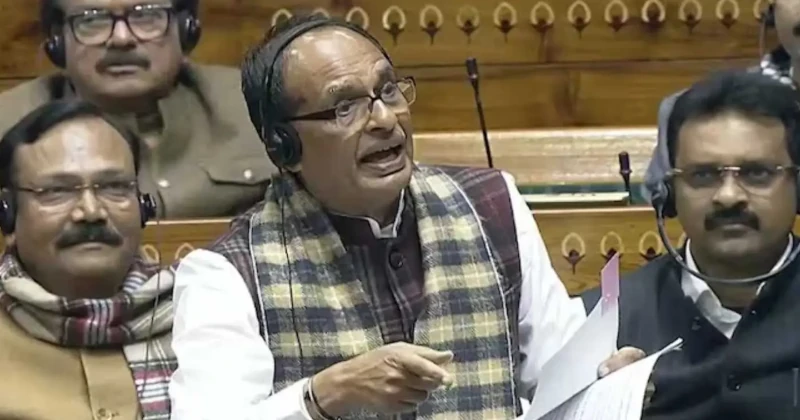
The Lok Sabha on December 18, the BJP slammed Congress on its long-standing “dynasty politics,” as Union Agriculture and Rural Development Minister Shivraj Singh Chouhan defended the Viksit Bharat Guarantee for Rozgar and Ajeevika Mission (Gramin) Bill, 2025 and slammed the Opposition for what he described as an outright assault on parliamentary democracy.
As Congress and INDI Alliance MPs protested loudly some allegedly tearing copies of the Bill and climbing onto desks Chouhan accused them of reducing Parliament to “mobocracy” and betraying the ideals of Mahatma Gandhi. “Pages were torn, members climbed onto tables. Isn’t this the murder of Bapu’s ideals?” Chouhan asked, condemning the conduct of Opposition MPs during his address.
Backing his criticism with data, the Union Minister and BJP leaders highlighted what they called Congress’s decades-long obsession with naming public assets after the Nehru-Gandhi family, contrasting symbolism with substance.
25 schemes are named after Rajiv Gandhi.
27 after Indira Gandhi, meaning a total of 52 schemes named after the Gandhi family.
55 educational institutions named after Rajiv Gandhi, 21 after Indira Gandhi, 22 after Nehru.
23 sports trophies named after Rajiv Gandhi, 4 after… pic.twitter.com/HO0itfVDtk
— Megh Updates 🚨™ (@MeghUpdates) December 18, 2025
According to figures cited in Parliament:
52 government schemes are named after the Gandhi family
- 25 after Rajiv Gandhi
- 27 after Indira Gandhi
55 educational institutions bear Rajiv Gandhi’s name,
- 21 after Indira Gandhi,
- 22 after Jawaharlal Nehru
23 sports trophies are named after Rajiv Gandhi,
- 4 after Indira Gandhi,
- 2 after Nehru
- 74 institutions and 51 awards carry the Nehru-Gandhi family name
- 39 medical institutions and hospitals, 15 national parks, and 15 scholarships are named after the family
- Five airports and ports are named after Rajiv Gandhi
“These numbers expose Congress’s priorities,” BJP leaders argued. “For decades, governance was reduced to glorifying one family, while rural India waited for real delivery.”
The VB-G RAM-G Bill, passed by voice vote amid uproar, replaces the MGNREGA framework with what the government says is a stronger, better-funded rural employment guarantee.
Key highlights defended by the BJP:
- Employment guarantee increased from 100 to 125 days
- Total proposed allocation: Rs 1,51,282 crore
- Centre’s share: Over Rs 95,000 crore
- Continued Centre–State partnership with a 60:40 funding ratio
“There have been many rural schemes over the years Jawahar Rojgar Yojana, Sampoorn Gramin Rojgar Yojana, then MGNREGA,” Chouhan said. “MGNREGA was not named after Pandit Nehru. Was that an insult to him? Welfare of the poor is not about names; it is about outcomes.”
The Minister underlined that under Prime Minister Narendra Modi’s leadership, more than 25 crore people have been lifted out of poverty, calling it proof that delivery not dynasty is driving governance today.
Congress MP Priyanka Gandhi Vadra strongly opposed the Bill, claiming it would “end MGNREGA in the coming months” by shifting financial burden onto states. “This is a clever trick 100 to 125 days sounds good, but once states are forced to bear the cost, the scheme will gradually die,” she alleged, demanding the Bill be sent to a Standing Committee.
The Opposition protested inside the House, holding up posters of Mahatma Gandhi and accusing the government of undermining a lifeline for rural households.
The BJP rejected the allegations outright, saying the Congress was trying to shield its political discomfort behind emotive symbolism. “You speak your view, but do not let others speak isn’t that immoral?” Chouhan asked, accusing the Opposition of stalling debate because it lacks answers.