India has recorded a substantial increase in fish production and aquaculture productivity following the implementation of the Pradhan Mantri Matsya Sampada Yojana (PMMSY), the flagship fisheries scheme launched by the Centre in 2020. According to official data shared in Parliament, the country’s total fish production rose from approximately 141.6 lakh tonnes in 2019-20 to an estimated 197.75 lakh tonnes in 2024-25, marking a robust growth of 38 per cent within five years.
The information was provided by Union Minister for Fisheries, Animal Husbandry and Dairying Rajeev Ranjan Singh (Lallan Singh) in a written reply to a question in the Lok Sabha, highlighting the far-reaching impact of targeted policy interventions, infrastructure development and technological adoption under PMMSY.
Inland Aquaculture and Marine Fisheries Drive Growth
Officials attributed the sharp rise in fish production primarily to the expansion of inland aquaculture, modernisation of marine fisheries, and strengthening of the fisheries value chain. PMMSY was conceived with the objective of harnessing the untapped potential of India’s vast inland water resources and coastline while ensuring sustainability, income generation and nutritional security.
Inland fisheries have emerged as a major contributor, supported by scientific practices, improved seed quality, enhanced feed management and increased adoption of modern aquaculture systems. The scheme has also prioritised responsible marine fishing through harbour development, fleet modernisation and post-harvest infrastructure.
Among inland fish-producing states, Bihar has consolidated its position among the top five contributors. In 2024-25, the state recorded fish production of 959.76 thousand tonnes, reflecting the success of focused interventions under PMMSY. Within Bihar, Darbhanga district alone contributed 88.28 thousand tonnes, underscoring the role of district-level implementation and farmer participation.
Officials noted that Bihar’s success is closely linked to pond-based aquaculture expansion, improved access to institutional credit, and promotion of allied fisheries activities, which have enhanced both production and rural livelihoods.
Productivity Gains Reflect Technological Adoption
India’s average aquaculture productivity has also shown significant improvement. From around 3 tonnes per hectare prior to PMMSY, productivity increased to 4.7 tonnes per hectare by 2025, reflecting better management practices and technological interventions.
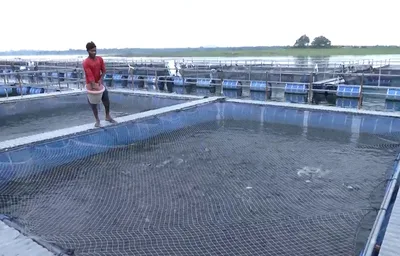
The government has promoted advanced systems such as Recirculatory Aquaculture Systems (RAS), Biofloc technology, raceways and cage culture to optimise resource use and reduce environmental impact. These technologies have helped farmers achieve higher yields, lower mortality rates and better quality produce.
The fisheries sector’s economic contribution has expanded significantly in recent years. The Gross Value Added (GVA) from fisheries rose to Rs 3,68,124 crore in 2023-24, compared to Rs 2,12,087 crore in 2018-19. Correspondingly, the sector’s share in the agricultural GVA increased from 7 per cent to 7.55 per cent, indicating its growing importance within India’s agrarian economy.
Officials said the rise in GVA reflects not just higher production but also improved value addition, better market access and stronger supply chains enabled by PMMSY.
Exports Show Strong Momentum
India’s fish and fishery product exports have also recorded strong growth during the period. Export earnings increased by 33.7 per cent, rising from Rs 46,662.85 crore in 2019-20 to Rs 62,408.45 crore in 2024-25. This growth has been driven by improved quality standards, compliance with international regulations and diversification of export markets.
Shrimp, frozen fish and value-added products continue to dominate exports, with PMMSY-supported cold chain infrastructure and processing facilities playing a key role in maintaining quality and reducing post-harvest losses.
Beyond conventional fish production, the Department of Fisheries has promoted allied activities such as the cultivation of fox nut (makhana) and water chestnut (singhara), particularly in states with abundant wetlands and ponds. These activities have provided additional income streams to fishers and farmers while optimising water resource utilisation.
Technological interventions aimed at value addition, processing and branding have further enhanced the commercial viability of these allied products.
Infrastructure Expansion Under PMMSY
Infrastructure creation has been a cornerstone of PMMSY implementation. As of 2024-25, more than 52,000 reservoir cages, 22,000 RAS and Biofloc units, raceways, and 1,525 sea cages have been established across the country. These initiatives have involved a cumulative investment of Rs 3,040.87 crore, significantly expanding India’s aquaculture capacity.
Additionally, the development of fishing harbours, fish landing centres, cold storage facilities, ice plants and transport infrastructure has strengthened the fisheries value chain from harvest to market.
The government has also focused on fostering entrepreneurship and innovation within the fisheries sector. Collaborations with Indian Council of Agricultural Research (ICAR) institutes and private incubators have supported fisheries start-ups, business incubation and skill development. Capacity-building programmes have been rolled out to train fishers, entrepreneurs and young professionals in modern aquaculture practices and business management.
Maharashtra Sees Remarkable Growth
Maharashtra has emerged as a key beneficiary of PMMSY interventions. Fish production in the state increased by 40.27 per cent, rising from 5.24 lakh tonnes in 2020-21 to 7.43 lakh tonnes in 2024-25. Notably, Palghar district recorded an extraordinary 546 per cent increase, with production rising from 21.45 tonnes to 138.54 tonnes during the same period.
Officials attributed this surge to targeted investments in fishing harbours, post-harvest facilities, dredging works and fish landing centres, which have improved efficiency and reduced losses.
The government said the achievements under PMMSY highlights its role as a transformative scheme aimed at enhancing fishers’ incomes, ensuring nutritional security and promoting sustainable fisheries. With continued focus on technology, infrastructure and market integration, the fisheries sector is expected to remain a key driver of rural growth and export earnings in the coming years.