
Vande Bharat Debate in Parliament: Partition Vs Integration
July 18, 2026
  • Read Ecopy
  • Circulation
  • Advertise
  • Careers
  • About Us
  • Contact Us
Android AppiPhone AppArattai
Organiser
  • ‌
  • Bharat
    • Assam
    • Bihar
    • Chhattisgarh
    • Jharkhand
    • Maharashtra
    • View All States
  • World
    • Asia
    • Europe
    • North America
    • South America
    • Africa
    • Australia
  • Editorial
  • International
  • Opinion
  • RSS @ 100
  • More
    • Op Sindoor
    • Analysis
    • Sports
    • Defence
    • Politics
    • Business
    • Economy
    • Culture
    • Special Report
    • Sci & Tech
    • Entertainment
    • G20
    • Azadi Ka Amrit Mahotsav
    • Vocal4Local
    • Web Stories
    • Education
    • Employment
    • Books
    • Interviews
    • Travel
    • Law
    • Health
    • Obituary
  • Subscribe
    • Subscribe Print Edition
    • Subscribe Ecopy
    • Read Ecopy
  • ‌
  • Bharat
    • Assam
    • Bihar
    • Chhattisgarh
    • Jharkhand
    • Maharashtra
    • View All States
  • World
    • Asia
    • Europe
    • North America
    • South America
    • Africa
    • Australia
  • Editorial
  • International
  • Opinion
  • RSS @ 100
  • More
    • Op Sindoor
    • Analysis
    • Sports
    • Defence
    • Politics
    • Business
    • Economy
    • Culture
    • Special Report
    • Sci & Tech
    • Entertainment
    • G20
    • Azadi Ka Amrit Mahotsav
    • Vocal4Local
    • Web Stories
    • Education
    • Employment
    • Books
    • Interviews
    • Travel
    • Law
    • Health
    • Obituary
  • Subscribe
    • Subscribe Print Edition
    • Subscribe Ecopy
    • Read Ecopy
Organiser
  • Home
  • Bharat
  • World
  • Operation Sindoor
  • Editorial
  • Analysis
  • Opinion
  • Culture
  • Defence
  • International Edition
  • RSS @ 100
  • Magazine
  • Read Ecopy
Home Bharat

Vande Bharat Debate in Parliament: Partition Vs Integration

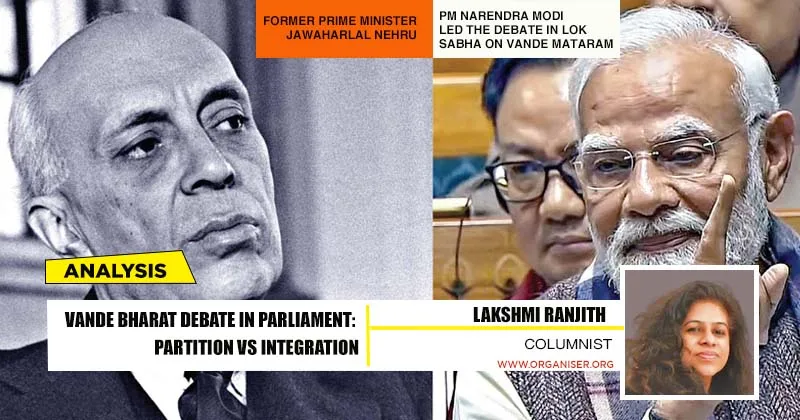
On December 8, 2025, Parliament witnessed one of the most ideologically charged debates in decades as the nation marked 150 years of Vande Mataram. What began as a commemoration soon turned into an excavation of historical choices, especially those made by Jawaharlal Nehru in the 1930s that, in Prime Minister Narendra Modi’s telling, altered the fate of the national song and symbolised a deeper pattern of political appeasement that led to the partition of Bharat

Lakshmi RanjithLakshmi Ranjith
Dec 15, 2025, 09:40 pm IST
in Bharat, Analysis
Follow on Google News
FacebookTwitterWhatsAppTelegramEmail

The ten-hour debate in Parliament on December 8, 2025 will walk into history not only for its intensity, but for how sharply it illuminated one man’s choices, Jawaharlal Nehru’s, in shaping the destiny of Vande Mataram. The occasion was the 150th anniversary of Bankim Chandra Chattopadhyay’s immortal composition, yet the debate swiftly expanded into a reckoning with cultural memory, political compromises of the pre-Independence era, and the place of civilisational symbols in modern Bharat.

Prime Minister Narendra Modi opened the discussion with a sweeping narration of how Vande Mataram emerged under colonial rule. While the British were aggressively inserting “God Save the Queen” into public consciousness, Bankim’s composition became a rebellious counter-song a pavitra yuddha-ninaad, he said, that stirred a colonised nation into awakening. Modi recalled how British authorities banned the chant, lathi-charged school children, jailed entire processions, and even beat women on the streets for singing it. “Such was the fear this song instilled in the rulers,” he said, linking the cultural repression of the past to present-day debates on national identity.
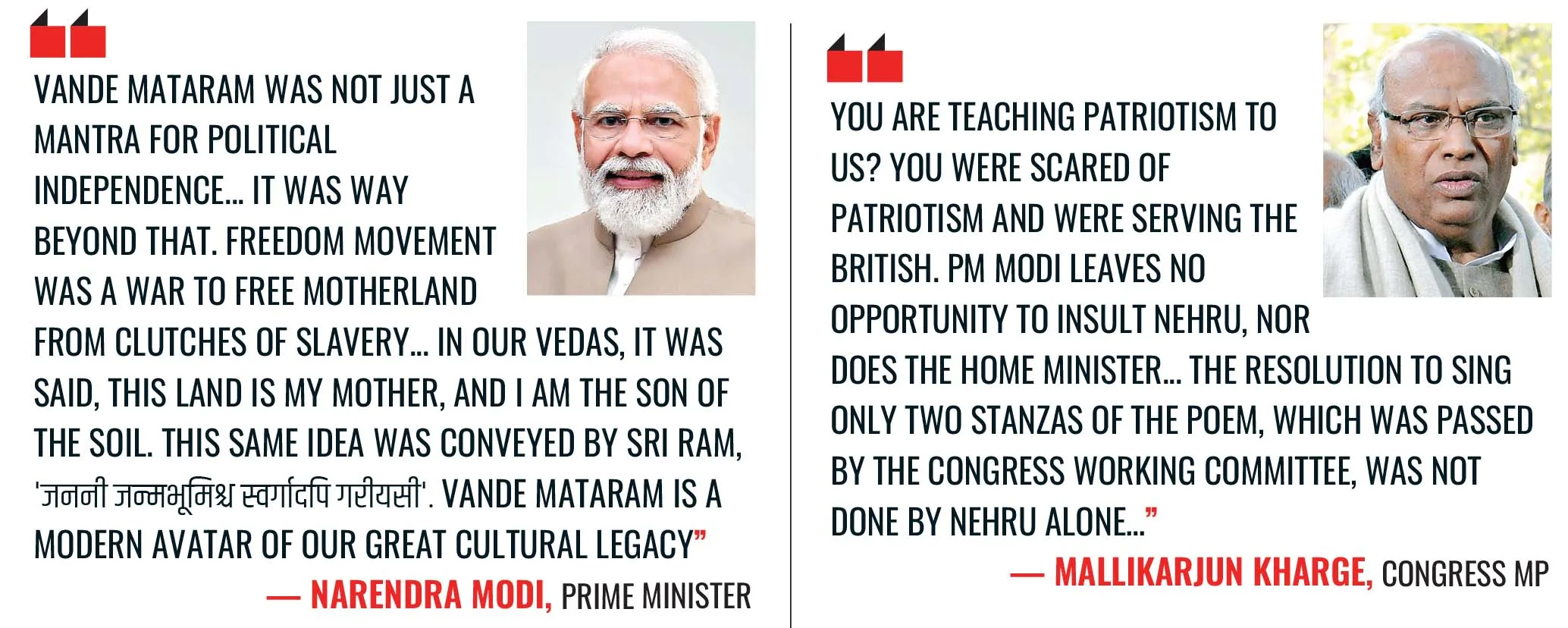
But Modi’s speech moved quickly towards the political storm at the centre of the day’s proceedings: the historical role of the Congress, and specifically Jawaharlal Nehru, in diluting the song. The Prime Minister invoked Mahatma Gandhi Ji’s writings praising Vande Mataram as “the sweetest and most elevating of all national songs,” and contrasted this with what he called the Congress’ gradual capitulation to communal objections beginning in the 1930s.

Then came the explosive revelation that dominated the entire debate – a reference to Jawaharlal Nehru’s 1937 letter to Subhas Chandra Bose. Modi quoted Nehru as writing that the background of Vande Mataram, rooted in Anandamath, “may provoke Muslims.” This, Modi argued, was the moment the Congress leadership “began bending,” eventually leading to the chopping off of the song’s later stanzas.

“In Bankim Babu’s own Bengal, in his own Kolkata,” PM Modi said, “the Congress decided to cut down the very song that had fired up freedom fighters.” He framed this not as a tactical compromise but as a civilisational retreat – one that, in his interpretation, set the stage for the mindset that made Partition possible. His most-quoted line captured this merging of cultural and territorial narratives:
“Vande Mataram was divided first… and soon after, the nation was divided.”

What made Modi’s charge even more damaging for the Congress was the context he outlined. In October 1937, the Muslim League under Muhammad Ali Jinnah launched a nationwide agitation against Vande Mataram. Jinnah objected to the idea of “bowing” to the motherland, calling it un-Islamic; he also opposed the portrayal of Muslim rulers in Anandamath. Instead of resisting these objections, Modi argued, Nehru accepted their premise – a claim he supported by quoting Nehru’s letter to Bose.

From Modi’s perspective, this was the first ideological fracture: the Congress’s willingness to reshape a national symbol to appease religious sensitivities. The CWC’s subsequent decision to restrict the song to its first two stanzas was portrayed as the culmination of Nehru’s shift. Modi described it as a watershed moment when “the Congress knelt before the Muslim League,” a compromise that would return to haunt the party for decades.
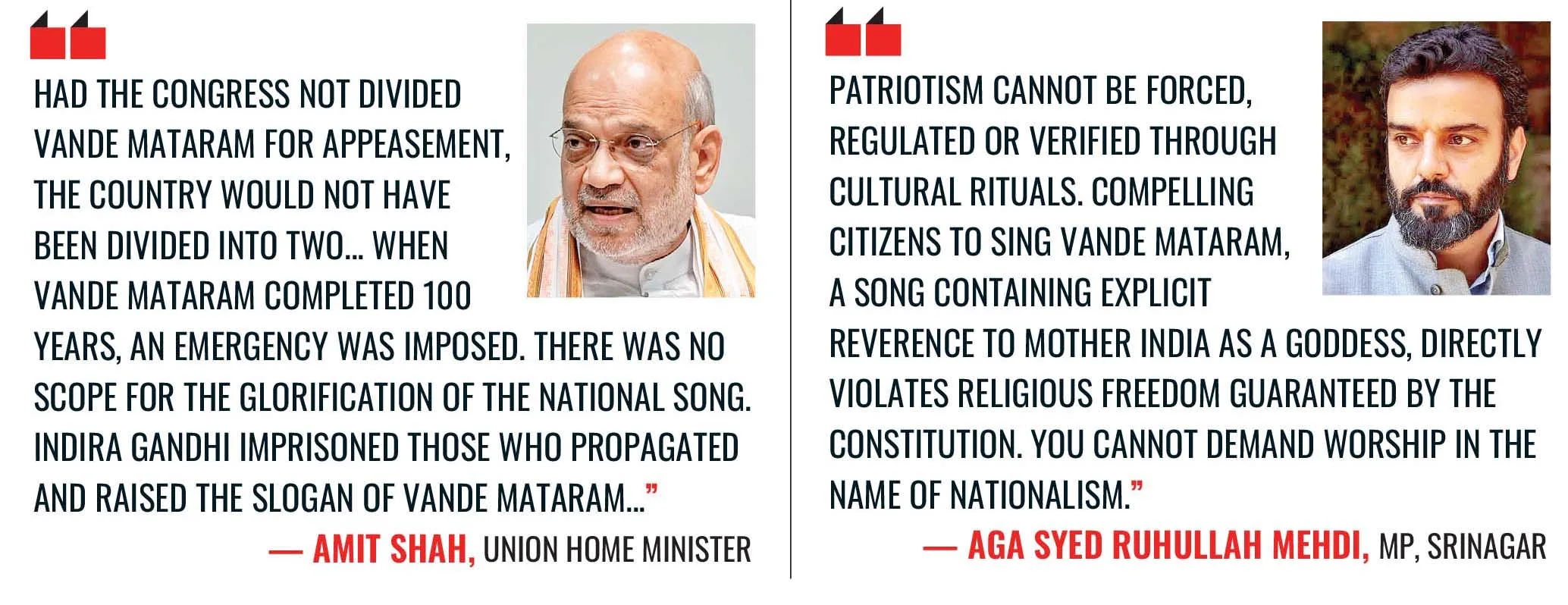
Union Home Minister Amit Shah then took the debate forward in the Rajya Sabha with characteristic bluntness. While rejecting Opposition allegations that the timing of the debate had electoral motives, Shah used the opportunity to sharpen the ideological divide. Vande Mataram, he declared, was above politics – a proclamation of freedom that inspired revolutionaries even as they walked to their deaths.
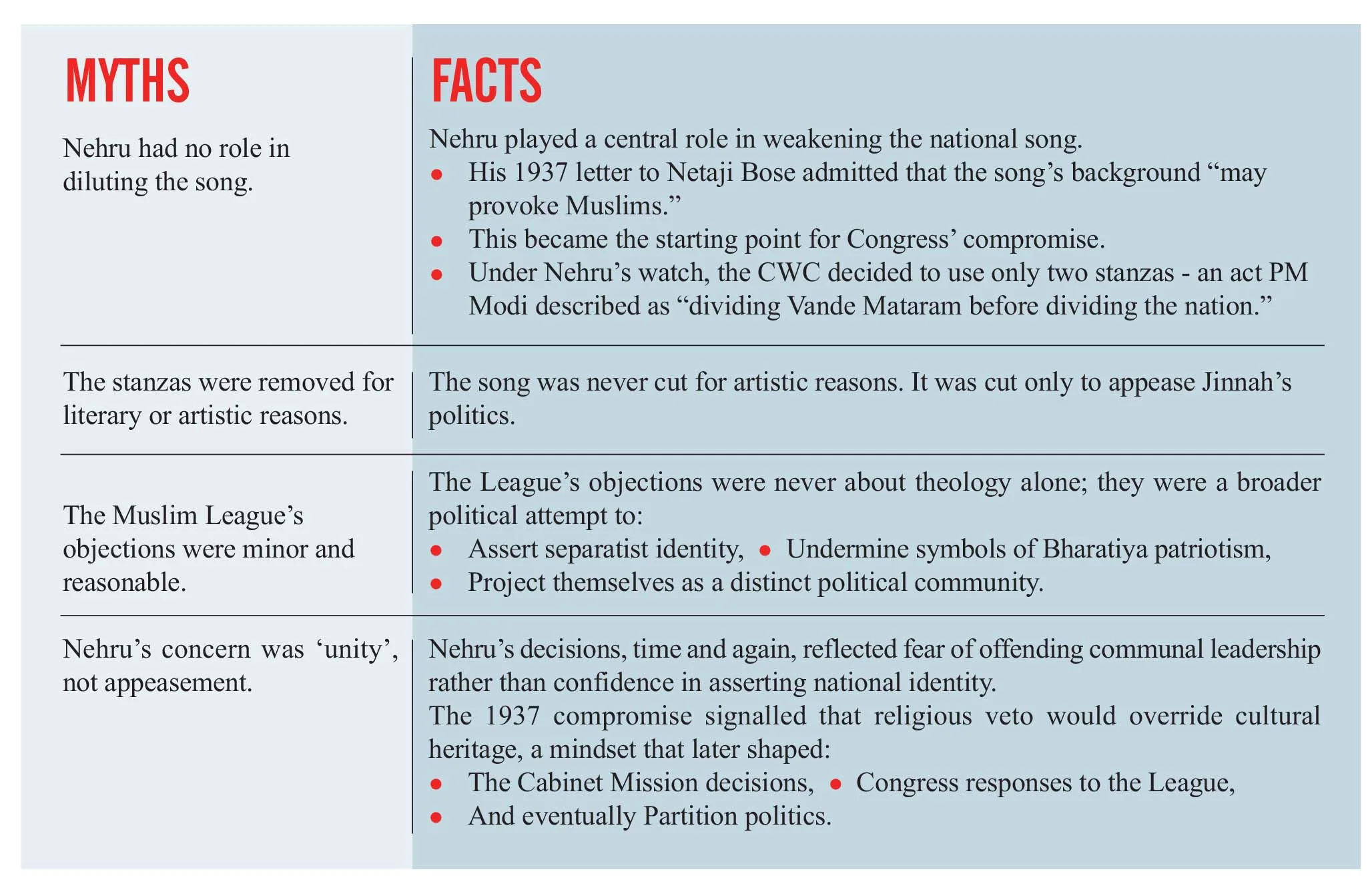
But Shah’s most forceful intervention was again directed at Nehru. By highlighting the 1937 compromise, Shah accused Congress of creating a historical legacy of appeasement – one that continued, he said, in its positions on the Waqf Amendment Act, UCC, and other contemporary issues. In Shah’s framing, the Congress had inherited and perpetuated a worldview that placed “religious sensitivities” above the nation’s civilisational identity.

The Opposition countered vigorously, accusing the government of rewriting history and unfairly targeting Nehru. Congress MP Gaurav Gogoi insisted that the party’s contributions to the freedom struggle were being ignored. Priyanka Vadra called the government’s approach a “bada paap,” while Jairam Ramesh charged the BJP with manufacturing cultural controversies. TMC’s Mahua Moitra accused the Treasury benches of “weaponising culture ahead of elections.”

The debate brought in by the Modi government is not just about a song; it has prominence in the current political scenario, where the Opposition’s arguments clearly mirror those of separatist leaders before Independence. The pattern of selective secularism continues – appeasing minorities to woo their voter base in Congress-ruled states. The tendency to place certain religious interests above national integrity and Bharat’s cultural identity is still evident.


Topics: Muslim LeagueModi governmentTMC's Mahua MoitraVande Bharat DebateBankim Chandra Chattopadhyay’sModi’s perspectiveParliament on December 8Congress
Lakshmi Ranjith
Lakshmi Ranjith
A digital journalist with over 18 years of experience in mainstream media, she began her career in television news before expanding into print, social media, and digital platforms. She has travelled extensively across India to cover elections, political developments, and major business events, reporting on issues ranging from politics and governance to business and social affairs. Her key strengths include sharp analysis of national and state politics, as well as international relations. Over the years, she has worked with The Times of India, Google, News24 Digital, MMTV, TV News, and the Ministry of Information & Broadcasting. She currently serves as Assistant News Editor at Organiser, overseeing digital platforms. She is Committed to continuous learning; she maintains high editorial standards and a strong commitment to ethical journalism in a rapidly evolving media landscape. [Read more]
ShareTweetSendShareSend
✮ Subscribe Organiser YouTube Channel. ✮
✮ Join Organiser's WhatsApp channel for Nationalist views beyond the news. ✮
Previous News

Chhattisgarh: Row erupts over Changai Sabha in Korba, Hindu activists allege conversion activities, demand action

Next News

RSS Telangana, Gurudwaras mark Guru Tegh Bahadur’s 350th martyrdom in Hyderabad; Sikh legacy honoured

Related News

BJP Protest against Bidadi Township project

Karnataka: BJP steps up protest against Bidadi Township; Exposes Congress government’s land grab scam

The organisers of the 'Melbourne Meets Modi' community have issued a strongly worded open letter to Rahul Gandhi

Don’t insult Indian-Australians: Melbourne Meets Modi organisers demand apology from Rahul Gandhi over paid crowd claim

Congress leader Priyanka Gandhi

‘Where is Priyanka Gandhi?’ BJP questions Wayanad MP’s absence after deadly landslide, alleges ‘Token tweet’ response

Congress supremo Rahul Gandhi

BJP calls Rahul Gandhi a ‘Non-serious politician’, alleges student outreach events cancelled due to vacation

Bharat Jodo Yatra has faced scrutiny over participation of several individuals later linked to arrests, FIRs & major criminal controversies

From Hate Speech to Crime: How Rahul Gandhi’s Bharat Jodo Yatra became a haven for radical and disreputable elements

Karnataka Home Minister Priyank Kharge (Left) ; kumkum (Right)

Karnataka: Priyank Kharge schooled for mocking Hindus and spreading misinformation about kumkum and saffron

Load More

Latest News

Dignitaries on the stage on the concluding session of Saushrutam 2026 that was organised of AIIA

AIIA concludes Saushrutam 2026, renews IIT Delhi MoU to advance ayurvedic surgery and research

AKG Centre for Research and Studies

Kerala University orders survey over alleged occupation of university land by CPM’s research centre

ABVP wages protest demanding Increase in Seats for One-Year Postgraduate Programmes

ABVP holds massive protest at Delhi University demanding increase in seats for one-year postgraduate programmes

President Droupadi Murmu

President Murmu visit to Eastern Europe: A natural transit corridor for Indian businesses to boost supply chains

BJP Protest against Bidadi Township project

Karnataka: BJP steps up protest against Bidadi Township; Exposes Congress government’s land grab scam

RSS Sanghik held at the Parvathi Kalyana Mandapam in Chandranagar

Keralam: Kanchi Shankaracharya calls for societal upliftment and cultural preservation at Sangh Sanghik

CM Dhami Announces Special Agniveer Cell, 10% Reservation in State Jobs for Retired Agniveers

Uttarakhand: CM Dhami unveils first dedicated Agniveer cell, homestay grants and job benefits for ex-servicemen

Amid rising Gulf tensions, DGMA has advised shipping firms to avoid deploying Indian seafarers through Strait of Hormuz until further orders

Strait of Hormuz Tensions: DGMA advises shipping firms to avoid deploying Indian seafarers until further orders

Female Toppers of NEET 2026 Exam

Re-NEET 2026 Result: Women lead success rate, UP records highest number of qualifiers

Prime Minister Modi addresses public gathering in Punjab

Punjab: Centre committed to the development of state despite no BJP government, says PM Modi

Load More
  • Privacy
  • Terms
  • Cookie Policy
  • Refund and Cancellation
  • Delivery and Shipping

© Bharat Prakashan (Delhi) Limited.
Tech-enabled by Ananthapuri Technologies

  • Home
  • Search Organiser
  • Bharat
    • Assam
    • Bihar
    • Chhattisgarh
    • Jharkhand
    • Maharashtra
    • View All States
  • World
    • Asia
    • Africa
    • North America
    • South America
    • Europe
    • Australia
  • Editorial
  • Operation Sindoor
  • Opinion
  • Analysis
  • Defence
  • Culture
  • Sports
  • Business
  • RSS @ 100
  • Entertainment
  • More ..
    • Sci & Tech
    • Vocal4Local
    • Special Report
    • Education
    • Employment
    • Books
    • Interviews
    • Travel
    • Health
    • Politics
    • Law
    • Economy
    • Obituary
  • Subscribe Magazine
  • Read Ecopy
  • Advertise
  • Circulation
  • Careers
  • About Us
  • Contact Us
  • Policies & Terms
    • Privacy Policy
    • Cookie Policy
    • Refund and Cancellation
    • Terms of Use

© Bharat Prakashan (Delhi) Limited.
Tech-enabled by Ananthapuri Technologies