





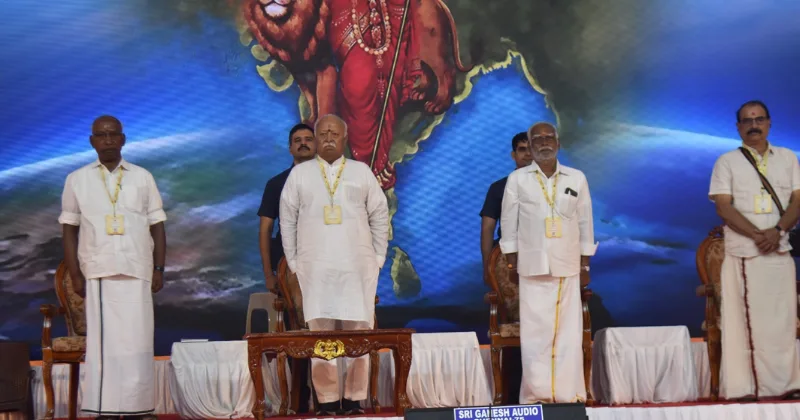
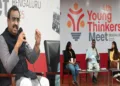
Rashtriya Swayamsevak Sangh (RSS) Sarsanghchalak Dr Mohan Bhagwat reaffirmed that the organisation’s core mission is national development and societal upliftment, not the pursuit of political power or dominance. He addressed a gathering of young achievers, intellectuals, youth and startup entrepreneurs—numbering over 1,300—during his two-day visit to Tamil Nadu. The interaction, held on December 9, saw the audience listening in pin-drop silence for nearly two hours.
As part of the series ‘100 years Saga of RSS – Envisioning the Way Forward’, Dr Bhagwat emphasised that “building and improving one’s nation is the responsibility of every citizen, and by doing so, individuals ultimately safeguard their own interests too.” He reiterated that the RSS is not driven by a desire for dominance, saying: “Our aim is not power; but the vision of a united, disciplined, and value-based society committed to the nation’s long-term progress.”
He highlighted the richness of India’s diversity, noting, “We celebrate diversity. But the bigger identity as a nation and as a society is that we are one. Mind boggling diversity is the first obvious specialty of our country. Despite all these diversities, we have been living as one ‘Rashtra’ for a long time. The very identity of our ‘Rashtra’ encompasses all diversities.”
Dr Bhagwat underscored the importance of water conservation and ending the use of plastic in daily life, stressing that such habits must begin at the individual and family level before policy-level changes follow. He urged people to speak in their mother tongue at home, stating, “Every Indian language is our national language. We should also know the language of the place where we live, so that we can mingle with others. We should also have our signature in our mother-tongue.”
He said society thrives not on isolated individuals but on families, villages and communities bound by written laws and unwritten traditions. He explained that the RSS aspires to build a society composed of individuals with strong national character, saying, “The RSS is not here to contest or oppose anyone. We have to dispel misunderstandings created by narratives. RSS focuses on man-making and social organisation, believing that strengthening society—morally, culturally and socially—is the foundation for a strong nation.”
Reflecting on the organisation’s origins, he spoke at length about the vision of Dr K.B. Hedgewar, the founder of the RSS. He recalled how Dr Hedgewar, who lost his parents at the age of 11 on the same day, pursued his education, completed medicine, and later dedicated himself entirely to the nation. Through interactions with prominent figures like Bal Gangadhar Tilak, Gandhi Ji, and Bhagat Singh, Dr Hedgewar realised that societal vulnerabilities made India susceptible to invasions, despite the attackers often being less advanced.
Dr Bhagwat described how Hedgewar pledged lifelong service to the nation, choosing Brahmacharya to ensure complete dedication. “Doctor ji felt liberty and equality can only happen if there is cohesiveness. If there is no cohesiveness, the Constitution cannot protect us,” he said. Hedgewar believed that societal transformation requires an environment where individuals and systems reinforce honesty, selflessness and Desh bhakti.
Addressing narratives in Tamil Nadu that likened Sanatana Dharma to diseases such as dengue and malaria, Dr Bhagwat asserted, “We are Sanatan Rashtra. Our identity of Rashtra is, it encompasses all diversity, accepts all. We celebrate our diversity as the base of our Nation and that nation is Hindu nation. The word Hindu also means Bharatiya, Hindavi, Indic. The difference we see is temporary and unity is permanent and absolute.”
He clarified that the RSS does not seek to become a powerful organisation but seeks to organise the entire society, including those who differ in opinion. “God helps those who help themselves. We cannot depend on Government alone to help. So the individual Swayamsevak is tasked to enable the society to help itself.”
He described Rashtriyata not as a mere nation-state but as a civilisational ethos—sanskriti—that has endured across generations and has been upheld by countless individuals who sacrificed their lives. “Dharma is not worship, it is that which unites and uplifts,” he said. “The Rashtra will flourish when everyone is prepared to work for it.”
Dr Bhagwat stressed that the RSS does not seek credit for societal changes. “We don’t want history to mention that RSS brought about this change, but we want society to lead and take credit,” he said. The goal is to create a society capable of taking Bharat to the peak of glory and sharing its civilisational wisdom with the world.
Calling upon the younger generation, he urged them to take an active interest in politics as a tool for societal transformation, warning that personal growth should not overshadow integrity. He emphasised the impact of leading by example: “Children do not hear what parents say but they see what parents do.”
He urged individuals to “learn the art of taking along everyone with you” through teamwork, adding that the Sangh focuses only on man-making, while “Swayamsevaks will do everything.”
He reminded that even those who do not attend shakas but work selflessly for Bharat embody the spirit of a swayamsevak: “Because working for Bharat is working for Sangh.”
Dr Mohan Bhagwat reflected on the organisation’s century-long journey, noting that 100 years was not an easy journey, our thoughts were not accepted. There were no financial support, no media to propagate our ideas. British was always anti-Sangh. People felt Hindu society is a dying society. Yet, he pointed out that inspire of that, on the basis of the dedication of our Swayamsevaks, through their commitment, Sangh has come this far.
He emphasised that the RSS is now preparing our society to deliver this message, recalling how the organisation faced opposition which no organisation faced. He said Swayamsevaks were assaulted, murdered, but inspite of all this, on the devotion of Swayamsevaks, we have come to a stage where society has developed faith in RSS. However, he cautioned that this alone is insufficient, stressing that to raise a nation to deliver its duty is not a simple task and that we have to prepare the nation by uniting the society.
Dr Bhagwat explained that the Sangh’s next steps are being actively shaped, saying that our Swayamsevaks are thinking how to do this. One approach, he said, is to expand more and learn the art of taking the society along, with the aim of extending RSS presence in every area which has a 10,000 population. The intention, he said, is to make our outreach larger, go to every strata of society and make our presence meaningful and network with society.
He highlighted that the Sangh has a special outreach for a local, social, apolitical leadership, whose members work together separately and be aware that there are people who can work with us. According to him, the networking and organising organised society is the goal for next few years, and he asserted that if we do this, our challenges will disappear and Bharat will become Vishwaguru.
He detailed the RSS’ five societal initiatives—Pancha Parivartan: oneness (no discrimination), protecting the environment, self-identity, family values and responsible living. These, he said, are key to building national character.
Dr Bhagwat also spoke of the growing demand for freeing temples from government control, noting that while both government-run and trust-run temples vary in performance, a proper apparatus must be developed before transferring management to devotees.
Quoting Dr B.R. Ambedkar, he recalled his warning that divisions, not external strength, allowed others to conquer India. Ambedkar emphasised that liberty and equality cannot exist without bandhubhav (fraternity). Dr Bhagwat said Hedgewar dedicated his life in building the Sangh to address these societal challenges.
He explained there are four types of Hindus: 1. We are Hindus and proud 2. We are Hindus, what is there to be proud 3. We are Hindus but don’t say it loud 4. Those who have forgotten or made to forget that they are Hindus.
Dr Bhagwat called for unity, saying shakas cultivate intellectual, mental and physical development—the core attributes needed for nation-building. He noted that Tamil Nadu has strong nationalist roots, which must be encouraged to express themselves more freely.
He stressed the cultural importance of language, noting that at least at home, people should speak in their mother tongue. He underscored that every Bharatiya language is our national language, and emphasised the need to know the language of the place one lives in so that we can mingle with others. He urged the audience to develop the habit of speaking in Mother Tongue, and also to make signature in the same, framing it as a necessary step in nurturing identity and social cohesion.
On temple administration, he observed that the people are generally of the opinion that temples should be handled by bhaktas (devotees) and be centre of many societal activities and the funds to be used in the seva of bhaktas. He pointed out that the judiciary has also expressed agreement with this view. However, he raised a critical concern: who will take charge of the temple and deliver that charge? He explained that some temples taken over by Govt and some ones run by Trust are run well and the opposite is also true, highlighting the inconsistency in management. According to him, there has to be an apparatus that should be made ready and the temple question can be solved, indicating the need for a structured and capable system before reforms are executed.
Addressing social conduct, he remarked that being neutral means watching injustice some times, and questioned whether such neutrality can truly be called neutrality. He noted that there are bound to be opinions, and encouraged people to stick to your opinions, hold others opinions sacred and have dialogue. He clarified that identity assertions need not create conflict, emphasising that if I say, I am Hindu it does not mean I am anti Muslim.
On organisational participation, he spoke about the growth of the Sangh, saying that if you want to expand sangha work, come to shaka, give time and get involved in activities. He acknowledged that there are individuals who have not gone to shaka but say they are swayamsevaks, and clarified that even if you don’t come to shaka, but if you do something selflessly, you are still a swayamsevak. Because working for Bharat is working for Sangh. His remarks reinforced the idea that service to the nation, rooted in selflessness, remains the defining spirit of the organisation.
He concluded by calling for collective effort: “Together we have to organise this society as one with unity and quality. Because the future of world depends on Bharat becoming Vishwaguru and the task is on our shoulders.”
Later, interacting with the participants, Dr Bhagwat answered their questions. He said, “If you require help, reach out to the sangha karyakarta locally for any assistance in overcoming difficulties. There are economists and social workers who, through their training and skills, can enable individuals to grow. Swayamsevaks are working everywhere, so you need to keep in contact with them.”
On the RSS organisation and its values, he was asked: in today’s fast-paced world, how does the RSS see itself among youth? Is Hindutva and the RSS the same? Is there a way to provide skills to youth through shakas? How can RSS values be inculcated in the minds of society?
Answering these, he said, “The latest technology cannot go on only with traditional values. Communication technology will help. It has its own merits and limits. We are for technology, but certain things technology cannot do, such as shaping the human mind. It is door-to-door contact and heart-to-heart talk that can truly communicate values. Theoretical knowledge is not of much use, but those who undertake these practices, who are in the process of man-making, can communicate ideas. So we will adapt to technologies as time demands.”
He said, “Hindutva is principle and the RSS is practice. Hinduness is not merely information but a principle that can be expressed only through practice, and that practice is the RSS. So both are the same. Shaka is the methodology that infuses the swayamsevaks with spirit. We have 100 years of experience. We are not born with this, but we came to the shaka, practised, and equipped ourselves. Shakas are the local centres. All activities happen in each shaka, which is our local centre. If any school wants the programme, the RSS can help. The RSS happens inside the shaka.”
Mohan Bhagwat said, “Even if you do not come to the shaka, but if you do something selflessly, you are still a swayamsevak. Working for Bharat is working for the Sangh. Society has faith in us. We are carrying out house-to-house contact programmes and have reached out to 18 crore families and are achieving success. We are doing this because we have changed the habit of society — the habit of thinking only of oneself or one’s family. We have to create the habit of thinking of society as a whole, and not just the individual or family.”
He concluded his address by saying that this process will continue and requested everyone to come to the Sangh and see it from inside. “There is no membership and there are no doors, so visiting is free. Come to our camp, stay for two days, and see us from inside. There is no other comparable organisation to the Sangh in the past 200 years. Do not see the Sangh from the angle of the BJP, VHP, Seva Bharati, etc. If you want to understand the Sangh, come inside and decide what you want to do according to your prerogative.”
Dr Mohan Bhagwat’s address, spread over nearly two hours, presented a comprehensive view of the RSS’s philosophy, its century-long journey, and its aspirations for nation-building through societal unity, character-building and cultural rootedness.








Comments