
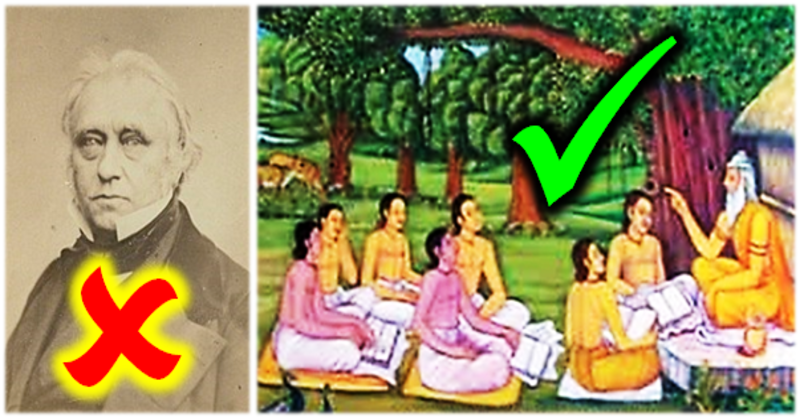
Macaulay was no Indologist. He was not an academician or a notable intellectual. Nonetheless, he caused long-term damage to Bharat’s social and educational structure. He was undoubtedly the most accomplished perpetrator of the self-deprecation mentality that continues to haunt the Hindu community till today. He successfully instilled in Hindu minds a hostility for their own great literary and cultural legacy. By successfully portraying Sanskrit as archaic and praising English, Macaulay not only aimed to replace the former but also sowed seeds of hatred for it. This developed in a type of cultural subservience, with Hindu society blindly accepting Western values. The subsequent depreciation of Sanskrit resulted in a massive loss of cultural and intellectual capital, irreversibly changing Bharat’s societal environment. Macaulay’s ideological imposition triggered a type of linguistic and cultural enslavement in Bharat.
The Gurukul system, which had been the foundation of Bharatiya education for generations, was gradually marginalized. Traditional topics such as Sanskrit, philosophy, Ayurveda and classical arts, which were essential to the Gurukul curriculum, were overlooked. The policy caused a slow deterioration of Bharat’s rich cultural legacy. The Gurukul system not only taught academics but also instilled moral ideals, cultural traditions and spiritual practices. Macaulay’s policy, which emphasized Western principles, eroded these elements, resulting in a loss of cultural identity among the educated elite. Many local educators and intellectuals who were the keepers of traditional knowledge were displaced. Their skills and talents were underestimated, resulting in a decrease in the status and quantity of conventional teachers.
The focus shifted from holistic education to rote learning and examination-oriented studies. The Gurukul system’s emphasis on full student development(for both boys and girls) lost way to a restricted, utilitarian approach to education. A sizable portion of Bharatiya society, particularly its elite, became heavily Westernized. This resulted in a socio-cultural divide between those educated in English and those who continued to practice traditional ways. This divide persists to this day, contributing to socio-economic inequalities. The emphasis on English led to a fall in the usage of indigenous languages in educational and administrative contexts. This led to the gradual extinction of many traditional forms of literature and oral traditions.
Successive generations had an identity crisis, split between Western influences and traditional traditions. As a result, many people lack pride in their origin and favor Western lifestyles and ideals. The school system’s congruence with Western norms led to a reliance on Western knowledge systems and practices. This impeded creativity and the development of local solutions to current concerns. The English-educated elite had greater access to economic possibilities, which exacerbated social and economic inequality. Those who were not fluent in English were at a disadvantage, continuing cycles of poverty and marginalization.
Bharatiyas are completely unaffected by internal, frequently freely accessible resources, such as traditional knowledge, wisdom and natural resources, but they have grown accustomed to external resources, such as western methods, information and markets
The historical universities and proliferation of Gurukul institutions
According to one estimate, ancient Bharat once had more than 50 universities. Takshashila, Nalanda, Vikramshila and Valbhi Universities, Odantapuri, Mithila University, Telhara University, Sharda Peeth Temple University, Pushpagiri University, Somapura University and Bikrampur University are a few of the well-known institutions.
Some well-known Takshashila (Taxila) alumni include grammarian Panini, who wrote the classic book Ashtadhyayi and Acharya Chanakya, who created Arthashastra. “In this first study, he (W. Adams) observed that there were around 1,00,000 village schools in Bengal and Bihar during the 1830s. Thomas Munro, Governor of the Madras Presidency, had noticed before Adam that “every village had a school”. Prendergast observed “that there is hardly a village, great or small, throughout our territories, in which there is not at least one school and in larger villages more”. Dr. G.W. Leitner’s observations in 1882 reveal that education spread in Punjab circa 1850 to a similar level.
Thomas Munro also collected caste data on the pupils who attended these Gurukuls, and the bulk of them were non-Brahmins. In some localities, Brahmins accounted for as little as 8 per cent, while the highest figure was around 37 per cent. Dharampal’s book “The Beautiful Tree” has all of this information. The Gurukul system ensures a child’s overall learning. The primary subjects offered by the Gurukul system are as follows:
- Astronomy
- Darshan (Philosophy)
- Mathematics
- Science
- Dharmasutras (Study of Laws)
- Brahmanas
- Arthashastra (Political Science)
- Ayurveda (Medicine)
- Dhanurvedam (Defense Studies)
- Vedas
- Vedanga
These are only a few of the courses previously taught in Gurukuls. There are many more, including music and pottery. One of the Gurukul system’s primary benefits is the development of skills. The Gurukul system’s flexibility makes it a viable option in today’s fast-changing circumstances.
How Macaulay destroyed the Bharatiya society: The Downward Filtration Method
However, what took place in Bharat? Even the meager sum of one lakh rupees set aside for Bharatiya education infuriated foreign Christian missionaries. A new Bharat was born in 1835, according to G.D. Trevelyan in “Life of Lord Macaulay”(vol. 1, p. 164). The British reduced financial resources and imposed a series of regulations, such as “there has to be a ‘pucca’ building etc”. However, that was not the end. They invited T.B. Macaulay to decide how to divert the money, what should be the medium of instruction and the mode of educating the Bharatiya. Macualay’s educational minutes, which mandated that Bharat acquire instruction through English, the language of the West, accomplished what the western missionaries had failed to do. “Her ancient civilization’s fundamental foundations started to tremble. The building’s pillar after pillar collapsed.
However, Macaulay did something more detrimental that is not widely understood. He used the “downward filtration method” to teach the Bharatiyas. What is this technique? Macaulay’s issue was that there were many Bharatiyas and few British. How were they going to teach the Bharatiyas? How could this country be undermined to the point where it would unconsciously back the British Raj? The tale goes that once when he was in Ooty, in his mansion, he witnessed an Bharatiya officer approaching and touching the feet of a peon sitting outside his office which was close his residence and was obviously shocked. Why was an officer stroking the feet of a peon? “You don’t know, this Bharatiya society is a peculiar one. Here the Brahmins are respected and the peon belongs to that caste”. Following this, Macaulay made adjustments that have been thoroughly recorded and verified in publications. Even though this was developed much later, the advance caste was given advantage in schools under the downward filtration approach. “But it is impossible for us with our limited means to educate all in English”, he said.
Currently, we must make every effort to create a class of people who are English in intellect, morals, preferences and opinions but Indian in blood and color. We simply need to examine the history of the educated classes in Bharat since then to determine the extent to which he was successful in his aim. Even after independence, we still haven’t addressed the Macaulayian dilemma and even worse, few people are aware that it even exists. Even after independence, we still haven’t addressed the Macaulayian dilemma and even worse, few people are aware that it even exists. The government’s partiality for Brahmins & missionary run schools kept on for approximately hundred years. In the meantime other castes performing any trade had lost their business due to the saturation of Bharatiya markets with British goods and also due to the deliberate strangulation of their business by the British.
Because of the British land policy, which was motivated by avarice, the landlords were the brutal stooges of the British and the farmers had become landless laborers in their own territories. Certain castes were denied access to school due to the deliberate dismantling of the Bharatiya educational system. As a result, these castes had become poor and illiterate over the course of a century and the Brahmins, who were meant to be in charge of society, had a warped worldview as a result of receiving western education.
In a letter dated October 12, 1836, Macaulay wrote to his father: “Our English schools are flourishing wonderfully; we find it difficult to provide instruction to all”. The impact of this teaching on Hindus is enormous. No Hindu who has gotten an English education has ever remained firmly committed to his religion. It is my sincere confidence that if our educational plans are fulfilled, there will be no idolaters among the respected classes in 30 years. And this will be accomplished without our proselytizing efforts; I am overjoyed at the possibility.
Thomas Babington Macaulay’s broad dismissal of the rich corpus of Sanskrit literature reveals either utter ignorance or more likely, a purposeful disrespect for its profundity and importance. His claim that all historical material in Sanskrit literature cannot be compared to the most basic English school books ignores the Vedas and Upanishads’ ageless philosophical teachings. His refusal to acknowledge the great teachings of the Bhagavad Gita, a literature that transcends cultural barriers and provides universal lessons on duty, righteousness and the route to freedom, reflects his highly prejudiced viewpoint.
Macaulay’s incapacity to grasp the rich tapestry of life, ethics, politics and governance depicted in epic works such as the Ramayana and Mahabharata demonstrates stunning myopia. His scorn for Kautilya’s Arthashastra, a book that approaches and in some ways outperforms, Machiavelli’s The Prince in terms of incisive insights on statecraft, demonstrates his lack of interest in non-European intellectual achievements. Thomas Babington Macaulay’s misunderstanding of the tolerance and philosophical depth inherent in Hindu society and Dharma demonstrates great ignorance. His opinions are based on a Eurocentric worldview that ignores the essence of Hindu Dharma, which promotes intellectual research and recognizes a wide range of spiritual pathways. He was unable to understand the inherent flexibility and accommodating attitude of Hindu beliefs and practices because he had been raised in Europe’s dogmatic religious traditions.
Macaulay’s Minute on Indian Education dismisses the essential precepts of Sanatan Dharma, namely ahimsa (nonviolence), tolerance and spiritual pluralism. His claim to European intellectual dominance ignores Hindu philosophy’s great tolerance, which does not impose a single, ultimate truth but rather offers a variety of spiritual paths, encouraging personal investigation and acceptance of other faiths. His inability to recognize this inclusion and adaptation-ideals that many modern cultures aim for, demonstrates his lack of comprehension of Hindu Dharma’s depth and sophistication.
Macaulay’s Minute is a notable example of colonial condescension, complete with ethnocentric biases and a Eurocentric superiority complex. His brazen attempt to delegitimize and undervalue the rich, millennia-old traditions of Sanskrit literature in favor of European knowledge systems reveals a fundamental contempt for non-European cultures. Macaulay’s contemptuous dismissal of the great body of Eastern literature is obvious when he claims that “a single shelf of a good European library was worth the whole native literature of Bharat and Arabia”. His claim that the highest forms of Eastern literature, particularly poetry, couldn’t compete with the masterpieces of European nations is not only a gross misunderstanding, but also a reflection of his anti-Hindu attitude and Western elitism.
Furthermore, his conviction in the inferiority of Bharat’s indigenous languages and the intellectual superiority of English demonstrates a complete contempt for linguistic diversity and cultural sovereignty. It also demonstrates his arrogance about the British Empire’s “civilizing mission”, which is based on colonial chauvinism.