
Magnets drive so much of the modern world, but all the while most of us don’t think about their scientific applications. The crucial applications is for electric vehicles, smartphones, renewable-energy systems and defense technologies. The underlying physics of magnetism was understood mainly through electron spin, an intrinsic property responsible for the alignment that creates a magnetic field. Indian scientists have opened an entirely new chapter in this field.
The researchers at the Jawaharlal Nehru Centre for Advanced Scientific Research, Bengaluru, have find a form of magnetism driven not by spin but by the orbital motion of electrons. This finding was demonstrated in thin films of neodymium nitride (NdN) and published in American Chemical Society (ACS) Nano, by representing a significant advancement in magnetic materials research and paves the way for a new area known as orbitronics. It is a development with far-reaching implications for quantum devices, energy efficient electronics and high-performance memory technologies.
New Form of Magnetism: Why It Matters
In traditional magnets, the electrons align their spins in a common direction and, in doing so, create a stable magnetic field. This explains why permanent magnets-from fridge magnets to turbine motors-can retain their strength.
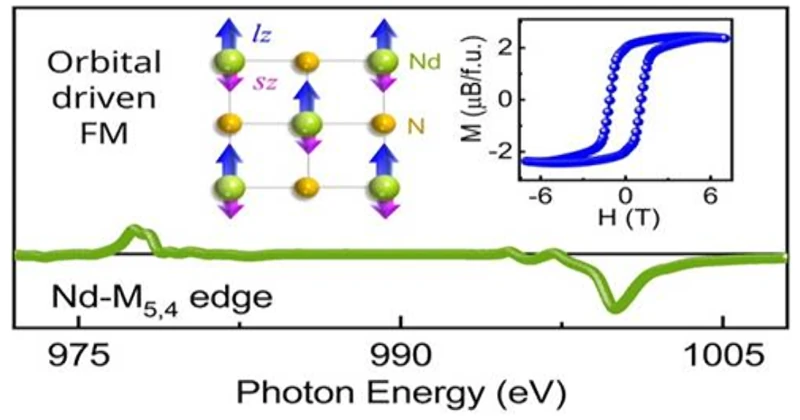
The team from JNCASR, headed by Prof. Bivas Saha has now demonstrated a way in which NdN magnetism can arise largely due to the orbital angular momentum of electrons, the path traced by electrons as they orbit the nucleus. This is a mechanism normally weak or suppressed in most materials, but NdN features a strong and stable orbital-driven magnetic moment.
The experimenters conducted magnetic and spectroscopic measurements on the single-crystalline thin films grown with care including XMCD. These measurements show unambiguously that the orbital contributions dominate the magnetic behavior of NdN. The well-defined ferromagnetic hysteresis loop proves that this magnetism is stable without an external magnetic field.
There are interesting academic findings, such discovery challenges conventional wisdom about magnetic materials and shows that both spin and orbital properties can be utilized deliberately, with multiple implications for new design principles towards next-generation technologies.
From Spintronics to Orbitronics
Spintronics has opened new frontiers for electronics over the last twenty-plus years by using electron spin to store and process information. It has enabled faster memory access, greater energy efficiency and more stability of the data stores. The scaling in all spin-based technologies becomes increasingly difficult as devices shrink. Orbitronics takes this concept forward by utilizing the orbital angular momentum.
- Information could be stored with higher density.
- Devices could operate with much lower power
- Magnetic states may become more stable and tunable
- Quantum devices could achieve higher coherence and precision
This finding points to the new frontier where the orbitally active materials might complement or even outperform spin-based approaches in some applications.
How Indian Scientists Unlocked Orbital Magnetism
This breakthrough happens with precision, advanced instrumentation and interdisciplinary collaboration. The necessary thin-film deposition methods used had to guarantee high structural order-a very critical factor, since orbital magnetism is extremely sensitive to the Crystal symmetry and electronic hybridisation.
These absorption edges, Nd-M5,4 were observed to discern the spin and orbital contributions. The dominant orbital component observed in such measurements is very rare in solid-state materials. Magnetic anisotropy in which the direction of magnetic properties depends on its measurement was also investigated for NdN. This is important for material engineering for a device in order to orient magnetic states in a controlled way.
It involved contributions from IISER Thiruvananthapuram, the Raja Ramanna Centre for Advanced Technology at Indore and international facilities such as DESY in Germany and ALBA in Spain. This blend of domestic expertise and global infrastructure reflects the high level of sophistication required for frontier materials research.
Rare-earth elements and India’s strategic position
Rare-earth materials are indispensable to clean-energy systems, high-performance electronics and defence manufacturing. Neodymium, which forms the base of NdN, is one of the most important rare-earth elements used in the making of high-strength permanent magnets for EV motors, Wind turbine generators, Precision-guided defense platforms, High-fidelity audio systems, Laptop and smartphone components
The strategic value of research on rare earths has increased significantly with global competition, especially on supply chains dominated by a few countries.
India has about 8% of the world’s rare-earth reserves, thus becoming one of the few countries that can build strong domestic ecosystems in this area. The new find bolsters India’s standing by adding not only to resource availability but also to state-of-the-art scientific innovation regarding rare earth technologies.
Applications in Quantum and Emerging Technologies
The implications of orbital magnetism go far beyond conventional electronics as nations race to develop quantum infrastructures, emergent materials with controllable orbital properties may become key building blocks.
Applications may be utilized in Quantum information systems, where orbital states can improve coherence. Low-power memory technologies outperforming current spin-based devices. Advanced sensors may greatly take advantage of stable and tunable magnetic responses of hybrid quantum materials, combining spin and orbital degrees of freedom.
The finding lays the grounds for the design of rare-earth compounds with tailored magnetic and electronic properties. It forms a perfect illustration of how deep scientific insights can fuel long-term innovation across sectors central to national competitiveness.
Milestone in India’s Scientific Journey
This achievement supports India’s growing contribution to advanced material science. Institutions such as the JNCASR, funded by the Department of Science and Technology has steadily expanded their capabilities in condensed matter research, thin-film physics and quantum materials. The discovery illustrates the effect of sustained investment in basic science, an area in which progress often emerges after years of careful experimentation.
It also underlines the importance of global scientific cooperation when international facilities supplement national research capabilities. All these can place India at the leading edge of new technological revolutions.
Orbital-driven magnetism in NdN constitutes both a scientific and a strategic milestone. It has opened another dimension of magnetism, showcased the excellence in Indian research and laid grounds for potential technologies of the future that shall require speed, efficiency and quantum-level precision.
World is in need of cleaner energy, robust digital infrastructure and advanced defence capabilities where these breakthroughs are critical. They not only deepen scientific understanding but also strengthen national capabilities in fields that define the future. India entry into the field of orbitronics era reflects its growing confidence and ambition a clear sign that country is ready to shape the next generation of technological innovation.