





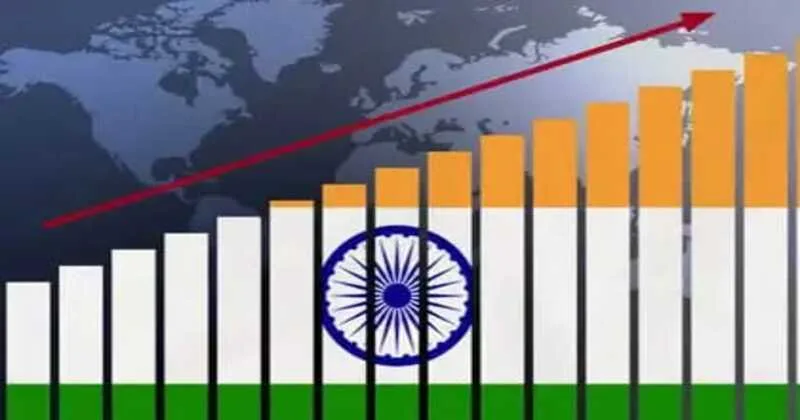
India’s GDP growth appears to have remained resilient despite US President Donald Trump’s imposition of a steep 50 per cent import duty on several Indian products. Multiple financial and research agencies have indicated that the tariff shock has not significantly dented India’s broader economic momentum. The country’s official GDP growth figures for the July–September quarter will be released tomorrow, and expectations are high that India will retain its position as the world’s fastest-growing major economy.
According to various forecasts, India’s economic expansion remains robust. SBI Research anticipates growth of 7.5 per cent for the September quarter. Reuters has estimated 7.3 per cent, while India Ratings (Ind-Ra) expects 7.2 per cent and ICRA projects 7 per cent. Most of these assessments surpass the Reserve Bank of India’s own estimate of 7 per cent for the same period. In the first quarter of the financial year, from April to June, growth stood at 7.8 per cent, India’s strongest in the previous five quarters. That performance exceeded projections made by both the Reserve Bank and the central government.
India–US trade breakthrough set to revive exports and lift investor confidence
Trump’s 50 per cent tariff, described by some analysts as a “thunderbolt,” has been applicable to Indian exports since August. Yet India’s growth trajectory has remained largely unaffected, thanks to the exceptional strength of its domestic market. While the export sector experienced temporary stress, the internal economy continued to power ahead. The timely rationalisation of Goods and Services Tax rates helped spur consumer demand across a range of sectors. Household consumption improved noticeably, supported by higher agricultural production, which further strengthened the economic outlook. Government capital expenditure also played a crucial role in sustaining momentum.
The sentiment surrounding the Indian economy has been further buoyed by indications that trade negotiations between India and the United States are nearing completion. There is strong optimism that President Trump may reduce the tariff burden from 50 per cent to a more manageable 10–17 per cent. Such a move would provide a substantial boost in the coming quarters. A reduction in duties is expected to revive the export sector and help India regain competitiveness against countries such as China, Bangladesh, Vietnam, the Philippines and Cambodia. Reports suggest that the trade agreement may be announced before the end of 2025. Beyond the United States, India is also making progress toward free trade agreements with the European Union, New Zealand and other partners. These developments, taken together, have significantly lifted investor confidence and strengthened expectations of sustained economic expansion.
The Indian stock markets, which appeared somewhat subdued yesterday due to weak global cues, showed a renewed sense of optimism today. Expectations of gains from the US and other major Asian markets have provided a favourable backdrop. Early in the morning, the GIFT Nifty climbed by around 110 points, signalling the likelihood of continued upward movement in the Sensex and Nifty. Foreign institutional investors, who have been net sellers in Indian markets for several months, exhibited renewed interest by purchasing Indian stocks worth Rs 785 crore yesterday. A potential reduction in US interest rates is expected to encourage even more inflows from FIIs in the coming weeks, which will also support the strength of the Indian rupee.
Possible shake-up at the US Federal Reserve signals major policy shift
In the United States, expectations of a Federal Reserve rate cut in December surged dramatically overnight, from 40 per cent to 80 per cent. This sharp shift in sentiment invigorated American equities. The Dow Jones Industrial Average jumped 665 points, or 1.43 per cent. The S&P 500 rose by 0.91 per cent, and the Nasdaq gained 0.67 per cent. The ongoing enthusiasm surrounding the artificial intelligence boom also contributed to the upward trend in stock prices. Meanwhile, consumer sentiment in the US continued to weaken in November, increasing the probability of an interest rate cut. The consumer confidence index fell to 88.7, its second-lowest reading since April, compared to 95.5 in October.
There is also significant speculation in Washington about potential leadership changes at the Federal Reserve. Reports indicate that White House National Economic Council Director Kevin Hassett could replace current Fed Chair Jerome Powell, who has publicly disagreed with President Trump on interest rate policies for several months. US Treasury Secretary Scott Bessant confirmed that Trump will announce a decision before Christmas. Powell’s term ends in May, and his reluctance to cut rates earlier, despite repeated requests from Trump, has been a point of contention. Hassett, who advocates lower interest rates, is widely believed to be aligned with Trump’s economic vision. His possible appointment is expected to have major implications for the US economy and financial markets. Asian and European markets also benefited from the prospect of a US rate cut and diminishing concerns about AI-related market volatility. Japan’s Nikkei rose 1.93 per cent, Hong Kong advanced 0.37 per cent, South Korea’s KOSPI climbed 0.67 per cent, and Australia’s ASX 200 improved by 1.2 per cent. In Europe, the FTSE rose 0.78 per cent while Germany’s DAX added 0.97 per cent. These positive trends are likely to influence investor behaviour in India as well.
Dollar weakens, gold surges, oil steadies
The US dollar weakened significantly due to expectations of lower interest rates. The dollar index, which measures the greenback’s performance against six major currencies including the euro, yen and pound, fell from above 100 to 99. The yield on the 10-year US Treasury dropped from 4.13 per cent to 4.01 per cent. When the Federal Reserve lowers rates, American Treasury securities and bank deposits become less attractive, prompting investors to seek alternative assets. The reduction in demand for dollar-denominated instruments generally weakens the dollar and supports investment flows into commodities such as gold. Favourable global conditions have already pushed up international gold prices, which rose by 68 dollars per ounce to reach 4,162 dollars this morning. This upward trend suggests that domestic gold prices in India are likely to increase today.
In geopolitics, reports suggest that Ukraine has agreed to a US-led peace plan aimed at bringing an end to the ongoing war. Trump stated that he will meet Russian President Vladimir Putin and Ukrainian President Volodymyr Zelensky once both countries formally accept the plan. Global crude oil prices initially fell on speculation that the deal could be realised soon, but have since stabilised. WTI crude rose 0.26 per cent this morning to 58.10 dollars per barrel, while Brent crude edged up 0.24 per cent to 62.63 dollars. Overall, the combination of strong domestic fundamentals, favourable global market conditions and promising diplomatic developments has set an encouraging tone for the Indian economy. With the possibility of tariff relief from the US and a pipeline of major trade agreements, India appears well-positioned to consolidate its status as one of the world’s most dynamic and resilient economies.















Comments