




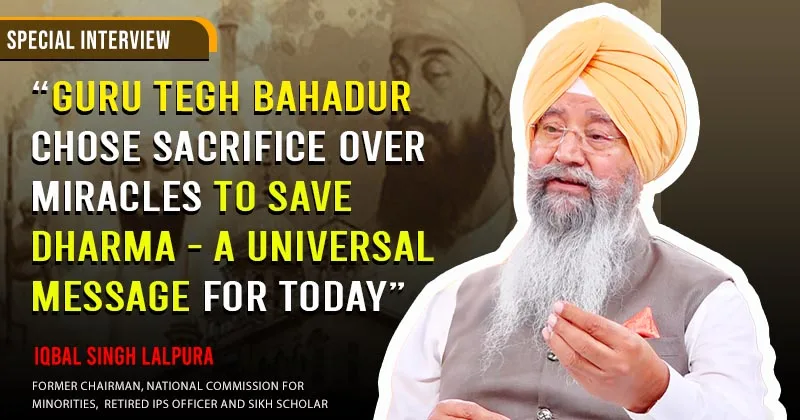
Guru Tegh Bahadur’s 350th martyrdom year offers a profound moment to reflect on his sacrifice for dharma and freedom of conscience. Organiser Weekly’s Editor Prafulla Ketkar speaks with Iqbal Singh Lalpura, Former Chairman, National Commission for Minorities, retired IPS officer and Sikh scholar, on its relevance today, Punjab’s challenges, and reclaiming the state’s true spiritual spirit.
The entire nation is preparing to mark the historic occasion of the 350th year of Guru Tegh Bahadur Ji’s martyrdom. How do you see this event in the context of its universal message in protecting dharma, freedom of conscience, our religious practices, and human rights?
To truly understand the significance of Guru Tegh Bahadur Ji’s martyrdom, we must go back to the year 1675. At that time, there was no constitution anywhere in the world, no written guarantee of religious freedom, no codified human rights. The principle that prevailed was very simple: Might is Right. People were being converted by force.
For the common people, there were only two options: either convert to Islam or be prepared to die. For the Gurus, there was technically a third option: to perform miracles and escape persecution. But the Sikh religion prohibits the display of miracles to prove spiritual authority.
Guru Tegh Bahadur Ji’s grandfather, Guru Arjan Dev Ji, had already accepted martyrdom for the principles of living with honour and protecting the dignity and honour of others. In Guru Tegh Bahadur Ji’s time, Aurangzeb had deputed Iftikhar Khan, the Governor of Kashmir, to convert Kashmiri Pandits to Islam. In 1675, led by Bhai Kirpa Ram and others, the Kashmiri Pandits approached Guru Ji seeking his help.
The Guru listened to them and nonchalantly said that someone would have to sacrifice their life if dharma was to be protected. He told them to go back and inform Aurangzeb that if Guru Tegh Bahadur was converted to Islam, all the Hindus of Bharat would accept Islam. He is the first person in world history who sacrificed his life purely to protect religion and freedom of conscience.
How did Guru Tegh Bahadur Ji’s teachings travel across Bharat?
As Bhagwan Krishna says in the Bhagavad Gita, whenever dharma declines and adharma rises, God Himself incarnates (Chapter 4, verses 6 and 7). Guru Nanak brought that divine message into this world. He taught that if one loses honour, it is better to die than to live in dishonour. This is the central message of Guru Nanak. All nine Gurus who followed him carried this forward. He also said that you must step into the field of sacrifice for a righteous cause.
“The Sikh religion we see today is not the one created by Guru Nanak and Guru Gobind Singh – caste divisions have weakened the Panth from within”
This is a religion of love. A Sikh must be a model of love, but at the same time, must be brave enough to offer his head for dharma. Guru Arjan Dev Ji wrote about the acceptance of death in the path of faith, and then he attained martyrdom in Lahore. Like his grandfather, when Guru Tegh Bahadur Ji’s turn came, he wrote in his bani that we neither threaten anyone nor allow ourselves to be threatened. When there is a threat, we are there to help. So, when dharma was under attack, he lived by his own words and offered his life.
When Guru Tegh Bahadur Ji was arrested in Delhi, his martyrdom also conveyed a deep spiritual message which continued up to the sacrifices of the Char Sahibzaade. How do you see this spiritual continuity in Sikhi?
For us, Guru Nanak is God Himself, and the following nine Gurus are His manifestations. Guru Gobind Singh Ji himself explains why God sent him to this world. He says that he was happy in God’s presence, but God summoned him and said He was sending him as His son.
For such a divine lineage, performing miracles was an easy thing. Let me give two examples. At the Golden Temple complex, you have Gurdwara Baba Atal. Baba Atal Rai was a boy of about five. His friend died, and when he went to the boy’s home, he saw the family crying. He asked them to wake the boy up so they could play. When they said the boy was dead, he insisted he was just sleeping and touched him, and the boy stood up alive. When this was reported to Guru Hargobind Sahib, he said, “There cannot be two Gods,” and ordered that Baba Atal must now leave this world. Baba Atal obeyed and passed away then and there.
“Guru Tegh Bahadur Ji is the first person in world history who sacrificed his life purely to protect religion and freedom of conscience”
Similarly, his elder brother Baba Gurditta Ji once revived a dead cow. The family said that was their only source of income. He touched the cow, and it stood up alive. Guru Hargobind Ji again said, “You cannot act as God,” and Baba Gurditta too had to depart.
So for Guru Tegh Bahadur Ji, performing miracles would not have been difficult, but he did not choose that path. His message was clear: We are here to protect dharma, even if that means dying for a genuine cause. His bani teaches us how to come close to God, how to become a part of the Divine, and it reminds us that this world is temporary and we must act with that awareness.
On the one hand, we see growing intolerance and terror in the name of religion; on the other hand, in Punjab, especially among youth, there is a drift away from the original teachings of Gurbani. How do you see the relevance of Guru Ji’s divine message today?
It is said that Bertrand Russell once remarked that the next world war would be an atomic war, but the only scripture that could guide humanity afterwards would be the Guru Granth Sahib. Someone asked him, “If it can guide people so well, why can’t it prevent the war?” He replied, “Because the Sikhs have not taken this bani to the world.”
Guru Granth Sahib gives a very clear definition of religion: remember God, recite the Divine Name, and do good deeds. Fifty per cent of religion, it says, is good action. Whichever name of God you want to use, Ram, Krishna and so on, you can find in Guru Granth Sahib. If you want even more, you can read Jaap Sahib, where you will find hundreds and hundreds of names of God.
In recent years, Punjab has seen a different kind of challenge: not always forced conversion, but conversion through allurements to induce vulnerable and poor people to change their faith. How do you see this trend in a sacred land like Punjab, and what solutions do you propose?
This problem is not new. From the very beginning, when the British took over Punjab, they targeted the highest authority first. Maharaja Duleep Singh, the last Sikh ruler of Punjab, was converted to Christianity and taken to England, far from his homeland.
Another royal family that fought against the British, the Ahluwalias, faced the same pressure. Sardar Harnam Singh Ahluwalia was also converted to Christianity. Many people may not know that Rajkumari Amrit Kaur, Bharat’s first Health Minister, was a Christian and the daughter of Harnam Singh Ahluwalia.
So, this effort began around 1849 itself. Many people were converted then, and a similar pattern continues now. People are misled. I have full respect for all religions, including Christianity, but I ask only one simple question when preachers come to me: “If you can cure my diabetes, I will be the first person tojoin you.”
“Poverty is being used as a weapon to mislead vulnerable people into conversion, and this is morally wrong and against the law”
What is happening today is that poverty is being used as a weapon, offering education, health, and material benefits in exchange for religious conversion. This should not happen. It is morally wrong and against the law. The government should take strict action against such misuse.
At the same time, our own institutions, gurdwaras and educational bodies, must also introspect and take more responsibility. And for that, we must understand that the Sikh religion we see in practice today is not the same as the one created by Guru Nanak and Guru Gobind Singh. Sikh Dharma was firmly against casteism. Sri Guru Granth Sahib begins with Ik Onkar. When the Khalsa was created, Sikhs were given three simple identity markers:
- Their spiritual father: Guru Gobind Singh, hence “Singh”.
- Their spiritual mother: Mata Sahib Kaur, hence “Kaur” for women.
- Their spiritual home: Anandpur Sahib.
If I am the son of Guru Gobind Singh, what is my caste? My caste is that of my father, and he belongs to all. This is a casteless society in principle.
But over time, casteism crept in through vested interests. Until around 1960–62, Sikh leaders like Master Tara Singh, Baba Kharak Singh, and others came from varied backgrounds but identified themselves as sons of Guru Gobind Singh, not as members of separate castes.
In 1956, Sikhs formally accepted caste divisions in certain institutional contexts. This has created gaps between various groups, separate gurdwaras, and separate langars. This is a serious internal weakness that needs to be bridged.















Comments