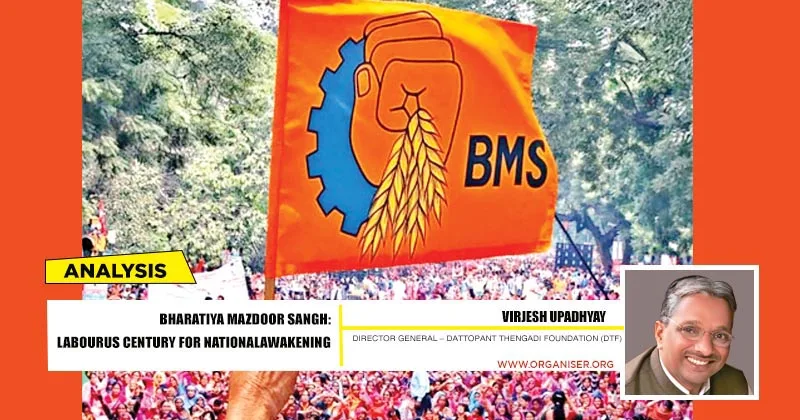
As the Rashtriya Swayamsevak Sangh (RSS) celebrates its centenary year in 2025, Bharat stands at a moment of deep reflection on a hundred years of transformative evolution. The Sangh’s journey has been one of quiet strength and profound influence, extending far beyond the realm of politics. Its mission has always been rooted in a larger vision of national regeneration, one anchored in cultural awakening, social service, and institutional nation-building that touches nearly every sphere of public life. Among the many institutions inspired by its ideals, the Bharatiya Mazdoor Sangh (BMS), founded by Dattopant Thengadi Ji in 1955, stands out as a pioneering example of how the dignity of Labour can be interwoven with the destiny of the nation.
Defining Moment for Labour Movement
The establishment of BMS marked a defining moment in the evolution of Bharat’s Labour movement. At a time when trade unions worldwide were modelled on class struggle and ideological confrontation, the BMS introduced a new idiom: “a Bharatiya way of organising workers that combined cultural rootedness with national purpose”. Shri Guruji Golwalkar, the second Sarsanghchalak of RSS, recognised that the millions who constitute Bharat’s Labour force, farmers, artisans, industrial workers, and service providers form the very backbone of the nation. He envisioned a labour movement that transcended ideological borrowings from the West and drew inspiration from Bharat’s civilisational ethos. Entrusted with this vision, Shri Dattopant Thengadi humbly admitted his lack of experience in the Labour organisation. Guruji’s simple yet profound guidance, “Go, learn, and do it”- became the foundation for a movement that would grow into the largest trade union in Bharat and one of the most distinctive in the world.
The spirit of BMS found expression in its powerful yet harmonious slogans – “Desh ke hit mein karenge kaam, kaam ke lenge poore daam,” “Rashtra pratham, shramik samman,” and “Kaam hamara, desh ke liye.” These were not calls to conflict but affirmations of dignity, duty, and national solidarity. They encapsulated the essence of a movement that placed the nation first while asserting the rights and honour of every worker. From this philosophy emerged the three guiding principles of BMS: “to industrialise the nation, to nationalise Labour, and to labourise industry”. Together, these ideas shaped a unique framework that balanced productivity with patriotism and human values.
Unlike conventional unions that often centered their struggles around wages or strikes, BMS sought to redefine the very nature of industrial relations. Its approach was based on cooperation, not confrontation; on shared responsibility, not rivalry. It championed the ideal of the “industrial family,” where employers and employees are partners in progress rather than adversaries in a perpetual battle. Even its stance on strikes reflected restraint and maturity, viewing them not as weapons of first resort but as a last resort when dialogue failed. This balance won BMS respect from workers, employers, and policymakers alike.
Throughout Bharat’s post-Independence journey, the BMS has remained steadfast in upholding democratic values and the dignity of Labour. During the Emergency, when civil liberties were curtailed, the organisation stood firm in defence of workers’ rights and freedom of association. It played a crucial role in drawing attention to the plight of unorganised workers, paving the way for landmark legislation such as the Unorganised Workers’ Social Security Act of 2008. It fought tirelessly for pension reforms, ensuring that retirement benefits were recognised as rights rather than acts of charity. In the era of economic liberalisation during the 1990s, the BMS supported modernisation and efficiency but opposed reckless privatisation and the unchecked growth of contract labour. In recent decades, it has constructively engaged with Labour reforms, advocating simplification without compromising workers’ protection. Even on international platforms such as the International Labour Organisation, BMS has presented a Bharatiya perspective on Labour, one that upholds dignity, cooperation, and moral responsibility as the pillars of a civilised economy.
The Distinctiveness of BMS
What truly sets BMS apart is its grounding in Bharat’s civilisational philosophy. Since ancient times, Bharatiya thought has regarded work not merely as a means of livelihood but as yajna; a sacred duty performed for the welfare of society. The artisans, farmers, and craftsmen of the “Rig Vedic” age were honoured not only for their skill but for their role in maintaining social harmony. The ancient guilds, or shrenis, embodied the fusion of economic activity with ethics and accountability. Reviving this spirit, BMS presented a Labour philosophy distinct from the class-war models of the West. It reminded the worker that in Bharat, the purpose of labour is not just self-sustenance but service to the nation and the larger community.
It is this deep-rooted synthesis of tradition and adaptability that enables BMS to remain relevant through changing times, standing firm in its values while evolving with the demands of modernity. BMS continues to be progressive and resilient in its approach and philosophy, consistently navigating every challenge that arises during periods of transition in the world of work. As the global labour landscape undergoes rapid transformation in the age of artificial intelligence, automation, and globalisation, the challenges before the workforce are immense. New jobs will emerge even as old ones disappear; gig and platform economies will redefine security and stability; climate change will reshape livelihoods, particularly in agriculture and coastal regions. In navigating these transitions, the principles of BMS remain as relevant as ever: to industrialise India with sustainability, to nationalise Labour by instilling pride and skills in the youth, and to labourise industry by making growth humane and inclusive.
The centenary of the RSS is thus not merely an occasion to commemorate a century of endurance but a celebration of vision. By inspiring institutions such as the BMS, the Sangh demonstrated that the Labour movement in Bharat can be both culturally rooted and globally aware, constructive rather than confrontational, and moral as much as material. It taught the nation that every worker is not just a wage earner but a nation-builder, and that every enterprise is not merely a source of profit but a family bound by shared duty. In the philosophy of the RSS and the work of the BMS, Bharat has been gifted not only a model of social organisation but a timeless ideal; the dignity of Labour as the foundation of national strength. As RSS steps into its next century, this legacy will continue to guide Bharat’s journey toward self-reliance, social harmony, and the ideal of Vasudhaiva Kutumbakam—the world as one family.