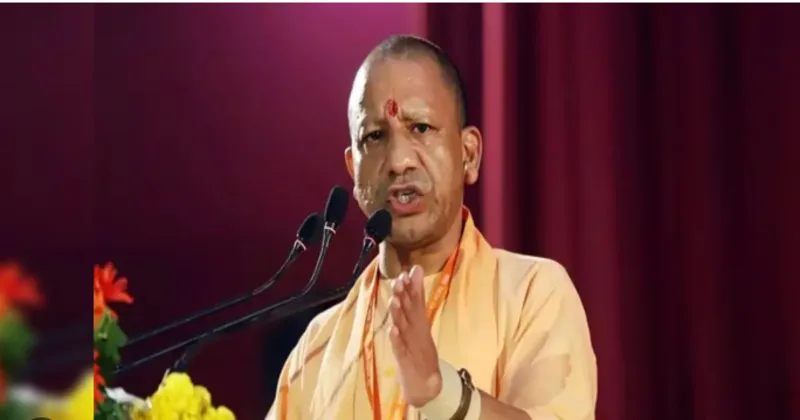
LUCKNOW: In a strong statement highlighting his government’s success in maintaining law and order, Uttar Pradesh Chief Minister Yogi Adityanath said that the “New Uttar Pradesh has no place for crime”. While inaugurating the upgraded Regional Forensic Science Laboratory (RFSL) in Gorakhpur, he asserted that anyone committing a crime in Uttar Pradesh is caught and punished within hours. His words reflected his aim to transform Uttar Pradesh’s old image of lawlessness into one of safety, order, and modern governance.
Once described as one of the most crime-ridden states in India, Uttar Pradesh has undergone a visible transformation in the last eight years. Yogi Adityanath credited this change to the government’s zero-tolerance policy towards crime and corruption, a proactive police force equipped with modern technology, and a governance model that prioritises accountability at every level.
“Earlier, there was a time when criminals roamed freely while victims waited endlessly for justice. But today, those days are gone. The message is clear, there is no place for criminals in the new Uttar Pradesh,” he said.
CM Yogi added that incidents of organised crime, land mafia operations, and public loot have drastically reduced. “Our police and special task forces have not only controlled crime but also dismantled criminal networks that once operated with political protection,” he remarked.
The newly inaugurated six-storey forensic laboratory in Gorakhpur, built at a cost of Rs 72.78 crore, is part of a wider effort to infuse scientific precision into the justice process. Equipped with cutting-edge technology, it will handle investigations in ballistics, DNA profiling, cyber forensics, narcotics analysis, toxicology, and digital evidence verification.
CM Yogi called the facility “a symbol of technological self-reliance in criminal investigation,” and said it would ensure “speedy, error-free, and transparent justice delivery.”
Before 2017, Uttar Pradesh had only four forensic labs, often leading to long delays in investigations. Today, the number has tripled to 12, with six more under construction. To ensure no crime goes unexamined, each district now has two mobile forensic vans for rapid evidence collection. “Scientific evidence is now central to every investigation. With the new criminal laws making forensic examination mandatory for serious crimes, our state is ready to lead by example,” Adityanath said.
Revisiting a decades-old demand, Yogi ji said that the Commissionerate system, first proposed in 1970 finally became a reality under his leadership in 2020. “This system ensures faster response, better coordination, and greater accountability in urban policing. Today, it is operational in seven key districts, and we plan to extend it further,” he said.
Adityanath added that the state’s Smart Policing Model integrates command centres, surveillance systems, and AI-based monitoring tools to ensure quick intervention. “Technology is our biggest weapon against lawlessness. From predictive policing to crime mapping, Uttar Pradesh police are now equipped to anticipate and prevent crimes, not just respond to them,” he noted.
The Chief Minister also linked improved law and order with growing women’s empowerment in the state. “Before 2017, insecurity had kept women away from the workforce. Now, more than 35% of our workforce comprises women. They are working confidently, whether in offices, markets, or public spaces,” he said.
Three women’s battalions, named after Veerangna Jhalkari Bai, Veerangna Uda Devi, and Veerangna Avanti Bai Lodhi, have been deployed in Gorakhpur, Lucknow, and Budaun, respectively, alongside newly established PAC battalions in Balrampur, Jalaun, Mirzapur, Shamli, and Bijnor. These initiatives reflect the state’s shift toward gender-sensitive policing and inclusive security frameworks.
Adityanath also highlighted the establishment of the Uttar Pradesh State Institute of Forensic Science (UPSIFS) in Lucknow as a crucial step in creating a skilled workforce for modern investigation systems. The institute offers specialized courses in forensic chemistry, cyber forensics, evidence collection, and field investigation, designed to create employment opportunities for youth in both public and private sectors.
“Our goal is not just to punish criminals but also to build a generation of scientific investigators who can prevent crime through evidence and expertise,” he said.
From Fear to Faith: The Changing Narrative of Uttar Pradesh
CM Yogi’s speech painted a broader picture of transformation, one where the state is not merely fighting crime, but rebuilding public confidence in justice. The expansion of Integrated Command and Control Centres in cities like Noida and Greater Noida, with real-time monitoring through 13 lakh CCTV cameras, has significantly enhanced surveillance and emergency response.
Modern police lines are being constructed in 10 districts, while new training academies are being planned to keep personnel updated with evolving technology and investigative techniques.