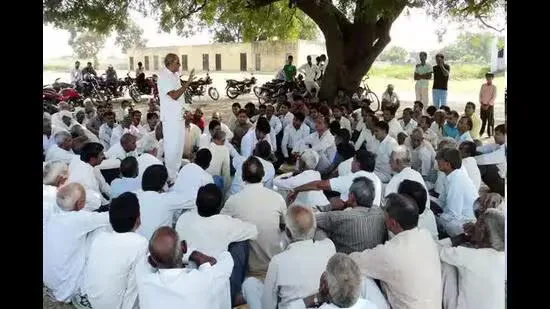
The Punjab and Haryana High Court has brought fresh scrutiny to the legal status of Panchayati divorces while hearing the petition of a dismissed Punjab Police constable who argued that he had entered his second marriage only after his first union was dissolved by a village council. Justice Jagmohan Bansal, while examining whether the dismissal from service was justified, asked the State of Punjab to clearly assess if Panchayati settlements hold any validity under the Hindu Marriage Act, 1955, and whether the petitioner’s claim of customary divorce could alter the disciplinary outcome.
The case has sparked wide interest because it touches upon a question repeatedly raised in rural disputes: whether marriages dissolved by community elders carry any legal weight in the absence of a court decree.
The petitioner joined the Punjab Police in March 1992 and married for the first time in 1996. His relationship with his first wife deteriorated over time due to matrimonial discord, eventually leading to their separation. However, instead of approaching a civil court for divorce, the couple relied on a Panchayati settlement which, according to the petitioner, amounted to a customary divorce recognised in his community. He asserted that he even paid permanent alimony of one lakh rupees to his first wife as part of the settlement. Believing himself to be legally free, he entered his second marriage in June 2000. Trouble surfaced when the second wife approached the Senior Superintendent of Police in Amritsar accusing him of deception and alleging that he had contracted a second marriage while the first one was still legally subsisting. This prompted the registration of an FIR and the initiation of criminal proceedings.
The criminal allegations were grave and included accusations of rape and cheating. The trial court eventually acquitted the petitioner and his family members after the complainant settled the matter through a compromise. Despite the acquittal, the department initiated disciplinary action and dismissed him from service under the Punjab Police Rules and the Government Employees Conduct Rules of 1966. The authorities labelled the act of contracting a second marriage without securing a judicial divorce as the gravest misconduct, warranting the strictest administrative penalty.
Before the High Court, counsel for the petitioner argued that his client acted in good faith because the Panchayati divorce was a recognised practice in his community and should be considered valid under Section 29(2) of the Hindu Marriage Act, which preserves certain customary practices. He said the dismissal order was flawed because the authorities failed to examine whether the customary divorce, backed by the Panchayat’s endorsement, satisfied the legal requirements recognised by the Supreme Court. He insisted that disciplinary authorities dismissed the petitioner without fully appreciating the cultural and customary context in which his first marriage was dissolved.
The State counsel took a contrary position. He stated that although the petitioner produced a document purporting to show a Panchayati divorce, he did not provide adequate proof that such divorces were recognised customs within his community. Without this evidence, the authorities had no reason to treat the Panchayati settlement as a valid dissolution of marriage. The State defended the decision to dismiss the constable, arguing that the absence of a civil court decree meant his first marriage remained legally intact and his second marriage, therefore, amounted to bigamy.
Justice Bansal observed that the matter merited a deeper inquiry because the petitioner appeared to have contracted his second marriage under the genuine belief that his first marriage had already been dissolved. He noted that neither the disciplinary authority nor the appellate authority examined whether Panchayati divorces were valid in the petitioner’s community, nor did they consider relevant judicial precedents interpreting Section 29(2). The judge held that, given the significance of the consequences, the matter should be reconsidered in the proper legal light.
The court directed the petitioner to provide evidence establishing that the Panchayati divorce was recognised as a customary practice within his community and that such custom met the legal requirements set out under Section 29(2). Justice Bansal emphasised that the exercise must be completed within six months and clarified that the petitioner would not be entitled to reinstatement on the basis of the court’s order. The final decision on his service status would depend entirely on the outcome of the reconsideration by the disciplinary authority. The court also underscored that its observations should not be taken as a final opinion on the merits and that the authority should arrive at an independent conclusion.
Under the Hindu Marriage Act, only civil and family courts have the power to dissolve marriages. Village councils do not enjoy statutory authority to grant divorces. The Supreme Court in cases such as Shivani Kabra in 2010 and Sanjana Kumari versus Vijay Kumar in 2023 clarified that customary divorces are valid only when the custom is ancient, continuous, certain and not opposed to public policy. They also noted that parties claiming customary divorce must prove the existence of such custom with documentary or oral evidence. Advocates caution that parties relying solely on Panchayati decrees risk exposing themselves to criminal charges under laws penalising bigamy if they remarry without formal judicial dissolution.
Several High Court rulings in recent years have echoed similar concerns. For instance, in the 2021 judgment in Gurpreet Kaur versus State of Haryana, the court held that remarrying on the basis of a village council decree amounted to an offence under Section 494 of the Indian Penal Code, now part of the Bharatiya Nyaya Sanhita, because the first marriage continued to be valid in the eyes of law. These rulings underline that village councils can mediate disputes under statutes such as the Gram Panchayat Act and the Panchayati Raj Acts but cannot assume judicial powers to dissolve marriages.
Advocates also note that certain Scheduled Tribe communities are exceptions under the Hindu Marriage Act, where customary divorces are recognised, but even in those cases the burden of proof lies on the party asserting the custom.
The case of the dismissed Punjab Police constable has reopened a conversation that sits at the crossroads of tradition, law, and administrative discipline. As the disciplinary authority reconsiders the case, the outcome is expected to have implications for countless couples in rural India who continue to rely on Panchayat mediated divorces, often unaware that such dissolutions may not stand the test of law.