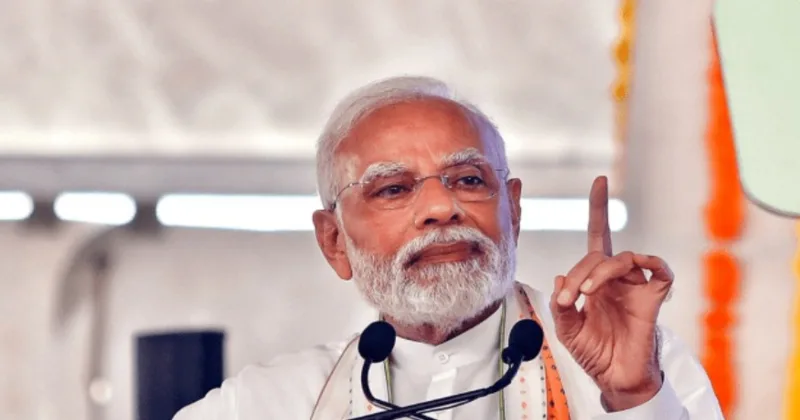
New Delhi: Noting that India’s traditional education system instilled pride in its culture and placed equal emphasis on both learning and skill development, Prime Minister Narendra Modi on Monday said that India’s education, economy, and societal aspirations became increasingly aligned with foreign models under the influence of the British and emphasised the need of freeing the society from any mindset of slavery.
Delivering the sixth Ramnath Goenka Lecture organised by The Indian Express in New Delhi here today, PM Modi said his government is not opposed to the English language, but firmly supports Indian languages.
Noting that Ramnath Goenka was often described as being impatient–not in a negative sense, but in a positive one, PM Modi highlighted that it was the kind of impatience that drives the highest levels of effort for change, the kind that stirs still waters into motion.
The Prime Minister drew a parallel, stating “today’s India too is impatient–impatient to become developed, impatient to become self-reliant”. He observed that the first twenty-five years of the 21st century have passed swiftly, bringing one challenge after another, yet none could halt India’s momentum.
Noting that the past four to five years have been filled with global challenges, the Prime Minister said that in 2020, the COVID-19 pandemic disrupted economies worldwide, creating widespread uncertainty. The global supply chain was severely impacted, and the world began to drift towards despair. As conditions began to stabilize, turmoil emerged in neighbouring countries. Amidst these crises, India’s economy demonstrated resilience by achieving a high growth rate.
PM Modi highlighted that in 2022, the European crisis affected global supply chains and energy markets, impacting the entire world. Despite this, India’s economic growth continued strongly through 2022-23. In 2023, even as conditions deteriorated in West Asia, India’s growth rate remained robust. He emphasized that even this year, in the face of global instability, India’s growth rate is hovering around seven percent.
“At a time when the world is fearful of disruption, India is confidently moving in the direction of a bright future”, exclaimed the Prime Minister, asserting, “India is not just an emerging market, but also an emerging model”. He highlighted that the world today views the Indian Growth Model as a Model of Hope.
“At a time when the world grapples with uncertainty and fears of disruption, India is charting a path toward a vibrant and promising future. India isn’t just an emerging market, it’s an emerging model, too,” PM Modi said.
“Ramnath Ji was often described as an impatient man, not in a negative sense, but in a positive way. His impatience was the kind that drives change, the kind that stirs movement in stagnant waters. In a similar vein, today’s India embodies this constructive impatience. India is eager for progress, restless to achieve development, and determined to become self-reliant,” PM Modi added.
He urged states to focus on development and compete in parameters such as ease of doing business.
“Whether it’s the central government or state governments led by regional parties, their primary focus should be on Development. I strongly encourage state governments to foster a spirit of healthy competition by attracting investments and promoting growth. Organizing competitions to improve the ease of doing business could be a great step in this direction,” he said.
Emphasising that a strong democracy is tested on many parameters, one of the most significant being public participation, PM Modi noted that the level of people’s confidence and optimism in democracy is most visible during elections. Referring to the results announced on November 14, he said they were historic, and alongside them, one crucial aspect stood out–no democracy can afford to ignore the increasing participation of its citizens. He pointed out that this time, Bihar recorded the highest voter turnout in its history, with women’s turnout approximately nine percent higher than that of men. He affirmed that this too is a victory of democracy.
PM Modi remarked that the results in Bihar once again demonstrate the high aspirations of the people of India. He stated that today, citizens place their trust in political parties that work with sincerity to fulfil those aspirations and prioritize development. The Prime Minister respectfully urged every state government–regardless of ideology, whether Left, Right, or Centre–to take note of the lesson from Bihar’s results: the kind of governance delivered today will determine the future of political parties in the years to come.
He pointed out that the opposition was given 15 years by the people of Bihar, and while they had the opportunity to contribute significantly to the state’s development, they chose the path of jungle raj. The Prime Minister asserted that the people of Bihar will never forget this betrayal. He emphasized that whether it is the central government or governments led by various parties in the states, the highest priority must be development–development and only development. PM Modi called upon all state governments to compete in creating better investment environments, to compete in improving ease of doing business, and to compete in advancing development parameters. He stated that such efforts will earn the trust of the people.
PM Modi remarked that following the Bihar election victory, some individuals–including certain media personalities sympathetic to him–have once again claimed that their party and himself operate in a constant 24×7 election mode. He countered this by stating that winning elections does not require being in election mode, but rather demands being in emotional mode round the clock. He emphasized that when there is an inner restlessness to not waste even a minute, to reduce the hardships of the poor, to provide employment, to ensure healthcare, and to fulfil the aspirations of the middle class, then continuous hard work becomes the driving force.
The Prime Minister asserted that when governance is carried out with this emotion and commitment, the results are visible on election day–as was recently witnessed in Bihar.
Sharing an anecdote about Ramnath Goenka receiving a Jan Sangh ticket from Vidisha, PM Modi said at that time, a discussion took place between Ramnath Ji and Nanaji Deshmukh on whether the organization or the face was more important. Nanaji Deshmukh told Ramnath Ji that he only needed to come for filing his nomination and later to collect his victory certificate. Nanaji then led the campaign through party workers and ensured Ramnath Ji’s victory.
PM Modi clarified that his intention in sharing this story was not to suggest that candidates should only file nominations, but to highlight the dedication of countless workers of their party. He emphasized that lakhs of karyakartas have nurtured their party’s roots with their sweat and continue to do so. He added that in states like Kerala, West Bengal, and Jammu & Kashmir, hundreds of karyakartas have even sacrificed their blood for the party. Shri Modi stated that for a party with such committed workers, the goal is not merely to win elections, but to win the hearts of the people through continuous service.
Emphasizing that for national development, it is essential that its benefits reach everyone, the Prime Minister stated that when government schemes reach the Dalits, the oppressed, the exploited, and the deprived, true social justice is ensured. He observed that in past decades, under the guise of social justice, certain parties and families pursued their own interests.
PM Modi expressed satisfaction that today, the country is witnessing social justice being translated into reality. He elaborated on what true social justice means, citing the construction of 12 crore toilets which brought dignity to those forced to defecate in the open. He highlighted that 57 crore Jan Dhan bank accounts enabled financial inclusion for those whom previous governments did not even consider worthy of a bank account. He added that 4 crore pucca houses have empowered the poor to dream new dreams and enhanced their capacity to take risks.
Underlining the work done on social security over the past 11 years has been remarkable, the Prime Minister highlighted that today, nearly 94 crore Indians are covered under the social security net, compared to just 25 crore a decade ago. He emphasized that earlier, only 25 crore people benefitted from government social security schemes, whereas now that number has risen to 94 crore–this, he said, is true social justice.
PM Modi added that the government has not only expanded the social security net but is also working with a mission of saturation, ensuring that no eligible beneficiary is left out. He noted that when a government functions with the goal of reaching every beneficiary, it eliminates any scope for discrimination. As a result of such efforts, 25 crore people have overcome poverty in the last 11 years. He remarked that this is why the world today acknowledges that ‘democracy delivers’.
The Prime Minister further cited the Aspirational Districts Programme as another example. He urged people to study the initiative, pointing out that over 100 districts in the country were previously labelled as backward and then neglected by earlier governments. These districts were considered too difficult to develop, and officials posted there were often seen as being punished. He revealed that more than 25 crore citizens live in these backward districts, underscoring the scale and importance of inclusive development.
PM Modi remarked that had these backward districts remained underdeveloped, India would not have been able to achieve development even in the next hundred years. He stated that this is why the government adopted a new strategy, bringing state governments on board and conducting detailed studies to identify how each district lagged on specific development parameters. Based on these insights, tailored strategies were formulated for each district.
The Prime Minister highlighted that the country’s best officers–bright and innovative minds–were deployed to these regions. These districts were no longer seen as backward but were redefined as Aspirational Districts. Today, many of these districts are outperforming other districts in their respective states on several development parameters.
Citing Bastar in Chhattisgarh as a notable example, PM Modi recalled how journalists once needed permits from non-governmental entities more than from the administration to visit the area. Today, the same Bastar is progressing on the path of development. The Prime Minister noted that he was unsure how much coverage the Indian Express had given to the Bastar Olympics, but expressed that Shri Ramnath Goenka would have been very pleased to see how the youth of Bastar are now organizing events like the Bastar Olympics.
Pointing out that when discussing Bastar, it is essential to also address the issue of Naxalism, or Maoist terrorism, Shri Modi stated that while the influence of Naxalism is shrinking across the country, it remains increasingly active within the opposition party. He noted that for the past five decades, nearly every major state in India has been affected by Maoist extremism.
The Prime Minister expressed regret that the opposition continued to nurture Maoist terrorism, which rejects the Indian Constitution. He added that they not only supported Naxalism in remote forested areas but also helped it take root in urban centres, even within major institutions.
Remarking that 10-15 years ago, urban Naxals had already entrenched themselves within the opposition, and today, they have transformed the party into what he termed the “Muslim League-Maoist Congress” (MMC). The Prime Minister alleged that this MMC has abandoned national interest for its own selfish motives and is increasingly becoming a threat to the unity of the country.
The Prime Minister stated that he would speak in detail on the subject of freeing India from the mindset of slavery. He said this requires going back 190 years, even before the First War of Independence in 1857, to the year 1835, when British MP Thomas Babington Macaulay launched a major campaign to uproot India from its cultural foundations. Macaulay had declared his intent to create Indians who would look Indian but think like the British. To achieve this, he did not merely reform India’s education system–he destroyed it entirely. The Prime Minister quoted Mahatma Gandhi, who had said that India’s ancient education system was a beautiful tree that was uprooted and destroyed.
Noting that India’s traditional education system instilled pride in its culture and placed equal emphasis on both learning and skill development, PM Modi stated that this was precisely why Macaulay sought to dismantle it–and succeeded. Macaulay ensured that British language and thought were given greater recognition during that era, and India paid the price for this in the centuries that followed. The Prime Minister noted that Macaulay broke India’s self-confidence and instilled a sense of inferiority. In one stroke, he discarded thousands of years of India’s knowledge, science, art, culture, and entire way of life.
Emphasizing that this was the moment when the seeds were sown for the belief that progress and greatness could only be achieved through foreign methods, Modi said this mindset became even more entrenched after Independence. India’s education, economy, and societal aspirations became increasingly aligned with foreign models. The Prime Minister observed that pride in indigenous systems diminished, and the swadeshi foundation laid by Mahatma Gandhi was largely forgotten. Governance models began to be sought abroad, and innovation was looked for in foreign lands. This mentality, he stated, led to a societal tendency to consider imported ideas, goods, and services as superior.
Prime Minister remarked that when a nation fails to honour itself, it ends up rejecting its indigenous ecosystem, including the Made in India manufacturing framework. He cited tourism as an example, observing that in every country where tourism has flourished, the people take pride in their historical heritage. In contrast, he noted that post-Independence India witnessed efforts to disown its own legacy. Without pride in heritage, there is no motivation for its preservation, and without preservation, such heritage is reduced to mere ruins of brick and stone. He emphasized that pride in one’s heritage is a prerequisite for the growth of tourism.
Addressing the issue of local languages, questioning which other country disrespects its own languages, the Prime Minister pointed out that nations like Japan, China, and South Korea adopted many Western practices but never compromised on their native languages. He stated that this is why the new National Education Policy places special emphasis on education in local languages. He clarified unequivocally that the government is not opposed to the English language, but firmly supports Indian languages.
Remarking that the crime committed by Macaulay against India’s cultural and educational foundations will complete 200 years in 2035, PM Modi issued a national call to action, urging citizens to take a pledge over the next ten years to liberate themselves from the mindset of slavery that Macaulay instilled. He emphasized that the evils and societal afflictions introduced by Macaulay must be eradicated in the coming decade. (With inputs from ANI)