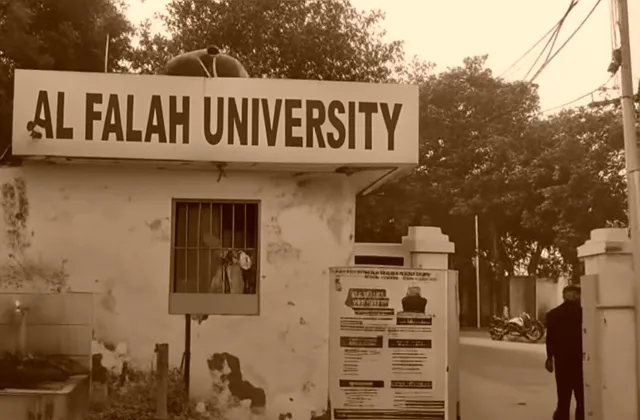
On November 10, Faridabad’s Al-Falah University came under intense scrutiny after the police unearthed one of the biggest explosive seizures in recent years, around 2,900 kilograms of explosive-making materials, along with sophisticated detonators, assault rifles, and other terror-related equipment. The seizure came just hours before a high-intensity blast near Delhi’s Red Fort, which left eight people dead and several injured, sending shockwaves across the national capital.
Initial investigations revealed that three doctors associated with Al-Falah University were part of a “white-collar terror module” with suspected links to Pakistan-backed terror outfits. The arrested individuals, identified as Dr. Muzamil Shakeel, Dr. Adeel Ahmed Rathar, and Dr. Shaheen Shahid, are believed to have provided logistical and operational support to Jaish-e-Mohammed (JeM) and Ansar Ghazwat-ul-Hind (AGuH).
Police source quoted in media said the group may have used university resources and academic cover to plan and coordinate their activities while evading security surveillance.
Inside Al-Falah University
Founded in 2014, Al-Falah University operates under the Al-Falah Charitable Trust and received recognition from the University Grants Commission (UGC) in 2015. The private institution, located on a sprawling 70-acre campus in Dhauj, Faridabad, offers courses in engineering, management, commerce, law, education, humanities, and medical sciences.
The university also manages a 650-bed charitable hospital under its School of Medical Sciences and Research Centre. It claims an “A” grade accreditation by NAAC, has separate hostels for boys and girls, and attracts students from across India and abroad.
While it has been largely known for offering affordable education, questions are now being raised about its administrative transparency, funding sources, and faculty background.
Who runs Al-Falah University?
At the helm of the institution is Chancellor Jawad Ahmed Siddiqui, the founder of the Al-Falah Charitable Trust. The Vice Chancellor, Prof. (Dr.) Bhupinder Kaur Anand, oversees academic operations, while Dr. Mohd Parvez serves as the Registrar.
Despite the grave allegations surrounding its faculty, the university administration has not issued any official statement clarifying its position or cooperating publicly with the investigation. This silence, according to law enforcement officials, raises concerns about possible concealment of internal activities.
Investigators are also probing whether the university’s Gulf-linked charitable funding sources were used to channel money for terror-related operations.
Trail that led to Al-Falah
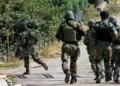
In a joint operation by the Jammu and Kashmir Police and Haryana Police, authorities recovered approximately 2,900 kilograms of explosive-making substances, including ammonium nitrate, assault rifles, detonators, timers, batteries, and remote-control circuits. The massive cache was traced to a rented accommodation of Dr. Muzamil Shakeel, located barely a few hundred metres from the Al-Falah University campus.
Ammonium nitrate, though commonly used in fertilisers, is also a key component in high-intensity explosives such as those used in industrial or terror attacks. The seizure has prompted suspicions that the university’s chemistry or medical laboratories could have been used to synthesise or test explosive materials, possibly including RDX.
According to Faridabad Police Commissioner Satendra Kumar Gupta, “The size and sophistication of the haul indicate large-scale terror preparation. A forensic audit of the university’s laboratories and chemical storage units is currently underway.”
Gupta confirmed that a team from the National Investigation Agency (NIA) has joined the probe to trace potential foreign and Gulf funding and to determine whether the university’s academic infrastructure was intentionally exploited.
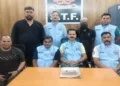
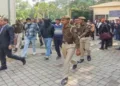
Eight individuals have been arrested so far, including three medical professionals from Al-Falah University.
Among them:
1. Dr. Muzamil Shakeel, a Kashmiri professor teaching at the university for over three years, believed to be the key link in the module.
2. Dr. Adeel Ahmed Rathar, another faculty member accused of providing medical cover and safe passage for operatives.
3. Dr. Shaheen Shahid, allegedly connected with Jamaat ul-Mominaat, the women’s wing of Jaish-e-Mohammed, tasked with recruitment and ideological indoctrination.
According to police sources quoted in media, the trio used their professional credibility to recruit educated youth and establish local logistics networks. Investigators suspect they maintained contact with handlers across the border through encrypted communication channels.
These revelations have added weight to a growing concern, the infiltration of radical elements into professional and educational institutions.
“White-collar terror module”
Officials describe this group as part of a “white-collar terror module,” individuals embedded within respected professions such as medicine and education to evade traditional intelligence surveillance. Such operatives often use academic credentials, research facilities, and institutional access to move materials, launder funds, or build sleeper cells without arousing suspicion.
An unnamed senior police officer said, “These aren’t foot soldiers. They are highly educated professionals who use their positions to facilitate terror operations, from radicalising youth to arranging safe houses and supplies.”
This model of infiltration represents a new and dangerous phase of terrorism, where ideologically driven individuals exploit institutional autonomy to mask subversive activities.
Following the arrests, the National Investigation Agency (NIA) and Intelligence Bureau (IB) have begun parallel inquiries into the financial and academic networks associated with Al-Falah University. Investigators are tracking foreign remittances, charitable trust accounts, and university-endorsed research grants to detect any flow of funds from Gulf or Pakistani entities.
As many as two foreign-linked NGOs, which had previously contributed to the university’s trust fund, are under scrutiny for their possible role in facilitating financial transactions to sleeper cells in India.
Academia and radical networks
The Al-Falah University probe has once again reignited debate over how educational institutions can be exploited for terror purposes. Experts note that while Indian universities are spaces of learning, they are not immune to ideological manipulation or foreign influence.
Brig (Retd.) S. S. Bakshi told reporters, “Universities must be more vigilant in vetting faculty, monitoring lab usage, and auditing funds. The Al-Falah case shows how easily a legitimate academic setup can become a cover for dangerous operations.”
Security agencies are now pressing for a comprehensive audit of private universities, especially those with foreign funding links and medical or chemical research facilities.
As of November 11, a police team remains stationed at the Al-Falah University campus, sealing access to certain laboratories and storerooms pending forensic analysis. Several faculty members and students have been detained for questioning.
Despite multiple media requests, the university administration has not issued any official statement. Its website and social media handles continue to operate normally, without any mention of the ongoing investigation.
This silence reflects an attempt to contain reputational damage, even as questions mount over how a prestigious NAAC-accredited institution became linked to terror activity.
The case of Al-Falah University serves as a wake-up call for Indian higher education institutions. The arrest of doctors, the massive explosive haul, and the proximity of the Delhi blast highlight a deep-rooted and evolving threat, one that uses the cover of education, research, and professional respectability to advance extremist goals.
Until the probe concludes, Al-Falah University stands as a stark reminder of how the line between education and extremism can dangerously blur and why India must stay vigilant to prevent its institutions of learning from being turned into laboratories of terror.