





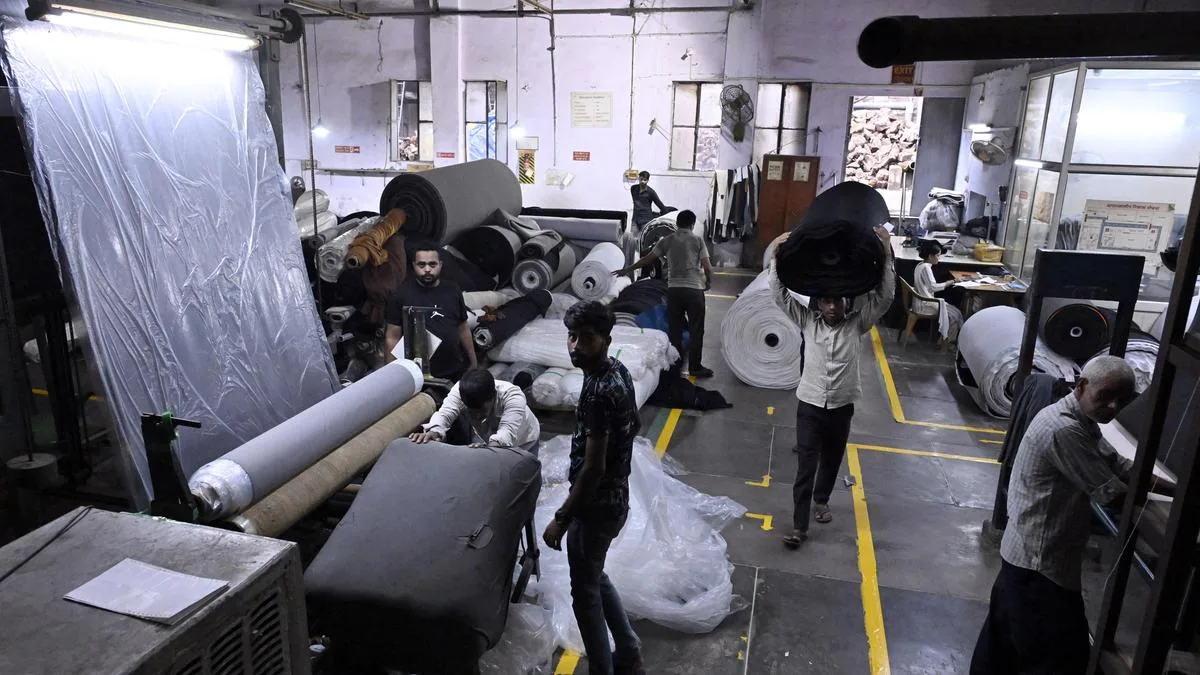
India’s manufacturing sector surged to near-record levels in October 2025, signalling sustained industrial recovery and rising domestic demand. The HSBC India Manufacturing Purchasing Managers’ Index (PMI) climbed to 59.2, up from 57.7 in September, marking one of the highest readings in 17 and a half years. The index, compiled by S&P Global, indicated a faster improvement in factory activity driven by strong order books, improved supply chains, and business optimism.
The PMI level of 59.2 is just shy of August’s 59.3, the highest since early 2008, reflecting the sector’s remarkable resilience amid a globally uncertain environment. Any reading above 50 denotes expansion, while below 50 signals contraction.
“Manufacturing sector conditions in India continued to strengthen in October, buoyed by GST relief, productivity gains, and tech investment,” noted the S&P Global report accompanying the index release.
Manufacturers across sectors reported robust demand and expansion in production volumes. The report highlighted that a faster rise in new orders helped accelerate output growth, which matched August’s joint-strongest pace in five years. Companies attributed this surge to a combination of advertising initiatives, tax rationalisation under the GST, and a strong festive season buildup.
According to the report, “The pace of expansion was sharp and stronger than that recorded in September.” Many firms noted that domestic orders were the key growth driver, even as new export orders rose at a slower pace compared to previous months.
“The uptick in sales growth was largely driven by the domestic market,” the survey observed, “with new export orders increasing at a lower rate than earlier.” Despite the moderation in international sales, the overall order flow remained robust enough to sustain high production activity through October.
A defining feature of this manufacturing uptrend has been the growing emphasis on efficiency and technology adoption. Firms have increasingly invested in automation, supply-chain digitisation, and process innovation, which have improved productivity while moderating input costs.
Manufacturers cited efficiency improvements, new clients, and technology investments as the main contributors to increased output. This suggests that beyond short-term demand recovery, structural reforms and private sector innovation are sustaining industrial momentum.
The Goods and Services Tax (GST) rate reductions, announced earlier this year for select sectors, have also played a catalytic role by lowering logistics costs and simplifying compliance.
Employment in the manufacturing sector rose for the 20th consecutive month, highlighting the strength of the recovery. Although the rate of job creation was moderate and similar to September’s level, firms continued to hire workers to manage increasing workloads and larger order books.
“Robust end-demand fuelled expansions in output, new orders, and job creation,” said Pranjul Bhandari, Chief India Economist at HSBC. “Meanwhile, input prices moderated in October while average selling prices increased as some manufacturers passed on additional cost burdens to end-consumers.”
A key positive indicator from the October survey was the softening of input cost inflation, which fell to its lowest level in eight months. The report noted that “the latest rise in overall expenses was modest, the weakest in eight months, and well below the long-run series average.”
Easing commodity prices and improved supplier delivery times have contributed to this relief. Supplier performance improved to the best level in four months, with fewer bottlenecks in transport and raw material availability.
However, while input costs declined, output charge inflation remained elevated, with selling prices rising at the joint-highest rate in 12 years. Many manufacturers indicated that they had passed on higher freight and labour costs to customers, sustained by strong demand that allowed them to maintain pricing power.
Reflecting optimism in the sector, purchasing activity among manufacturers rose at the fastest pace since May 2023. Firms increased procurement of raw materials to build inventories ahead of anticipated festive and export demand.
The report also mentioned that input inventories expanded at a near-record pace, underscoring business confidence and preparedness for sustained production momentum.
Backlogs of work increased slightly, reflecting firm demand conditions, while the overall supply chain showed marked improvement in delivery schedules.
Despite overall expansion, export demand presented a mixed picture. New export orders increased at the slowest rate in 10 months, indicating softening external conditions amid sluggish global trade. Nonetheless, the growth in export orders remained substantial and positive.
Economists view this moderation as an expected correction given the global manufacturing slowdown, while India’s domestic consumption and investment-led growth continue to buffer against global headwinds.
Looking ahead, business sentiment across manufacturing firms remains resilient. The future output sub-index, which measures confidence in the next 12 months, slipped slightly from its seven-month high in September but continued to signal robust optimism.
“Future business sentiment is strong due to positive expectations around GST reform and healthy demand,” said Bhandari, reaffirming the broad-based confidence in India’s economic trajectory.
With a stable policy environment, rising private investment, and easing inflationary pressures, most firms expect steady expansion through the fiscal year’s second half.
The S&P Global India Manufacturing PMI is a composite indicator derived from a survey of 500 manufacturing companies. It measures business conditions based on five key parameters, New Orders (30 percent), Output (25 percent), Employment (20 percent), Suppliers’ Delivery Times (15 percent), and Stocks of Purchases (10 percent). Delivery times are inverted in the calculation so that shorter delivery times indicate improvement.
A reading above 50 signals expansion from the previous month, while below 50 denotes contraction. The index serves as a leading indicator for policymakers, investors, and economists to gauge industrial health and economic momentum.
The October reading of 59.2, significantly above the neutral 50 threshold, reinforces the perception that India remains one of the world’s fastest-growing large economies, with manufacturing serving as a key growth engine.
October’s PMI report paints an encouraging picture for India’s industrial landscape. Strong domestic demand, GST rationalisation, technological adoption, and softening input costs have combined to push the sector to near two-decade highs.
Even as global trade remains uncertain, India’s manufacturing expansion reflects the resilience of domestic consumption and policy-driven supply chain improvements. The continued rise in employment, robust business confidence, and steady productivity gains point towards a sustained growth trajectory for the months ahead.
As Pranjul Bhandari aptly summed up, “India’s manufacturing sector is riding a strong wave of demand and reform-led optimism. With input costs easing and output prices stabilising, the sector appears well positioned for continued expansion.”
At 59.2, the October PMI does more than signal economic strength, it underscores India’s transition towards a more diversified, technology-driven, and globally competitive manufacturing ecosystem.
















Comments