




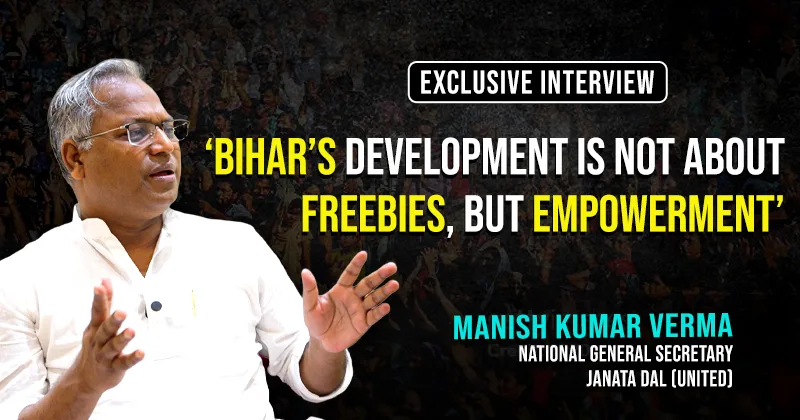
Few know Bihar’s recent policy playbook better than the National General Secretary of Janata Dal (United) Manish Kumar Verma. An engineer-turned-bureaucrat who moved into politics last year, Verma is often described as the “policy architect” behind Nitish Kumar’s governance. Speaking to Organiser’s Senior Assistant Nishant Kumar Azad, he traces how lawand-order was institutionalised, why the NDA’s new manifesto prioritises jobs and industry, and how cycles, uniforms and reservations for women altered Bihar’s social fabric.
This time, NDA has come up with a common manifesto which does not highlight Nitish Kumar’s pet project, Saat Nischay like before. Why?
The vision of Saat Nischay continues. Many ideas – such as 1 crore jobs, Rs 2 lakh assistance for women, industrial corridors, and textile hubs – originate from Nitish ji. Imagine a defence corridor in Bihar, it will transform the state’s image, attract MSMEs, create ancillaries and employment. Like Bangladesh became a textile hub, Bihar too can export through the Ganga waterway. Our manifesto envisions an educated, confident, industrial Bihar that contributes to Viksit Bharat 2047.
Nitish Kumar’s early focus on education bore fruit and increased students’ enrolment. Yet education quality remains a concern.
True, quality takes time. When Nitish ji took charge in 2005, there were no teachers, no infrastructure, and only Rs 4,000 crore for education. Contract teachers were appointed because resources were limited. Over time, the education budget has grown twentyfold to Rs 80,000 crore, which is 22 per cent of the state budget. Now, teachers are being recruited through BPSC, ensuring quality.
You have seen Bihar closely as a bureaucrat. How did Nitish Kumar manage to end the caste wars and Naxalism that once plagued the state?
Nitish ji replaced confrontation with participation. He empowered the marginalised through local-body reservations for OBCs, EBCs, and Dalits. People who once felt voiceless became mukhiya and sarpanch. When one gains respect in society, the gun loses appeal. He launched Sarkar Aapke Dwar camps in Naxal-affected areas, built roads, schools, and Anganwadis, and included locals in development. Violence subsided because people found ownership in governance. Bihar’s 11% growth rate reflects that harmony. Development cannot happen amid hatred; it needs peace and goodwill, and Nitish ji achieved that social cohesion.
Prashant Kishor, once Nitish Kumar’s strategist, claims JD(U) won’t cross 25 seats and Nitish won’t be CM again. What is your answer to him?
He is a good strategist, not a politician. His success came from working with Modi ji and Nitish ji, but now he thinks he “made” them. He uses media and psychological tactics, which I call dark psychology, to stay relevant. He talks about problems but has no solutions. Promising “1 crore jobs overnight” or “fixing Bihar in six months” is nonsense. Bihar’s people are intelligent; they won’t fall for such gimmicks.
How many seats will JD(U) win in these Bihar Polls?
I am no psephologist, and certainly not Prashant Kishor! But I can tell you this, wherever we are contesting, public support is immense. We will surprise many on the counting day.















Comments