





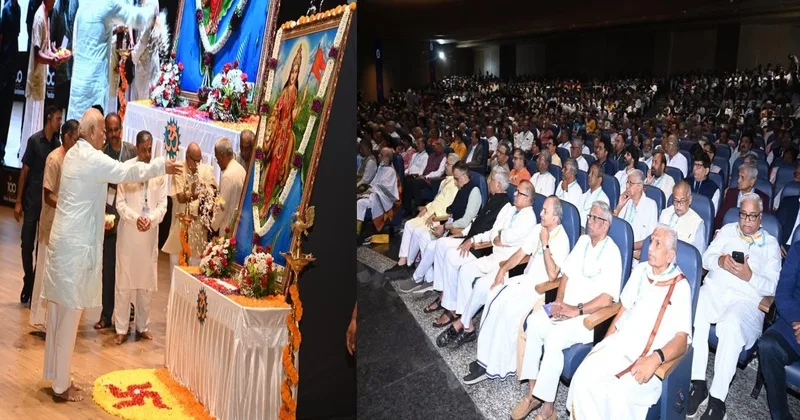
Bengaluru: The two-day lecture series of Rashtriya Swayamsevak Sangh (RSS) Sarsanghchalak Dr Mohan Bhagwat commenced in Bengaluru on November 8, focusing on the theme of the Sangh’s vision and role in national life. The event, attended by dignitaries from various sectors, including education, medicine, science, business, and foreign delegates, was inaugurated with the offering of flowers to Bharat Mata and a rendition of the national song, “Vande Mataram”.
On the dais with Dr Bhagwat were RSS Sarkaryavaha Dattatreya Hosabale, Dakshin Madhya Kshetra Sanghachalak Vaman Shenoy, and Karnataka Dakshin Sanghachalak Umapati GS
Dr Bhagwat began his address by observing that the RSS has been a subject of extensive discussions for over a decade, with much of the prevailing public understanding based on hearsay rather than facts. “One cannot know the Sangh through second-hand messages; that only leads to misunderstandings,” he said. To address this, a lecture series was organised in Delhi in 2018 to provide authentic information about the Sangh. “Support or opposition to the RSS must be based on facts, not opinions,” he asserted.
Marking the centenary year of the organisation’s founding, Dr Bhagwat said it was decided to hold similar lectures in four cities, Delhi, Bengaluru, Kolkata, and Mumbai, with the Bengaluru event being the second in the series.
He stated that the Sangh’s core work is to organise society, a task that is not reactionary but rooted in historical necessity. Reflecting on India’s long history of foreign aggression and rule, he outlined how different approaches emerged during the freedom struggle – armed revolution, political negotiation, and social reform – but many failed to reach the common people. He noted that leaders such as Swami Dayananda Saraswati and Swami Vivekananda inspired a return to the roots, and that RSS founder Dr KB Hedgewar (referred to as “Doctor Ji”) had worked across several of these movements.
Dr Bhagwat narrated Doctor Ji’s journey, from his participation in the independence movement to his membership in the revolutionary Anusheelan Samiti in Kolkata, his sedition trial, and his later realisation that India’s repeated invasions were the result of Atma-Vismriti (loss of self- awareness). “We forgot who we are and allowed our diversity to become divisions,” he said. “Doctor Ji realised that true unity must be built without disturbing diversity. The world believes uniformity brings unity; our tradition teaches that diversity brings unity.”
Quoting Rabindranath Tagore’s Swadeshi Samaj, Dr Bhagwat said that real transformation comes not through politics but through social awakening led by selfless individuals who live for the people. He added that similar thoughts were found in Mahatma Gandhi’s Hind Swaraj.
Dr Bhagwat recounted how Dr Hedgewar and his associates experimented for nearly 15 years before finalising the model of the Sangh, which emphasised apolitical, society-centric organisation through “man-making.” The daily shakha, he explained, became the means for character-building, where individuals gathered for an hour to engage in physical activities and discussions focused solely on Bharat Mata, leaving aside caste, region, and language differences. “This model was adopted by society and continues to thrive. The hearts of people are with the Sangh, even if opposition still comes from some lips,” he said.
Elaborating on the idea of Hindu identity, Dr Bhagwat said that ancient travellers referred to the people of this land as Hindus, and that “being different does not mean being separate.” He categorised the Hindu society into four groups: those proud of being Hindus, those who are Hindus but not proud, those who know they are Hindus but do not acknowledge it, and those who have forgotten they are Hindus. Muslims and Christians, too, have descended from Hindu ancestors. Hindu is an inclusive term,” he said.
He added that all Bharatiya Darshanas ultimately uphold the oneness of all beings and the principles of Yama-Niyama. “Being Hindu means being the son of Bharat Mata, one who strives to realise the truth. This quest for truth, continuing since the time of Bhagwan Ram, is sustained through Sanskar – and the creation of Sanskar is Sanskriti,” he said. Every faith in Bharat, he asserted, arises from these philosophical roots. “Nobody is ‘ahindu’; every Hindu must realise he is a Hindu and that being Hindu means being responsible for Bharat.”
Dr Bhagwat emphasised that organising the Hindu society is essential, and this is why “Bharat is a Hindu nation.” He maintained that this idea does not contradict the Constitution but aligns with it. “This is the Sangh,” he stated.
Reflecting on the Sangh’s journey, Dr Bhagwat said it had faced government opposition from its inception, and its founder, Doctor Ji, had no easy means to spread its message. “No other voluntary organisation in the world has faced such sustained opposition,” he said, adding that the RSS grew through the sacrifices and contributions of swayamsevaks, without external aid. Many have given their lives, too, he observed. Sangh manufactures its own Karyakartas.
Concluding his address, Dr Bhagwat said, “We have to organise the entire Hindu society, and the Hindu society in its prime and glory, it strives to unite the whole world as per the saying ‘Vasudaiva Kutumbakam’.” Quoting Sri Aurobindo, he said, “It’s gods will that Sanatan Dharma should rise and Bharat must rise, because Sanatan Dharma is Hidurashtra and uttan of Sanatan Dharma means uttan of Bharatvarsh”. Senior Sangh Pracharak Dadarao Parmart said. “RSS is the evolution of the life mission of the Hindu nation.”












Comments