
“The… supreme service of Bankim to his nation was that he gave us the vision of our Mother… It is not till the Motherland reveals herself to the eye of the mind as something more than a stretch of earth or a mass of individuals, it is not till she takes shape as a great Divine and Maternal Power in a form of beauty that can dominate the mind and seize the heart that these petty fears and hopes vanish in the all-absorbing passion for the Mother and her service, and the patriotism that works miracles and saves a doomed nation is born” – Sri Aurobindo, Volume 6 & 7, The Complete Works of Sri Aurobido, Sri Aurobindo Ashram Publication Department, Pondicherry, 2002 Edition, pp.317-18
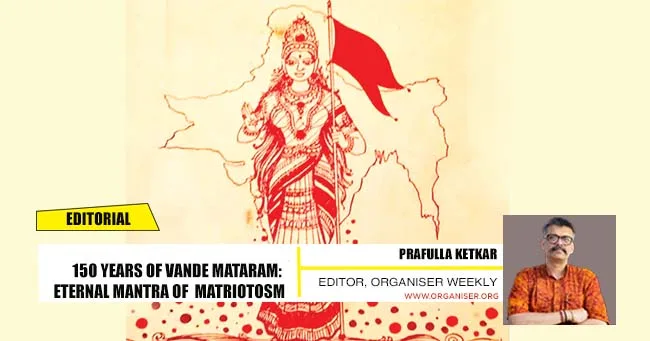
This year marks the 150th commemoration of the iconic national song that inspired the Independence struggle of Bharat – Vande Mataram. Rishi Bankim Chandra, as Sri Aurobindo chose to call him, first composed it as a beautiful mantra dedicated to the rich, caring, prosperous, and blissful Motherland in 1875 on the night of Saptami, the seventh day of Durga Puja, for the publication Bangadarshan. That day, as per the Gregorian calendar, happened to be November 7. In 1896, Gurudev Rabindranath Thakur composed a tune for it, and eventually it was sung during a Congress session. Despite the controversies created by the Muslim League in the pre-Independence period, which were sustained by the Secularists and Communists, the celebration of Vande Mataram needs to be observed in the true spirit it stands for – the eternal Mantra of Matriotism.
During the period of colonisation, ordinary people lost confidence in themselves. The English-educated intellectuals had accepted British rule as the saving grace and source of the rule of law. After the setback of the 1857 War of Independence, the self-abjuration about our past was so ingrained in our colonised minds that the fighting spirit was reduced to petitions. Amidst this, some revolutionaries and secret societies, along with Sanyasis in Maths and Mandirs, were trying to regroup and revive the fighting spirit against the inhuman colonialism. Anandmath by Rishi Bankim manifested as the Mantra for all of them. The setting of the novel was not against any religious enemy, but resistance against the inhuman and unrighteous force. Unfortunately, the Muslim League and Islamists failed to understand, and the pseudo-secularists failed to assert. The partition of Bengal in 1905, carried out on religious lines by Lord Curzon, revived the fighting spirit of the masses and provided a window for renewed vigour in the pursuit of Independence. When one part of the country was partitioned, the entire society came together, and the binding force was Vande Mataram. These two magical words, ‘Swadeshi’ and ‘Swaraj’, provided a complete sense and meaning. The collective resistance of all overcoming regions, religions, languages, and castes, and forcing the British to roll back the partition, shows the power that Sanjivani Mantra provided to the battle against Bengal’s partition. The only adverse side effect of this magnificent struggle was the formation of the Muslim League at the behest of the British, which eventually led to the partition of Bharat on both Easten and Western sides in 1947.
The Vande Mataram could become the galvanising mantra for the masses for three reasons. It was simple yet powerful to awaken the public to an unconditional love for the Motherland. The Mother of the chant was not a new Goddess for the people, but the same whom we have always worshipped – either in the form of Durga or Kali. So, even illiterate but culturally wise people of Bharat could relate to it immediately. The narration of the entire poem unfolds the physical, social, economic, political and spiritual manifestation of the idea called Bharat. The Sanskritised song with a Bengali overtone reconnected us to the civilisation’s wisdom of seeing Bharat as Mata, as our ancient Rishis had taught us, and we had forgotten during the series of invasions. It was the reinstatement of the spirit of ancient Rashtra, based on cultural unity and reverence for the Motherland. Unlike Europe, which was inspired by the idea of political patriotism based on the concept of the fatherland, Bharat has always cherished a knowledge tradition based on cultural nationalism, rooted in the concept of Matriotism. Vande Mataram was the revival of the same ethos. Swaraj is not just a political goal, but a divine duty, in which we dedicate ourselves to the cause of Bharat Mata and strive for the ultimate goal of spiritual freedom. Bankim Chandra gave purpose and substance to the idea of Swaraj through the song Vande Mataram. The Atman of Bharat reawakened through this Mantra. It was a seed Mantra that gave the self-belief that ‘ours is the eternal land, the eternal people, the eternal religion, whose strength, greatness, holiness, may be over-clouded but never, even for a moment, utterly cease’, as articulated by Sri Aurobindo. Swami Vivekananda’s clarion call –Vayam Amritasya Putrah (We are the children of Immortality)–was realised by Bharatiyas.
Vande Mataram is not just about the past but also about the present and the future. As Prime Minister Narendra Modi rightly put, “Our generations have seen a vibrant and magnificent image of Bharat in the words of Vande Mataram”. It is also a resolve to maintain the Sujalam, Sufalam, Sasya Shamalam nature of Bharat. It is about continuously striving for the true Swaraj, based on the immortal consciousness called Bharat Mata – the Mother of knowledge, encompassing both material and spiritual aspects.
Rishi Bankim Chandra’s Vande Mataram mantra during the freedom struggle was not an invention but a resurgence of the old Sanatan wisdom to see Earth and Bharat as the Mother, the spirit of Matriotism that is the unconditional reverence to Motherland. The 150th year celebration of the iconic rendition should be about connecting all of us with the ancient Rashtra based on a cultural continuum and knowledge tradition, so that we can address the present challenges and revitalise our energy in charting the future course to make Bharat Mata the guiding force for humanity. Vande Mataram!