“No society can progress if half its population stands still.”- Dr. Mohan Bhagwat
As India’s largest socio-cultural organization, the Rashtriya Swayamsevak Sangh (RSS) marks its centenary in 2025, the conversation inevitably turns to its evolving view of women. How has an institution, often seen as traditional and male-dominated, transformed into a platform fostering women’s leadership, self-reliance, and nation-building?
Rooted in Sanatan Dharma, which since the Vedic era has revered the feminine principle as Shakti—the very energy sustaining the universe—the RSS draws inspiration from this timeless respect for women. The tradition of strong Hindu queens like Rani Laxmibai and Ahilyabai Holkar exemplifies this ethos, showcasing women as embodiment of courage, wisdom, and leadership in nation-building.
Is this change a token gesture to modernity—or a deeper ideological evolution tied to the Sangh’s own pursuit of social harmony?
To understand the movement’s current posture, one must look at the intertwined history of the RSS and its autonomous sister organization, the Rashtra Sevika Samiti—a story of how Matri Shakti, the power of the feminine, is being repositioned as the moral backbone of a resurgent India.
The Foundation: From Dr.Hedgewar to Maushiji Kelkar
It was on Vijayadashami day in 1936 that Laxmibai Kelkar, a pioneering educationist from Wardha, founded the Rashtra Sevika Samiti with inspiration from RSS founder Dr. K. B. Hedgewar. He declined to convert the RSS into a mixed-gender organization but urged Kelkar to start a parallel structure for women that shared the same ideology but addressed their unique challenges.
Thus emerged a vision centered on three ideals:
• Matritva (universal motherhood),
• Kartritva (social action and efficiency)
• Netritva (leadership)
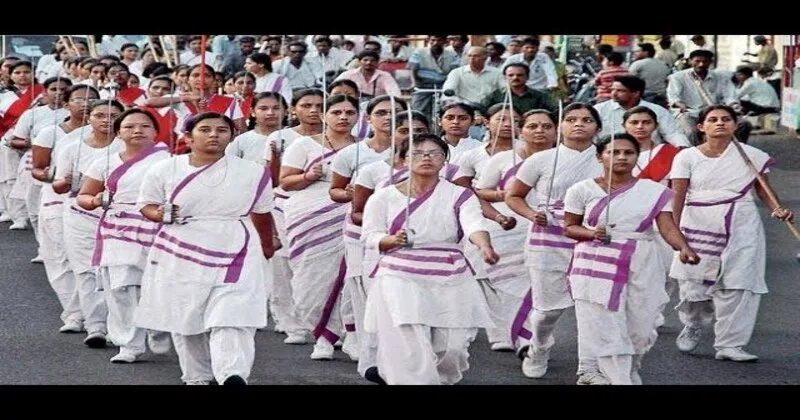
Today, the Rashtra Sevika Samiti functions through 5,200 centers, with 875 daily shakhas and a membership between one and ten lakh women. These branches serve as community hubs offering yoga, martial arts, singing, and civic education, weaving together faith and functionality. Over 475 service projects—from health camps and literacy programs to vocational training—illustrate the Samiti’s mission to make women both economically and culturally self-reliant.
Laxmibai Kelkar, affectionately known as Mausiji, viewed women not as passive beneficiaries of reform but as custodians of societal conscience. “So long as this force is not awakened,” she declared, “society cannot progress”.
The RSS Vision: Complementarity over competition
Contrary to Western feminist movements that define progress in antagonism to men, the RSS’s philosophy hinges upon complementarity. “Bharatiya tradition never pitted men and women against each other,” said Sarsanghchalak Mohan Bhagwat in his 2024 Nari Shakti Sammelan speech.
“Empowerment begins at home—first in the family, then in the organization and finally in society”. Rather than viewing gender as a battlefield, the RSS advocates sahabhagita (joint participation) and samanvay (harmony). Its ideology sees the woman as both the rakshika (protector) and the nirmata (creator). The emphasis is on enabling her to fulfil these roles through education, leadership and cultural rootedness.
The Rashtra Sevika Samiti now runs 4,900 shakhas, with about one-third of its 50 full-time pracharikas deployed in the northeastern region, strengthening cultural identity and community outreach. These figures underline that empowerment, in the RSS worldview, is not just philosophical—it’s operational.
The expanding ecosystem of women in the Sangh
While the core RSS remains male-only, its ideological family (Sangh Parivar) includes a vast array of organizations devoted to women’s upliftment. Sewa Bharti (1979) provides livelihood training to hundreds of thousands of underprivileged women. Bharatiya Stree Shakti (1988) works on public policy and civic leadership, while Durga Vahini (1991) emphasizes self-defence and self-respect among young women.
Their approach is holistic—blending skill-based education with moral and cultural grooming. A Rashtra Sevika Samiti summer camp in Delhi in 2017, for instance, trained girls simultaneously in martial arts, yoga, Sanskrit chanting, and civic responsibility, encapsulating the principle that empowerment and nurture coexist.
These programs have had tangible impact: in the last decade, over two lakh women have been trained under Sewa Bharti initiatives for self-employment and digital literacy. The influence extends beyond the grassroots—Sevika Samiti members now collaborate on educational reforms, family welfare initiatives, and disaster relief programs across the nation.
Panch Parivartan: A blueprint for shakti
To understand the RSS’s new articulation of women’s roles, one must consider its centenary doctrine—Panch Parivartan (five transformations). Introduced in 2024–25, this initiative identified five axes of societal renewal: social harmony (Samata), swadeshi self-reliance, selfless service (Seva), cultural pride (Sanskriti), and gender equality.
Under this framework, women’s participation is envisioned not merely as representation, but as leadership. At the 2025 Jodhpur conclave, Bhagwat emphasized that achieving these five transformations demands “women’s presence at every rung of the national awakening”. From environmental restoration projects led by women’s groups in Maharashtra, to Parivar Prabodhan programs strengthening families in Uttar Pradesh, the Sangh’s women cadres have become engines of moral and social change.
By rooting empowerment in cultural continuity, Panch Parivartan avoids the alienation that often comes with imported models of feminism. It proclaims a uniquely Indian pathway where Shakti (power) arises from Seva (service) and Sanskriti (civilizational pride).
Reform through ideological consistency
A deeper ideological thread runs through the Sangh’s transformation. The movement insists that external legislation cannot achieve what internal cultural conviction can. The RSS Facts analysis explains, “The Sangh does not believe in the dictates of isms; its mission is to change mindsets, not laws”. The organization sees reform as a cumulative process—reviving strī-samman (women’s dignity) through family education, community life, and vocational independence.
This conviction drives initiatives like Mahila Samanvay and Kutumb Prabodhan, which work on improving family awareness and coordination between women’s organizations. The RSS’s female leaders promote their own model of socio-cultural feminism, built upon respect, responsibilities, and rooted nationalism—a blend that seeks not to dismantle tradition but to modernize it from within.
The leadership transition
In organizational terms, women are now asserting influence beyond service and cultural education. The RSS’s affiliated bodies have begun inducting women into higher decision-making mechanisms, including consultative spaces like the Akhil Bharatiya Pratinidhi Sabha. According to Bhagwat, “This is not token inclusion—it is transformation through trust”.
Figures such as Shanthakka, the current Pramukh Sanchalika (chief) of the Rashtra Sevika Samiti, and Sita Annadanam, its Pramukh Karyavahika (general secretary), have become national voices articulating an indigenous feminism that emphasizes strength through self-discipline and social duty. Their leadership demonstrates the Sangh’s gradual but genuine shift from viewing women as cultural symbols to recognizing them as strategic contributors in societal transformation.
A balanced model for the future
Opponents often critique the RSS’s insistence on “motherhood first,” calling it conservative. Yet within the Sangh’s framework, motherhood is not confinement—it is creation, command, and compassion in continuity. The triad of Matritva, Kartritva, and Netritva assigns women the power to nurture, to act, and to lead—reflecting the lives of Rani Laxmibai and Ahilyabai Holkar, who serve as inspiration for the Samiti’s curriculum.
The Sangh’s women leaders argue that liberation without values risks moral anarchy, while tradition without transformation stagnates. Their vision aims to integrate both—the quiet dignity of culture with the assertive strength of leadership.
As the RSS completes 100 years, what was once a disciplined brotherhood has become the foundation of a gender-conscious movement that sees women not as followers but as partners in nation-building. The woman within the Sangh ecosystem—be she a Sevika, a Pracharika, or a Karyavahika—is both protector and pioneer.
In a society where debates about feminism often polarize, the RSS presents a different paradigm—
one rooted in cultural strength, community service and moral authority. It emphasizes that empowerment need not mean imitation; it can mean inspiration. The next century of the RSS might well belong to its women — not as shadows of change, but as the change itself.