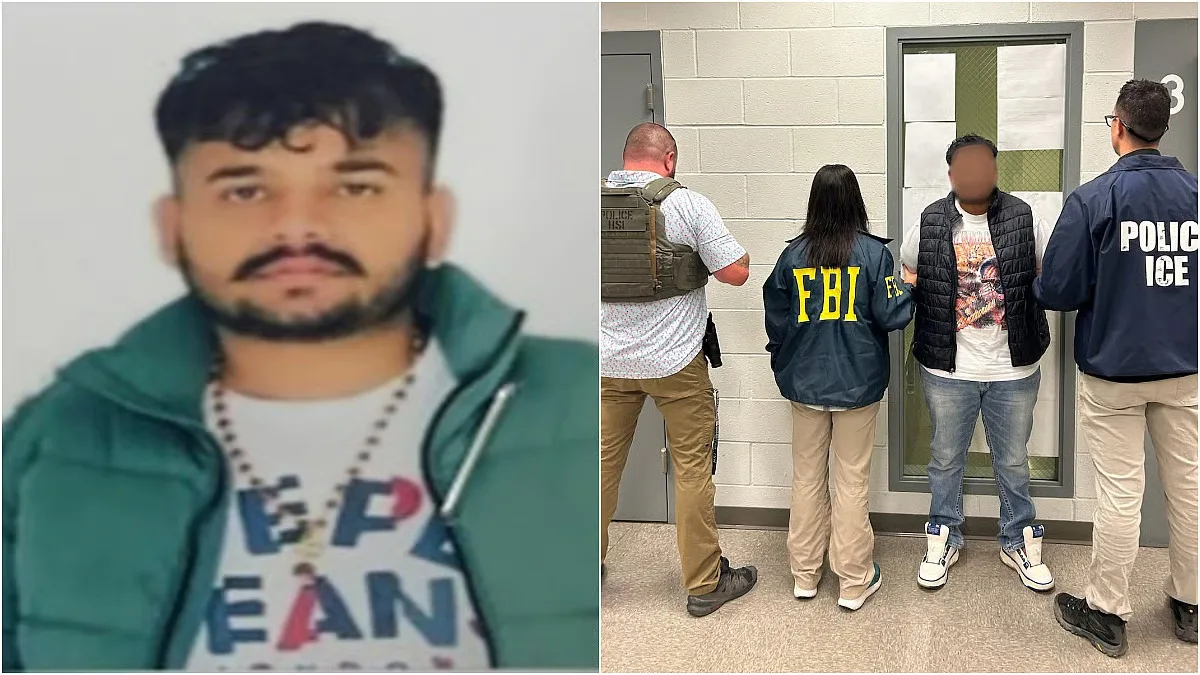
After years on the run, fugitive gangster Lakhvinder Kumar, affiliated with the notorious Lawrence Bishnoi gang, was deported from the United States and taken into custody by Haryana Police at Delhi’s Indira Gandhi International Airport on Saturday. The deportation followed an extensive international effort spearheaded by Indian law enforcement agencies and diplomatic channels.
Officials confirmed that Kumar was wanted in multiple criminal cases, including extortion, intimidation, illegal possession of firearms, and attempted murder. His capture marks a significant milestone in India’s ongoing campaign to bring back fugitives hiding abroad through coordinated efforts between CBI, Interpol, MEA, and MHA.
According to an official statement released by the CBI, a Red Notice against Kumar was issued by Interpol on October 26, 2024, at the request of Haryana Police. This notice enabled international tracking of the fugitive across law enforcement networks worldwide.
“The subject was deported from the USA and arrived in India on October 25, 2025. He was taken into custody by a team of Haryana Police at Delhi airport,” the CBI statement confirmed.
The CBI coordinated through its Interpol National Central Bureau (NCB-India) platform, also known as Bharatpol, ensuring real-time communication with American authorities. Over the past few years, more than 130 fugitives wanted in India have been successfully brought back through such international cooperation.
Investigators revealed that Lakhvinder Kumar had been a key operative of the Lawrence Bishnoi syndicate, involved in multiple cases of organised extortion and armed intimidation across Haryana. His name surfaced in several FIRs registered under the Arms Act and IPC sections relating to attempted murder and criminal conspiracy.
Lawrence Bishnoi’s network, active across Punjab, Haryana, Rajasthan, and Delhi, has long been accused of orchestrating high-profile crimes, including targeted killings and large-scale extortion rackets. Indian intelligence agencies have linked the gang’s operations to illegal arms supply chains extending beyond national borders.
The Lawrence Bishnoi gang, one of India’s most feared organised crime syndicates, continues to face intense crackdowns across multiple states. The gang’s network, known for its involvement in contract killings and terror-linked activities, has been under heightened international scrutiny, even being declared a “terrorist entity” in Canada earlier this year.
The latest deportation of Kumar follows a series of arrests and encounters involving gang members across North India. Just last week, Rajasthan Police arrested Sanjay Jat, a shooter affiliated with the Bishnoi syndicate, recovering a cache of foreign-made and country-made firearms, including pistols, rifles, and live cartridges.
Kumar’s deportation is being hailed as a testament to India’s strengthened international policing collaboration and the government’s resolve to dismantle transnational criminal networks. Officials emphasised that the success was achieved through diplomatic coordination and robust intelligence-sharing between agencies, further tightening the noose around fugitive gangsters operating overseas.
A senior CBI officer remarked that the agency’s cooperation through Interpol channels has become a model framework for locating and repatriating fugitives who exploit foreign jurisdictions to evade justice.
“This case demonstrates how international cooperation can be leveraged effectively to bring criminals to justice and protect Indian citizens from organised crime,” the officer said.
The return of Lakhvinder Kumar not only strengthens India’s legal proceedings against the Bishnoi network but also highlights the effectiveness of Interpol coordination through Bharatpol, India’s national link to global policing. The MHA’s policy of pursuing fugitive criminals abroad is yielding consistent results, ensuring that no offender remains beyond the reach of Indian law.
As the crackdown against the Lawrence Bishnoi gang intensifies, Kumar’s return reinforces India’s commitment to justice, international collaboration, and dismantling criminal monopolies that threaten internal security.