





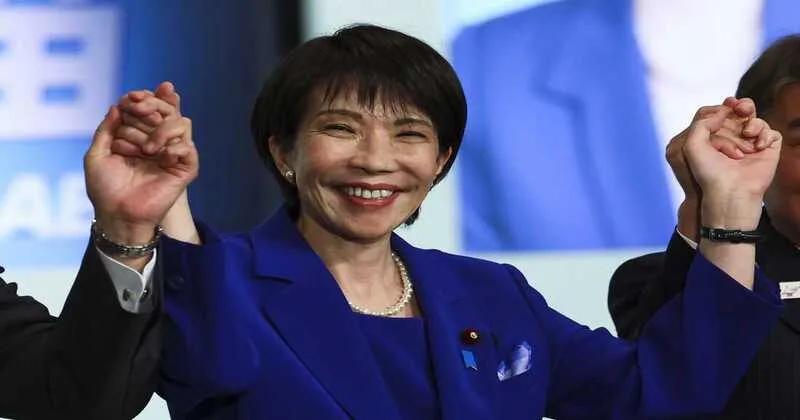
The election of Sanae Takaichi as Japan’s Prime Minister offers yet another indication that Tokyo’s relations with Washington and New Delhi are poised to grow further. Observers say Takaichi is a protégé of Japan’s legendary Prime Minister Shinzo Abe ( assassinated in 2022). During her early years in the Diet, she forged an enduring bond with Abe. The two were on the same page on the issues like increasing military spending and adding a more patriotic tone to the country’s history textbooks.
Interestingly, Takaichi has been of the view that, during the Second World War, Japan attacked China as part of the Axis powers. It was not Japan’s military aggression. She has claimed that the then Japanese forces made “overseas advances”. She has called the 1937 “Nanjing Massacre” as exaggerated.
The bond between Takaichi and Abe was very strong. During Shinzo Abe’s first term as Prime Minister in 2006, Takaichi held five ministerial portfolios, including a record-breaking tenure as the Minister for Internal Affairs and Communications. Abe reappointed Takaichi in 2012 in his second term too. Takaichi was a fierce defender of his policies, including efforts to revise Japan’s Constitution to unfetter its military. Abe backed her in the race for the party presidency as well in 2021.
Takaichi, thus would naturally follow Abe’s pro–US and India policies. She is already in that path by allowing the US nuclear weapons into Japan’s land and sea. She is pro the deployment of US medium-range missiles to Japan. Takaichi is in favour of the revision of the US-Japan Status of Forces Agreement (SOFA). She asserts it would be “contradictory” on the part of Japan not to allow the US nukes when, Tokyo can gain deterrence because of the US weapon system.
With respect to India, Takaichi has already met Prime Minister Narendra Modi in the past and has discussed with him a range of issues, including digital economy, smart city projects and cyber-security. Prime Minister Narendra Modi, too, is looking forward to working closely with Takaichi to further strengthen the India-Japan Special Strategic and Global Partnership. He is convinced that the deepening Indo-Japanese ties are “vital for peace, stability and prosperity across the Indo-Pacific and beyond”.
The observers say Takaichi can be expected to push forward her foreign policy agenda. She has had enough experiences in the government. She has held several ministerial posts under Prime Ministers Abe and Fumio Kishida. In this direction, it is good that the Komeito Party has recently withdrawn from the Liberal Democratic Party LDP coalition. The LDP’s new coalition partner, the Osaka-based Ishin no Kai (Japan Innovation Party), is largely aligned with the LDP on foreign policy issues. Both parties support Japan’s security alliance with the US.
However, one cannot be certain about the stability of the Takaichi government. Despite the support of the JIP, her government holds 231 seats in the Diet. It is two seats shy of a majority. It would need cooperation from other opposition groups to pass any legislation. It is to be seen how her government manages the Diet. Takaichi does not have a “progressive” social agenda. She has been opposed to the same-sex marriage, a revision to the civil law that allows women to keep separate last names after marriage and become emperor. This puts off several groups in Japan today.
Also, it has to be seen how Takaichi advances her nation’s status as the world’s fourth-largest economy. She needs to tackle Japan’s rising inflation, public debt, rice shortage and public dissatisfaction over the government’s inability to curb economic corruption.

















Comments