Nagaland University discovers compound for diabetic wound
July 16, 2026
  • Read Ecopy
  • Circulation
  • Advertise
  • Careers
  • About Us
  • Contact Us
Android AppiPhone AppArattai
Organiser
  • ‌
  • Bharat
    • Assam
    • Bihar
    • Chhattisgarh
    • Jharkhand
    • Maharashtra
    • View All States
  • World
    • Asia
    • Europe
    • North America
    • South America
    • Africa
    • Australia
  • Editorial
  • International
  • Opinion
  • RSS @ 100
  • More
    • Op Sindoor
    • Analysis
    • Sports
    • Defence
    • Politics
    • Business
    • Economy
    • Culture
    • Special Report
    • Sci & Tech
    • Entertainment
    • G20
    • Azadi Ka Amrit Mahotsav
    • Vocal4Local
    • Web Stories
    • Education
    • Employment
    • Books
    • Interviews
    • Travel
    • Law
    • Health
    • Obituary
  • Subscribe
    • Subscribe Print Edition
    • Subscribe Ecopy
    • Read Ecopy
  • ‌
  • Bharat
    • Assam
    • Bihar
    • Chhattisgarh
    • Jharkhand
    • Maharashtra
    • View All States
  • World
    • Asia
    • Europe
    • North America
    • South America
    • Africa
    • Australia
  • Editorial
  • International
  • Opinion
  • RSS @ 100
  • More
    • Op Sindoor
    • Analysis
    • Sports
    • Defence
    • Politics
    • Business
    • Economy
    • Culture
    • Special Report
    • Sci & Tech
    • Entertainment
    • G20
    • Azadi Ka Amrit Mahotsav
    • Vocal4Local
    • Web Stories
    • Education
    • Employment
    • Books
    • Interviews
    • Travel
    • Law
    • Health
    • Obituary
  • Subscribe
    • Subscribe Print Edition
    • Subscribe Ecopy
    • Read Ecopy
Organiser
  • Home
  • Bharat
  • World
  • Operation Sindoor
  • Editorial
  • Analysis
  • Opinion
  • Culture
  • Defence
  • International Edition
  • RSS @ 100
  • Magazine
  • Read Ecopy
Home Bharat

Nagaland University scientists discover natural compound with breakthrough potential for diabetic wound healing

Nagaland University researchers have discovered that Sinapic acid, a naturally occurring plant compound, can accelerate diabetic wound healing when administered orally, marking the first study of its kind globally

WEBDESKWEBDESK
Oct 23, 2025, 05:40 pm IST
in Bharat, Nagaland
Follow on Google News
FacebookTwitterWhatsAppTelegramEmail

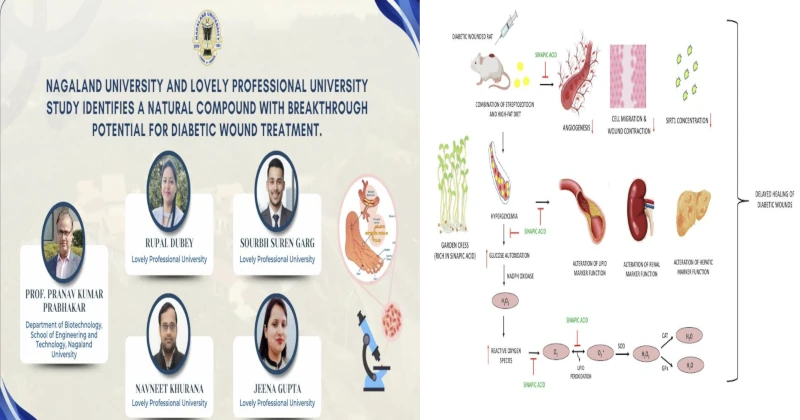
Researchers at Nagaland University have identified a naturally occurring plant compound, Sinapic acid, as a powerful therapeutic agent capable of significantly accelerating wound healing in diabetic conditions. The discovery, published in the globally reputed Nature Scientific Reports (Nature Portfolio), marks the first-ever study worldwide to demonstrate that oral administration of Sinapic acid can enhance diabetic wound healing in preclinical models opening up new possibilities for affordable, sustainable, and natural oral therapies to prevent amputations and chronic wound complications.

Led by Prof. Pranav Kumar Prabhakar, Head of the Department of Biotechnology, School of Engineering and Technology, Nagaland University, the research team included Rupal Dubey, Sourbh Suren Garg, Navneet Khurana, and Dr. Jeena Gupta from Lovely Professional University (LPU), Punjab. The interdisciplinary collaboration brought together expertise in biotechnology, pharmacology, biochemistry, and medical laboratory sciences, uniting efforts toward a common goal addressing one of the most challenging complications of diabetes: delayed wound healing.

According to the study, Sinapic acid, a natural antioxidant commonly found in various edible plants, accelerates diabetic wound healing by activating the SIRT1 molecular pathway, which regulates tissue repair, angiogenesis (formation of new blood vessels), and inflammation control.

This is the first research globally to establish that oral Sinapic acid unlike topical or invasive treatments can promote systemic bioavailability and target healing at the wound site, providing a safer and more practical therapeutic alternative.

“We set out seeking a safe, plant-based alternative exploring how Sinapic acid could accelerate tissue repair, reduce inflammation, and promote new blood vessel formation in diabetic wounds,” explained Prof. Pranav Kumar Prabhakar.

“Interestingly, a lower dose (20 mg/kg) proved more effective than a higher one (40 mg/kg), a phenomenon known as ‘Inverted Dose-Response,’ which has major implications for clinical dosing strategies and future drug development,” he added.

Expressing pride in the university’s scientific achievement, Prof. Jagadish K. Patnaik, Vice Chancellor of Nagaland University, stated:

“I am delighted to share that our researchers have identified a natural compound with remarkable potential for treating diabetic wounds. This discovery not only showcases the strength of our scientific community but also our commitment to addressing pressing health challenges through innovation rooted in nature.”

Dr. Jeena Gupta, from Lovely Professional University, highlighted the translational importance of the discovery:

“Our findings suggest that Sinapic acid enhances tissue repair by promoting angiogenesis and reducing oxidative stress. Unlike conventional therapies, oral delivery ensures systemic action, making it cost-effective and patient-friendly. The next step involves developing patentable formulations for scalable human use.”

Diabetes mellitus affects hundreds of millions worldwide, with diabetic foot ulcers and delayed wound healing among its most serious complications, often leading to infection and limb amputation. Current synthetic drugs frequently show limited efficacy and adverse side effects, underscoring the urgent need for safe, natural alternatives.

Also Read: West Bengal Tensions: Murti of Maa Kali desecrated in Kakdwip, BJP slams ‘appeasement politics’; TMC calls ‘distorted’

The discovery of Sinapic acid’s therapeutic potential carries significant implications for reducing amputation risk, accelerating recovery in diabetic foot ulcers, and offering a low-cost oral therapy accessible to patients in rural and resource-limited settings. The research also aligns with India’s vision for integrating traditional medicine, nutraceuticals, and modern biotechnological innovation, reflecting a sustainable, culturally compatible approach to healthcare.

Building on the strong preclinical evidence, the research team will now advance to the translational phase, focusing on:

  • Detailed molecular pathway studies involving PI3K/Akt and NF-κB mechanisms
  • Toxicity and pharmacokinetic profiling to ensure long-term safety
  • Development of capsule or nutraceutical tablet formulations for easy oral use
  • Pilot clinical trials in diabetic patients to validate efficacy and safety

The Nature Scientific Reports publication (DOI: https://doi.org/10.1038/s41598-025-03890-z) lends strong international credibility to the discovery, positioning Nagaland University at the forefront of cutting-edge biomedical research from India’s Northeast.


Topics: Nagaland UniversityDiabetic wound healingSinapic acidNature Scientific Reports
ShareTweetSendShareSend
✮ Subscribe Organiser YouTube Channel. ✮
✮ Join Organiser's WhatsApp channel for Nationalist views beyond the news. ✮
Previous News

Festive rush managed smoothly: Railways sets record with 1 crore safe journeys across 4,521 trains

Next News

Kerala: President Murmu unveils bust of former President KR Narayanan, calls for an inclusive and compassionate Bharat

Related News

Nagaland University & LPU researchers discover plant compound ‘sinapic acid’ that accelerates diabetic wound Healing

Load More

Latest News

The deities' three chariots are ready for the sacred Shree Gundicha Yatra

Three Grand chariots ready at Singhadwara as Puri immerses in devotion ahead of Rath Yatra 2026

Shikshit Uttar Pradesh 2047: “Education is the basic requirement for development”, says Pilot Rakesh Tyagi

Semicon 2.0 to Urea Self-Reliance: Union Cabinet unveils Rs 2.19L crore projects to propel economic prosperity of India

Tamil Nadu: Madras HC cancels registration of Rs 100 crore Palani Murugan Temple land in private individuals’ names

Keralam: ‘Tipu’s Nemesis’, AI-powered cinematic tribute recreates Travancore’s historic resistance against Tipu Sultan

Madhya Pradesh Chief Minister Mohan Yadav speaks at the inauguration of the 'MP Tech Growth Conclave 3.0: GCC, Data Centre and Semiconductor' event, in Bhopal

From Agrarian State to Technology Powerhouse: MP Tech Growth Conclave 3.0 shapes Madhya Pradesh’s high-tech future

Telangana: Hindu auto driver threatened by police over Sanatana Dharma quotes in Hyderabad; VHP demands action

Bharatbodh reflects Bharat's timeless civilisational consciousness and cultural identity

Bharatbodh Explained: Understanding Bharat’s civilisational consciousness and cultural identity

The MHA has proposed recruitment rules for CEO and Additional CEO posts at I4C, inviting stakeholder feedback till August 14

MHA proposes recruitment rules for CEO, additional CEO posts at I4C; seeks stakeholder feedback till August 14

Odisha Govt signs MoU with Guru Padmasambhava Baudh Mahavihara to boost Buddhist Heritage and spiritual tourism

Load More
  • Privacy
  • Terms
  • Cookie Policy
  • Refund and Cancellation
  • Delivery and Shipping

© Bharat Prakashan (Delhi) Limited.
Tech-enabled by Ananthapuri Technologies

  • Home
  • Search Organiser
  • Bharat
    • Assam
    • Bihar
    • Chhattisgarh
    • Jharkhand
    • Maharashtra
    • View All States
  • World
    • Asia
    • Africa
    • North America
    • South America
    • Europe
    • Australia
  • Editorial
  • Operation Sindoor
  • Opinion
  • Analysis
  • Defence
  • Culture
  • Sports
  • Business
  • RSS @ 100
  • Entertainment
  • More ..
    • Sci & Tech
    • Vocal4Local
    • Special Report
    • Education
    • Employment
    • Books
    • Interviews
    • Travel
    • Health
    • Politics
    • Law
    • Economy
    • Obituary
  • Subscribe Magazine
  • Read Ecopy
  • Advertise
  • Circulation
  • Careers
  • About Us
  • Contact Us
  • Policies & Terms
    • Privacy Policy
    • Cookie Policy
    • Refund and Cancellation
    • Terms of Use

© Bharat Prakashan (Delhi) Limited.
Tech-enabled by Ananthapuri Technologies