





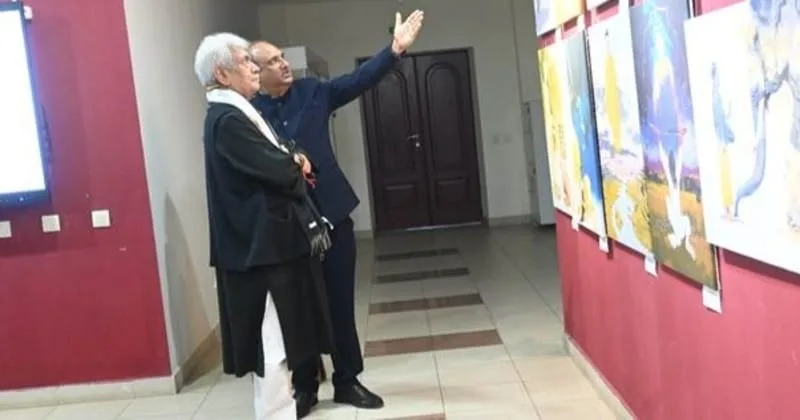
As part of the First Exposition of the Sacred Relics of Bhagwan Buddha in the Republic of Kalmykia, Russian Federation, a special art exhibition was organised, showcasing the works of eminent Indian artist, Padma Shri Shri Vasudeo Kamath. Curated for this historic cultural exchange, the exhibition offered a compelling visual narrative of the life and teachings of Bhagwan Buddha, blending artistic mastery with philosophical depth.
The exhibition was inaugurated by Keshav Prasad Maurya, Deputy Chief Minister of Uttar Pradesh, in the presence of dignitaries, including Lieutenant Governor of J&K Manoj Sinha, senior officials from India’s Ministry of Culture, and representatives from the Government of Kalmykia.
Organised by the National Museum, New Delhi, under the Ministry of Culture, Government of India, in collaboration with the National Museum of the Kalmyk Republic, the exposition aims to deepen cultural and spiritual connections between India and Russia, rooted in their shared Buddhist heritage.
Art Exhibition: “Depicting the life of the Buddha: From renunciation to enlightenment”
Featuring 28 original paintings created over a year, the exhibition traced the Buddha’s spiritual journey, from the renunciation of Sumedha in the Dipankara Buddha era to the attainment of enlightenment and his final teachings. Highlights included depictions of Prince Siddhartha’s departure, the defeat of Mara, the first sermon at Sarnath, the gift of the Jetavana monastery, and the surrender of Angulimala.
Kamath’s paintings, noted for their precise technique and subtle colour palette, exemplified a synthesis of classical Indian aesthetics and universal human emotion. Each canvas captured a moment of profound transformation, inviting viewers into both artistic and meditative reflection.
The exhibition attracted wide audiences, monks, scholars, students, critics, and the general public, who praised the work for its spiritual resonance and technical brilliance. Many described it as a bridge between Indian artistic traditions and Russian appreciation of Buddhist values.
In a generous act of cultural friendship, Kamath donated all 28 paintings to the National Museum of Elista. He described the donation as “a humble offering of art from India to the land where the Dharma continues to live in people’s hearts.” In gratitude, the museum’s Director presented him with a Letter of Appreciation and a commemorative gift, recognising the donation as a lasting symbol of Indo-Russian cultural harmony.
Artist Profile: Shri Vasudeo Kamath
Born in Karakal, Karnataka, in 1956, Shri Vasudeo Kamath is among India’s most acclaimed painters. A graduate of Sir J. J. School of Art, Mumbai, where he earned top honours in 1977, Kamath has built a distinguished career over four decades.
Celebrated for his versatility, Kamath’s works span portraiture, landscapes, and conceptual art across media such as oil, acrylic, and watercolour. His accolades include the Draper Grand Prize by the Portrait Society of America, multiple gold medals from the Bombay Art Society, and honours at international salons.
Kamath’s conceptual paintings delve into human consciousness, combining philosophical inquiry with visual expression. His art often reflects timeless spiritual values, compassion, renunciation, and awakening. In 2025, the Government of India awarded him the Padma Shri for his contributions to the field of art.
Special lectures by Professor Vinay Kumar Rao
As part of the academic exchange accompanying the exposition, Professor Vinay Kumar Rao, of Jawaharlal Nehru University’s Special Centre for the Study of North East India, delivered three lectures exploring Buddhist art and cultural linkages across Asia.
“Depiction of Nibbāna Scenes: Comparative Study between India and Myanmar” – Presented at Kalmyk State University, Elista.
“The Splendor of Buddhist Sculpture at Sāñcī” – Delivered at the Kalmyk Scientific Centre of the Russian Academy of Sciences on 16 October 2025.
“Bodwins from Burmā and its Predecessors in Bhārat” – Delivered at the National Museum of the Kalmyk Republic on 17 October 2025. The lecture series attracted scholars, researchers, and the public, sparking insightful discussions on Buddhist archaeology, iconography, and the philosophical threads connecting India and Southeast Asia.
Lecture by Prof. Adarasupally Nataraju
As part of the academic program, Prof. Adarasupally Nataraju, Chairperson of the Centre for Philosophy, JNU, delivered a profound lecture exploring the nature of Bodhicitta, the enlightened mind, and its relation to Dharmakāya, the universal reality in Mahāyāna Buddhism.
Drawing from Nāgārjuna’s and Sthiramati’s interpretations, Prof. Nataraju discussed Bodhicitta as a transcendental consciousness, beyond the five skandhas and empirical categories, embodying both wisdom (prajñā) and compassion (karuṇā). He emphasised its role in the Bodhisattva path and its ethical implications for peaceful coexistence.
Using metaphors such as Indra’s Net and insights from scholars like D.T. Suzuki and Theresa Der-Ian Yeh, he illustrated how Bodhicitta represents a reflection of ultimate reality in the human heart. The lecture emphasised Pratītya-samutpāda (Dependent Origination) as a key to understanding the interdependent nature of life and the cultivation of compassion.
Prof. Nataraju concluded that the realisation of Bodhicitta leads to Anuttara-samyak-sambodhicitta, supreme enlightened consciousness, offering a philosophical foundation for peace grounded in interconnectedness and spiritual awakening.
The Exposition of the Sacred Relics of Bhagwan Buddha in Kalmykia, encompassing visual art, academic dialogue, and spiritual reflection, was a testament to the enduring ties between India and Russia. Through the generosity of Vasudeo Kamath and the scholarly contributions of Professors Rao and Nataraju, the event illuminated the profound legacy of Buddhist thought and art as a unifying force across cultures.
As part of India’s ongoing Cultural Outreach, the exposition reaffirmed the timeless relevance of Buddhism in promoting compassion, wisdom, and global harmony.












Comments