





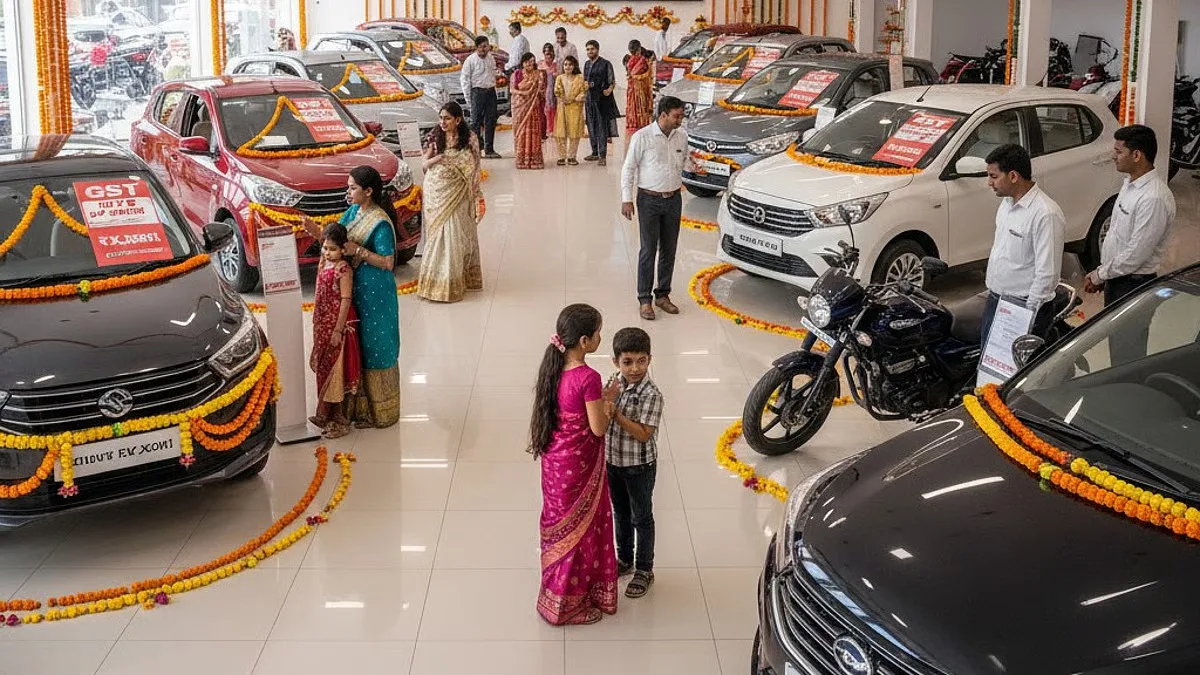
India’s automobile sector is witnessing a strong revival, with passenger vehicle and two-wheeler dispatches recording sharp growth in September, driven by GST 2.0 tax rationalisation and festive season demand.
According to the Society of Indian Automobile Manufacturers (SIAM), passenger vehicle (PV) dispatches rose 4 percent year on year to 3,72,458 units, while two-wheeler sales jumped 7 percent to 21,60,889 units.
The reforms, which came into effect on September 22, have sparked renewed optimism across the industry, particularly in small cars and scooters, which are showing strong sales recovery after years of stagnation.
Record sales despite late rollout
SIAM President Shailesh Chandra noted that despite the new GST rates being implemented for only the last nine days of September, the month saw the highest-ever sales for passenger vehicles, two-wheelers, and three-wheelers.
“In spite of the new GST rates covering just nine days, vehicle sales across all segments have achieved record numbers for September,” said Chandra.
Three-wheeler dispatches also showed a steady increase of 5.5 percent year-on-year, reaching 84,077 units, reflecting stronger demand from urban and semi-urban mobility segments.
Quarterly trends: PVs stable, 2Ws accelerate
In the July–September quarter, passenger vehicle sales totaled 10,39,200 units, slightly down 1.5 percent from the same period last year. Utility vehicles continued to dominate with two-thirds of total PV sales, though the segment saw a 2 percent dip year on year.
However, small cars made a notable comeback, benefitting from reduced GST rates, which brought down retail prices and reignited interest in the entry-level segment.
Two-wheelers continued to outperform, with quarterly sales up 7 percent to 55,62,077 units. The scooter segment led this growth with a 12 percent jump, while motorcycles grew by 5 percent, supported by improved affordability, rural demand, and better financing options.
Three-wheelers posted their highest-ever Q2 sales at 2,29,239 units, marking a 10 percent increase year-on-year, largely driven by last-mile connectivity and expanding shared mobility services.
GST 2.0: Game changer for auto affordability
According to a report by Grant Thornton Bharat, the recently introduced GST 2.0 has emerged as a major catalyst in reviving India’s automotive market. The most significant policy shift is the reduction of GST on small cars from 28 percent to 18 percent, covering petrol, diesel, and hybrid vehicles within specific engine and length categories.
This has translated into a price reduction of up to Rs 1 lakh per car, or roughly 12 percent of the total vehicle cost, making small cars more accessible to budget-conscious consumers.
The report found that 72 percent of prospective buyers had postponed purchases in anticipation of the tax cut, a clear indicator that GST reform was the trigger for this buying wave.
Festive surge and buyer sentiment
Post-GST rollout, retail vehicle sales surged 5.8 percent year-on-year in September, and an impressive 31.8 percent growth was recorded during Navratri, reflecting both improved affordability and festive enthusiasm.
“The GST 2.0 changes and festive spirit have combined to create a perfect storm for vehicle sales. We are seeing a visible revival in Tier-2 and Tier-3 cities, where price sensitivity is high,” the report noted.
Even larger vehicles, now under a 40 percent GST slab but without the earlier 17–22 percent compensation cess, are witnessing improved demand, benefiting mid-size and luxury car buyers as well.
Supply chain and industry benefits
The GST Council’s decision to introduce a uniform 18 percent tax rate on auto parts has simplified the supply chain, reducing classification disputes and compliance burdens for OEMs and component suppliers.
The streamlined tax structure ensures better cost predictability and improved margins for manufacturers, allowing some savings to be passed on to consumers in the form of reduced prices or added features.
This rationalisation will not only boost end-user affordability but also strengthen India’s automotive manufacturing ecosystem, particularly in export-oriented production and component manufacturing.
Future outlook: Small cars, big comeback
The GST 2.0 reforms are expected to rejuvenate the small car market, which had seen declining interest over the past few years. The report notes that 41 percent of respondents plan to purchase a vehicle within the next four months, a significant jump from just 18 percent in the previous six months.
With manufacturers offering aggressive festive discounts, streamlined tax rates, and easier financing, the auto industry is set for one of its most promising festive seasons in recent years.
India’s automotive industry appears firmly on the road to recovery. With GST 2.0 reducing costs, festive demand surging, and buyers returning to showrooms, the coming months could mark a historic turnaround for the sector, especially in Tier-2 and Tier-3 cities, where affordability remains the key driver.















Comments