





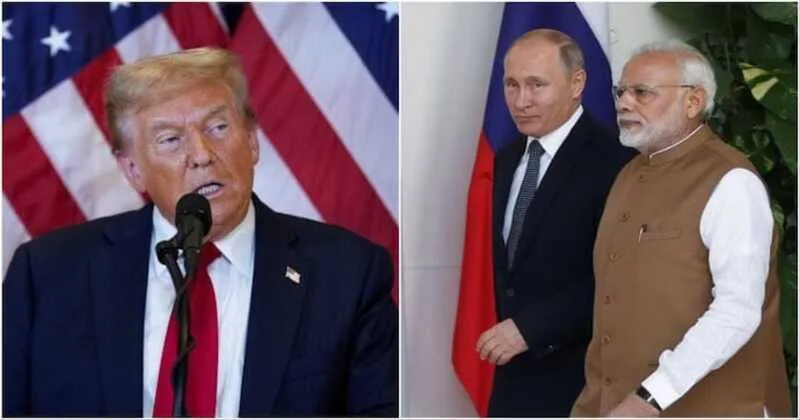
International oil prices rebounded sharply after US President Donald Trump claimed that Prime Minister Narendra Modi had assured him that India would stop purchasing oil from Russia. Trump’s statement seen as a calculated attempt to manipulate global oil markets, came despite his long record of unreliable claims. Nevertheless, the remarks caused immediate ripples in the commodity markets. WTI crude prices rose 0.82 per cent to $58.75 per barrel, while Brent crude gained 0.78 per cent to $63.29. Trump said that Modi had personally informed him during a conversation on Wednesday that India would stop buying Russian oil, calling it a “big step.” He went further to say that he would “bring China to the same position.” The comment, delivered without diplomatic restraint, triggered both market reactions and diplomatic discomfort. India has not officially responded to Trump’s remarks, maintaining a studied silence.
India and China lead the race for Russian oil
According to data from the Center for Research on Energy and Clean Air (CREA), both India and China have emerged as top buyers of Russian crude. In September, China imported Russian oil worth $3.2 billion, while India purchased $2.5 billion (around Rs 25,600 crore). China remains the world’s largest importer of Russian oil, followed by India. When coal and other refined petroleum products are included, China’s total energy imports from Russia amounted to $5.5 billion in September, while India’s reached $3.6 billion. After the two Asian giants, Turkey, the European Union, and South Korea rank among the top buyers of Russian energy commodities. China continues to dominate imports of Russian oil, LNG, and coal, while Turkey has become a significant buyer of refined petroleum products and pipeline gas. Despite this, Trump has singled out India for punitive action, announcing that a 25 per cent penalty duty would be added to the existing 25% import tariff, taking the total duty on Indian goods to 50 per cent.
Trump’s attack on India as an attempt to divert attention from his domestic troubles and influence global oil prices. By framing India’s energy trade with Russia as a political issue, Trump has sought to create pressure on New Delhi while bolstering US oil exports. India is reportedly planning to purchase US crude in larger quantities to diversify its import basket. Government estimates suggest that India could buy an additional $15 billion (about Rs 1.3 lakh crore) worth of American oil.
India currently enjoys a trade surplus of $42.7 billion with the United States, a figure that has long irked Trump. The White House is keen to reduce this gap, and India’s increased purchase of American oil could help narrow the deficit. For Washington, this would be a much-needed relief amid a slowing economy and a deepening political crisis for Trump.
Trump faces major legal and political setbacks
Even as he tried to project strength internationally, Trump suffered a major domestic setback. A federal court in San Francisco blocked his administration’s move to lay off thousands of government employees amid an ongoing government shutdown. The plan to dismiss 4,000 workers was halted, but reports indicate that the real target was to lay off nearly 10,000 federal employees.
The Senate’s failure to pass a funding bill has extended the shutdown for another two weeks, worsening the economic strain. The deadlock, now in its fourth week, has left large sections of the government paralysed. Republican leaders have accused Democrats of intransigence, while Trump is holding the government hostage for political leverage. The prolonged shutdown has raised fears that even US military personnel could miss their salaries in the coming pay cycle.
US–China trade war intensifies
Meanwhile, the US–China trade war shows no signs of easing. Although diplomatic channels for talks between Trump and Chinese President Xi Jinping have been reopened, the confrontation continues to escalate. US Treasury Secretary Scott Bessant warned that China’s move to restrict exports of rare earth minerals could have severe consequences for the global economy. In response, Trump announced an additional 100% import tariff on Chinese goods, ostensibly to counter “rare earth control.” The new tariffs are expected to take effect from November 1, though no formal confirmation has been made.
Trump also lashed out at China’s soybean import policy, accusing Beijing of deliberately hurting American farmers by refusing to buy US soybeans. In a post on his Truth Social platform, Trump claimed that if China does not want US soybeans, America can “produce its own cooking oil.”
Gift Nifty is positive today, market to continue gains; China moves against India
Despite the global uncertainty triggered by Trump’s statements and the ongoing trade wars, stock markets across the world showed signs of resilience. The S&P 500 rose 0.40 per cent, the Nasdaq gained 0.66%, while the Dow Jones Industrial Average fell slightly by 0.04 per cent. In Asia, Japan’s Nikkei gained 0.73%, China’s Shanghai Composite rose 0.20 per cent, and Hong Kong’s Hang Seng advanced 0.41 per cent. US stock futures continued to trade in the green, Dow futures up 0.2 per cent, S&P 500 up 0.1 per cent, and Nasdaq futures up 0.2 per cent. Investors appeared to shift focus from political turmoil to corporate earnings for the September quarter, offering some optimism amid global tensions.
In India, the derivatives index GIFT Nifty traded 55 points higher on thursday morning, indicating continued strength in domestic markets. The Sensex and Nifty, both of which gained around 0.7 per cent the previous day, are expected to maintain their upward momentum. Market sentiment has also been buoyed by Commerce Ministry Secretary Rajesh Agrawal’s statement that trade agreement negotiations between India and the European Union have entered the final stage. India’s export performance in September improved despite tariff challenges from the US, although the trade deficit touched an 11-month high.
Several major Indian companies, Infosys, Wipro, Nestlé, Zomato (Eternal), Jio Financial Services, JSW Infrastructure, Indian Bank, LTI Mindtree, Vari Energies, and Metro Brands, are set to announce their quarterly results today. HDB Financial Services reported a decline in profit yesterday, while Axis Bank’s profit fell from Rs 6,918 crore to Rs 5,090 crore. In a major boost to India’s industrial sector, Hyundai Motor has announced plans to invest Rs 45,000 crore in the country by 2030.
Adding to regional unease, China’s growing hostility toward India is causing fresh concern. Beijing’s new export restrictions on rare earth minerals are expected to severely affect India’s electric vehicle (EV), electronics, and machinery manufacturing sectors. The Chinese government’s move to file a complaint at the World Trade Organization against India’s EV subsidy policy has also rattled investors. These moves are part of China’s broader strategy to undercut India’s growth in the clean technology and manufacturing sectors.
Rupee strengthens sharply, gold soars
Meanwhile, the Indian rupee recorded its biggest single-day gain in four months, strengthening by 73 paise to close at Rs 88.08 against the dollar. The surge came as the dollar weakened globally amid expectations of another US interest rate cut. The strong performance of Indian equities also supported the rupee. However, the global economic turbulence, combined with the US shutdown and the continuing US–China trade conflict, has driven investors toward safe-haven assets. Gold prices hit an all-time high, crossing $4,200 per ounce for the first time. At one point, the price reached $4,234.60 before settling at $4,228.2. In India, the price of gold is expected to cross Rs 95,000 per 10 grams today, with market watchers saying it could even touch Rs 96,000 soon.
Trump’s claim about Modi’s assurance on Russian oil is less about diplomacy and more about optics. With domestic troubles mounting and international credibility eroding, Trump’s statement appears to be a deliberate ploy to boost oil prices, pressure India, and divert attention from his political and economic setbacks. India, for its part, continues to pursue a pragmatic policy of energy diversification, balancing national interests, economic imperatives, and global partnerships.










Comments