RSS at 100: The saviour and survivor
June 5, 2026
  • Read Ecopy
  • Circulation
  • Advertise
  • Careers
  • About Us
  • Contact Us
Android AppiPhone AppArattai
Organiser
  • ‌
  • Bharat
    • Assam
    • Bihar
    • Chhattisgarh
    • Jharkhand
    • Maharashtra
    • View All States
  • World
    • Asia
    • Europe
    • North America
    • South America
    • Africa
    • Australia
  • Editorial
  • International
  • Opinion
  • RSS @ 100
  • More
    • Op Sindoor
    • Analysis
    • Sports
    • Defence
    • Politics
    • Business
    • Economy
    • Culture
    • Special Report
    • Sci & Tech
    • Entertainment
    • G20
    • Azadi Ka Amrit Mahotsav
    • Vocal4Local
    • Web Stories
    • Education
    • Employment
    • Books
    • Interviews
    • Travel
    • Law
    • Health
    • Obituary
  • Subscribe
    • Subscribe Print Edition
    • Subscribe Ecopy
    • Read Ecopy
  • ‌
  • Bharat
    • Assam
    • Bihar
    • Chhattisgarh
    • Jharkhand
    • Maharashtra
    • View All States
  • World
    • Asia
    • Europe
    • North America
    • South America
    • Africa
    • Australia
  • Editorial
  • International
  • Opinion
  • RSS @ 100
  • More
    • Op Sindoor
    • Analysis
    • Sports
    • Defence
    • Politics
    • Business
    • Economy
    • Culture
    • Special Report
    • Sci & Tech
    • Entertainment
    • G20
    • Azadi Ka Amrit Mahotsav
    • Vocal4Local
    • Web Stories
    • Education
    • Employment
    • Books
    • Interviews
    • Travel
    • Law
    • Health
    • Obituary
  • Subscribe
    • Subscribe Print Edition
    • Subscribe Ecopy
    • Read Ecopy
Organiser
  • Home
  • Bharat
  • World
  • Operation Sindoor
  • Editorial
  • Analysis
  • Opinion
  • Culture
  • Defence
  • International Edition
  • RSS @ 100
  • Magazine
  • Read Ecopy
Home Bharat

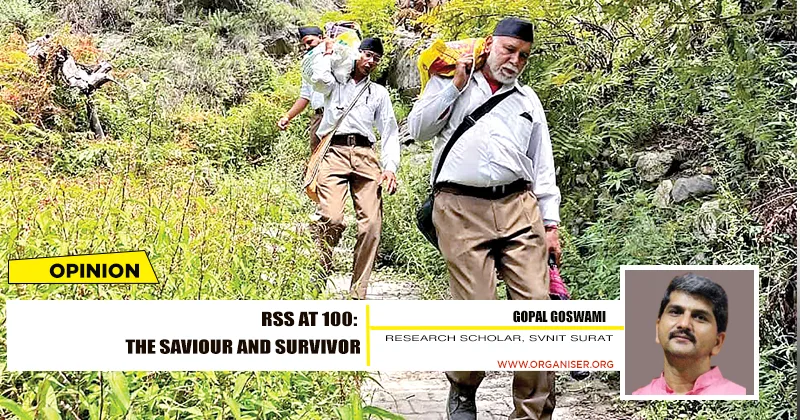
RSS at 100: The saviour and survivor

As RSS marks its centenary year, it’s time to acknowledge its extraordinary contribution, resilience and sacrifice in nation building. Its tireless Seva, inculcating nationalism and working for Hindu unity have made it a great survivor despite three bans imposed by anti-national Congress regimes

Gopal GoswamiGopal Goswami
Oct 12, 2025, 08:40 pm IST
in Bharat, Opinion
Follow on Google News
FacebookTwitterWhatsAppTelegramEmail

As Bharat marks centenary of the Rashtriya Swayamsevak Sangh (RSS) in 2025, founded on Vijayadashami in 1925 by Dr Keshav Baliram Hedgewar in Nagpur, the organisation’s role in nation-building remains a tapestry of quiet heroism and unyielding resolve. Dr Hedgewar envisioned RSS as a voluntary body to foster Hindu unity, character-building, and selfless service or Sewa to strengthen the cultural and spiritual fabric of Bharat.

Today, with over 70,000 Shakhas across the nation, RSS boasts millions of Swayamsevaks (volunteers) and thousands of Pracharaks (full-time life workers), who renounce personal lives for societal upliftment. Yet, this journey has been scarred by bans, brutal crackdowns, regional adversities, and relentless vilification. Amidst these trials, RSS’s commitment to unbiased service stands as a beacon, transcending caste, creed, and religion.

Nationwide Struggles & Sacrifices

RSS’s ethos is rooted in Samarpan (total dedication), exemplified by Madhav Sadashiv Golwalkar (Guruji), who succeeded Dr Hedgewar and expanded the Sangh from a handful of Shakhas to a pan-Indian movement. Pracharaks, estimated at 4,000 today, eschew families, wealth, and comfort, living austerely to propagate the RSS’s ideals of discipline, martial training, and civic duty. Swayamsevaks, ordinary men and women attending daily Shakhas, embody this through action, from Partition-era rescues to modern disaster response.

Embracing Martyrdom

During the 1947 Partition, RSS volunteers orchestrated one of the largest civilian relief operations in history. In Punjab and Bengal, Swayamsevaks formed human chains to protect fleeing Hindus and Sikhs from rioting Muslim mobs, rescuing over 100,000 refugees and establishing 500 refugee camps. Tales abound of unnamed heroes: in Lahore, a single Swayamsevak shielded 200 families, losing his life to Muslim extremists. In Jammu, over 200 RSS activists died defending Hindus against Pakistani tribal invaders in 1947-48, earning them the moniker “Kashmir Martyrs.” These sacrifices extended to the freedom struggle; though RSS avoided direct confrontation with British authorities per Hedgewar’s strategy of cultural revival, Swayamsevaks participated in Congress-led movements like Quit India, with Guruji Golwalkar urging underground resistance.
Post-Independence, Pracharaks like Eknath Ranade mobilised for projects like the Vande Vivekanand Rock Memorial, Mataram Temple and Boat Clubs, symbolising national integration. In the 1962 Sino-Indian War, RSS volunteers aided the Army, digging trenches and providing logistics, with many perishing in Arunachal. Today, amid urban alienation, Swayamsevaks run youth programmes combating drug abuse and radicalisation, their sacrifices often invisible, lost jobs, family strains, or jail terms for ideological fidelity.

Shadow of Bans

RSS’s loyalty to Bharat has invited three bans, each a saga of state-sponsored persecution. The first, in February 1948 after Mahatma Gandhi’s assassination by Nathuram Godse (a former RSS member who had quit it in 1930), saw the organisation branded as a threat to secularism. Over 20,000 Swayamsevaks were arrested without trial, many enduring tortures in Agra and Bareilly jails, beatings, sleep deprivation, and forced confessions linking RSS to the murder. Mobs, egged on by inflammatory reports, torched RSS offices and homes; in Maharashtra, 150 families were displaced. Home Minister Sardar Patel, initially sympathetic, demanded the ban’s lift in July 1949.

Rampant Torture During Emergency

The second ban, during Indira Gandhi’s Emergency (1975-77), was the darkest hour. Declared on June 25, 1975, it targeted RSS as an “anti-democratic” force, jailing over 80,000 members, including Sar Sanghchalak Balasaheb Deoras, under MISA (Maintenance of Internal Security Act). Prisons became torture chambers: electric shocks, solitary confinement, and sexual humiliation were rampant, as documented in survivor accounts like those of George Fernandes’ allies. At least 87 RSS workers died in custody or from injuries, including Pracharak Narayanrao Deshpande, beaten to death in Yerwada Jail. Underground networks of coded postcards and secret meals sustained the flame; Narendra Modi, then a young Pracharak, coordinated resistance from hideouts. The ban was lifted in 1977 after the Janata Party’s victory, crediting RSS’s mobilisation for restoring democracy.

The third ban, post-Babri Masjid demolition in December 1992, accused RSS of inciting violence. Under PV Narasimha Rao’s Congress regime, leaders were detained, assets frozen, and Shakhas shuttered nationwide. Though shorter (lifted in 1993 after a tribunal found no evidence), it echoed prior smears, with police raids and media trials amplifying fear. These episodes, imposed by Congress-led governments, reveal a pattern. RSS became a scapegoat for political expediency, its members bearing the brunt of extrajudicial wrath.

Sacrificing Lives in Hostile Terrains

RSS’s expansion beyond Hindi heartlands demanded extraordinary grit. In Bengal, post-1946 Calcutta Killings (5,000 Hindus dead), Swayamsevaks rebuilt shattered communities, establishing 1,492 Shakhas by 2015 despite CPM’s red terror. During 1971 Bangladesh War riots, they sheltered 50,000 refugees. Pracharak Jitendra Das braved Naxal threats to revive the Sangh, sacrificing his  education. Today, amid Islamist violence, RSS aids Hindu victims in Murshidabad.
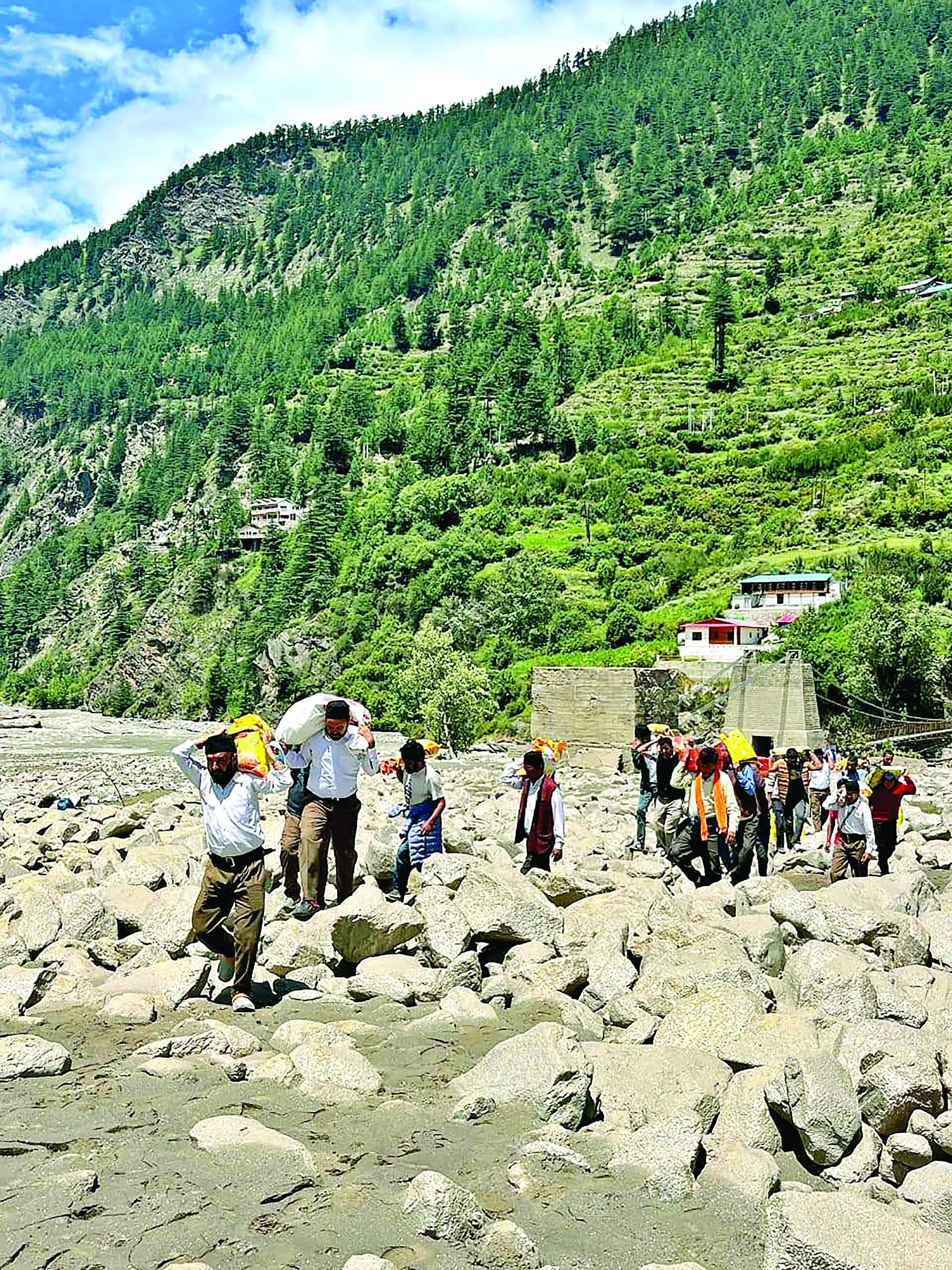
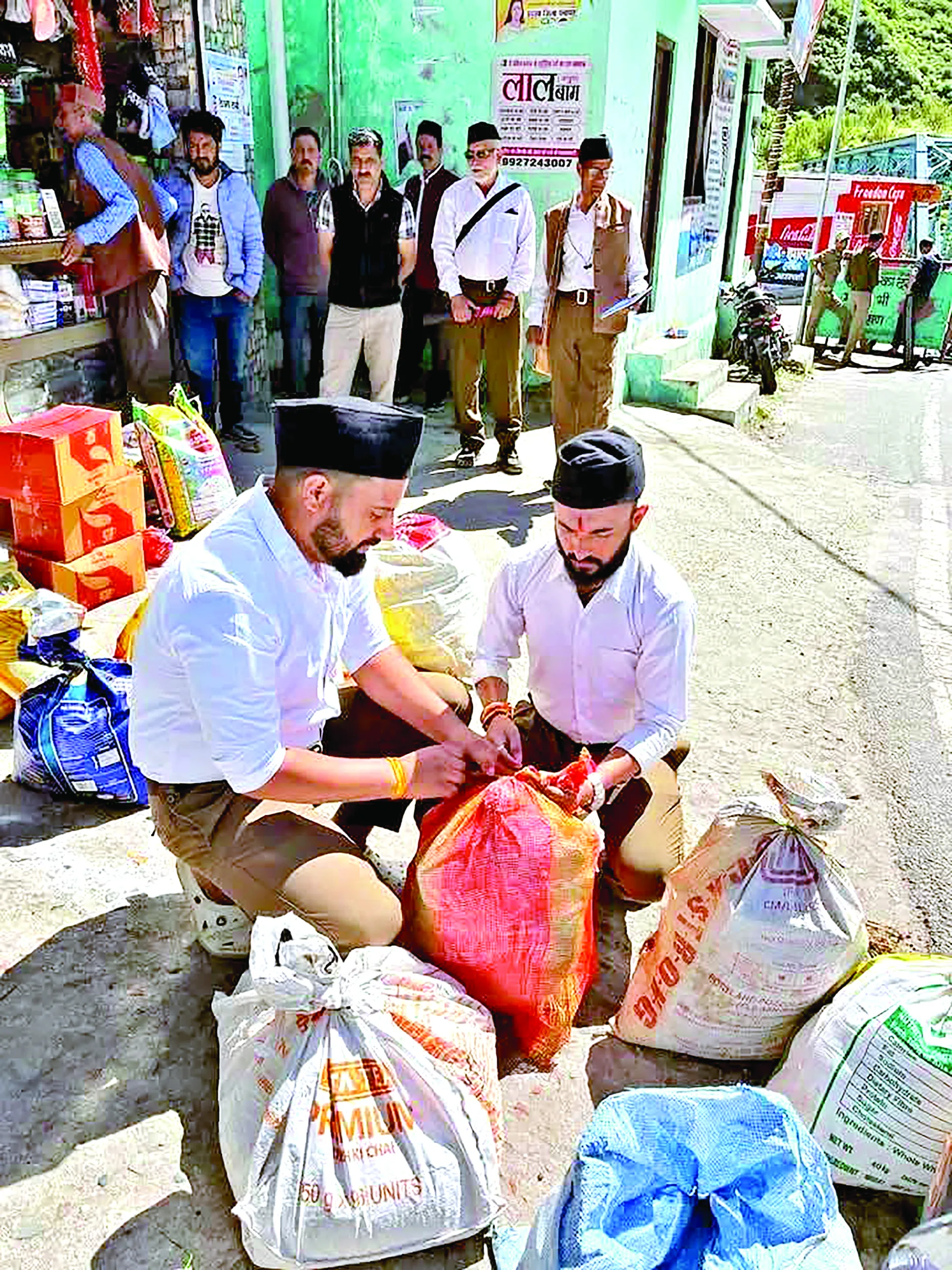
Swayamsevaks providing relief to flood victims in Uttarakhand

In the North East, RSS shattered stereotypes of “mainland” intrusion. Starting in 1950s in Assam, Pracharaks like R.K. Madhukar trekked jungles to plant 1,000+ shakhas amid insurgencies. In Manipur (107 Shakhas), they mediated Naga-Meitei clashes; in Arunachal (36 Shakhas), volunteers died countering Chinese incursions in 1962. Relief during 2017 floods fed 10,000 tribals, fostering trust across Christian-majority lines. Kerala’s 6,845 Shakhas mask brutal struggles against LDF’s atheism and SFI violence, over 200 attacks since 2017, including murders of Swayamsevaks like Sajith Santhosh in 2021. Yet, during 2018 floods, RSS deployed 5,000 volunteers, distributing 1 lakh meal kits to all faiths, earning praise from Chief Minister Pinarayi Vijayan.

In Karnataka, North Karnataka floods saw RSS build 500 shelters in 2005, aiding Dalits and Muslims alike. Tamil Nadu’s 2,060 Shakhas counter missionary conversions via Hindu Munnani; during 2004 Tsunami, Seva Bharati rebuilt 1,000 coastal homes for fishermen of all castes. These regional odysseys underscore RSS’s adaptability, sacrifices in blood and isolation yielding grassroots bonds.

Enduring the Storm: Propaganda’s Venomous Assault

RSS’s rise has spawned a cottage industry of defamation, orchestrated by ideological foes. Congress, from Nehru’s “communalist” label to Rahul Gandhi’s 2016 remark equating RSS with “violence” (leading to a defamation suit the Supreme Court rebuked), has weaponised bans and smears. Leftists and Communists, via CPM’s Kerala goons or national outlets like Frontline, paint RSS as “fascist” akin to Nazis, ignoring its non-violent ethos. Liberals in media, The Guardian and Caravan, amplify unproven terror links (e.g., 2008 Malegaon blast), while Islamists and Missionaries decry “anti-minority” pogroms, as in 2002 Gujarat coverage. World media echoes this: NPR calls RSS “Hindu nationalism’s architect,” fuelling global Islamophobia accusations. These campaigns, often ahistorical, aim to delegitimise RSS’s service, yet Swayamsevaks persist, their truth in deeds.

Sewa’s Silent Revolution: Service Beyond Boundaries

At RSS’s core is Sewa Bharti, coordinating 35,000+ projects sans discrimination, “service to man is worship of God.” Unbiased aid defines it: during 2020 COVID-19 lockdown, 1 crore meals reached Muslims in Delhi’s Jama Masjid and Christians in Kerala’s coastal belts. In 2013 Uttarakhand floods, 4,000 volunteers rescued 50,000, building inter-faith shelters and 2025 Punjab-J&K deluges saw 10,000 kits for Sikhs and tribals. Education via Vidya Bharati’s 22,000 schools (1.2 million students) eradicates caste barriers; health camps treat 2 crores annually, including leprosy patients from all faiths. A slum boy’s transformation via Seva Bharti, from abandonment to community leader, exemplifies this: aid without conversion, unity without proselytism. In a fractured world, RSS’s century affirms true nationalism blooms in sacrifice and service. As Pracharaks whisper to flames in hidden Shakhas, their light endures, unbowed, unbound. Millions of Swayamsevaks are working tirelessly to inculcate Sewa Bhav and Rashtra Prem in every Bharatiya. This journey has reached a milestone at 100, yet the journey has too far to go and achieve.

Topics: Politics of BansRashtriya Swayamsevak SanghChief Minister Pinarayi VijayanVidya Bharati’sHindu nationalism’s architectEknath Ranade mobilisedHindu victims in Murshidabad
Gopal Goswami
Gopal Goswami
Gopal Goswami, Columnist and founder, Surat Lit Fest Gopal Goswami stands at the intersection of intellectual depth, grassroots experience, and an unwavering commitment to nation-building. He has done his Ph. D from Sardar Vallabhbhai National Institute of Technology (SVNIT), Surat, Goswami brings to the contemporary discourse a rare blend of academic precision and lived reality. With a postgraduate degree in Public Administration and a doctorate in Business Management, his work transcends theoretical inquiry to engage directly with India’s socio-economic challenges. Rooted in the remote Himalayan village of Bageshwar, Uttarakhand, Goswami's early life, shaped by a disciplined army father and a resilient farmer mother, offers a firsthand perspective on the aspirations and struggles of rural India. These formative years, spent in government schools and colleges, laid the foundation for his lifelong empathy for the common citizen. His activism during the Mandal Commission agitation and the Uttarakhand statehood movement further cemented his commitment to social equity and justice. Goswami’s three-decade-long career in the construction sector, including leadership roles in projects of national importance and his current stewardship of the GAP Group in the ambitious Dholera SIR, has equipped him with a practical understanding of development and policy implementation. His association with the Rashtriya Swayamsevak Sangh (RSS) and his humanitarian efforts during the COVID-19 crisis highlight his deep engagement with societal welfare. As the founder of the Surat Literature Festival and a columnist for leading national dailies, Goswami also plays a pivotal role in shaping public thought. His upcoming book on India’s social welfare schemes, especially the Pradhan Mantri Awas Yojana in Surat, reflects his nuanced understanding of public policy and its impact on everyday lives. Through this work, Gopal Goswami emerges not only as a scholar but also as a vital voice in India's journey toward an inclusive and empowered future. www.gopalgoswami.com He is Chairman of www.gapgroup.in , www.jkprojectsindia.com www.greenmentors.in , www.srtlitfest.com [Read more]
ShareTweetSendShareSend
✮ Subscribe Organiser YouTube Channel. ✮
✮ Join Organiser's WhatsApp channel for Nationalist views beyond the news. ✮
Previous News

“To Oppose the RSS Was Never My Intention” – Dr. B.R. Ambedkar

Next News

Bharat Manthan: Churning on restoring development

Related News

VHP International President Alok Kumar

No place for Jihadi extremism in the modern world; ideological supporters must also be held accountable: Alok Kumar Ji

Dr. Purnendu Saxena, Madhya Kshetra Sanghachalak (Madhya Pradesh and Chhattisgarh) at the concluding ceremony of the Sangh Shiksha Varg (Students and Professionals), organised by the Mahakaushal Prant of the RSS

Family values & cultural upbringing can prevent religious conversions: Dr Purnendu Saxena, Madhya Kshetra Sanghachalak

Assam: 20-day Karyakarta Vikas Varg concludes

Assam: 20-day Karyakarta Vikas Varg concludes; Karyakartas asked to remain vigilant against manufactured conflict

Sunil Ambekar, Akhil Bharatiya Prachar Pramukh while addressing a special seminar of journalists and editors in Nagpur

RSS harbours no enmity towards anyone; it embraces the spirit of dialogue with all: Sunil Ambekar

Bhayyaji Joshi, Akhil Bharatiya Karyakarini Member of the Rashtriya Swayamsevak Sangh at the release of the Marathi translation of American Jewish author Dana Mariam’s book The Untold Story of Sita

Ramayana must be read with an open-mind, not merely through faith: Bhayyaji Joshi of RSS

Rashtra Sevika Samiti Organises Path Sanchalan in Rayagada

Odisha: Rashtra Sevika Samiti organises Path Sanchalan in Rayagada

Load More

Latest News

Former CPM leader PP Divya - Late Naveen Babu, ADM. (Left to Right)

Kannur ADM Naveen Babu’s death case: Keralam Cabinet approves CBI enquiry

(Left) Ramalinga Reddy (Right) KH Muniyappa

Karnataka: Ramalinga Reddy resigns, Muniyappa voices displeasure; Congress rebellion grows over portfolio allocation

MP Child Rights Commission uncovers massive record discrepancies at illegal residential Madrasa

MP Child Rights Commission uncovers massive discrepancies at Mandsaur Madrasa, questions fate of missing girls

Barkatullah University to be renamed as Vagdevi Bhojpal University

MP: Barkatullah University to be renamed as Vagdevi Bhojpal University; Varsity’s executive council approves proposal

How the Gulf Crisis Is Rewriting the Global Energy Order and Why India Holds the Next Ace

How the Gulf Crisis Is Rewriting the Global Energy Order and Why India Holds the Next Ace

Senior Advocate Prashant Bhushan

Delhi Anti-Hindu Riots: Prashant Bhushan’s ‘Cover Blown’? Held meetings, conspired with anti-nationals Umar, Sharjeel

Russia pitches for the co-production of Fifth Generation Su-57 with India

Russian President Putin renews Su-57 offer to India; Signals full access to 5th gen stealth fighter jet technology

Representative Image

Karnataka Terror Link Probe: Alla Baksh arrested in Tumakuru over links with foreign terrorists

From the Vedas to modern sustainability (This is an AI Generated image)

World Environment Day: Rediscovering Vedic ecology, ancient wisdom for a green future

K Annamalai Resigns from BJP, Party accepts his resignation

Ex- Tamil Nadu party chief K Annamalai quits from BJP, Nitin Nabin accepts resignation

Load More
  • Privacy
  • Terms
  • Cookie Policy
  • Refund and Cancellation
  • Delivery and Shipping

© Bharat Prakashan (Delhi) Limited.
Tech-enabled by Ananthapuri Technologies

  • Home
  • Search Organiser
  • Bharat
    • Assam
    • Bihar
    • Chhattisgarh
    • Jharkhand
    • Maharashtra
    • View All States
  • World
    • Asia
    • Africa
    • North America
    • South America
    • Europe
    • Australia
  • Editorial
  • Operation Sindoor
  • Opinion
  • Analysis
  • Defence
  • Culture
  • Sports
  • Business
  • RSS @ 100
  • Entertainment
  • More ..
    • Sci & Tech
    • Vocal4Local
    • Special Report
    • Education
    • Employment
    • Books
    • Interviews
    • Travel
    • Health
    • Politics
    • Law
    • Economy
    • Obituary
  • Subscribe Magazine
  • Read Ecopy
  • Advertise
  • Circulation
  • Careers
  • About Us
  • Contact Us
  • Policies & Terms
    • Privacy Policy
    • Cookie Policy
    • Refund and Cancellation
    • Terms of Use

© Bharat Prakashan (Delhi) Limited.
Tech-enabled by Ananthapuri Technologies