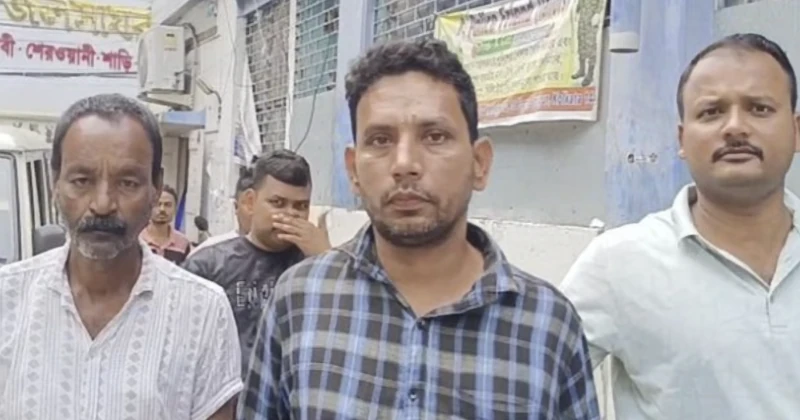
A major breakthrough by police in West Bengal has exposed a deep nexus of illegal immigration and forged documentation, leading to the arrest of Bangladeshi national Amir Hamza, who had lived in India for nearly a decade under the fake Hindu identity of “Sanjay Mondal.” The arrest, made in Champahati, Baruipur (South 24 Parganas district), has triggered alarm over the systematic infiltration of illegal migrants and the rampant misuse of India’s voter ID and Aadhaar systems.
According to police officials, Amir Hamza, a native of Bangladesh, illegally entered India in 2014 by crossing the Basirhat river border a known infiltration route after paying Rs 2,200 to a boatman. Upon arrival, he quickly assumed the fake identity of a local Hindu youth, “Sanjay Mondal,” and began to blend seamlessly into the community.
For the past ten years, Hamza lived an unassuming life, working on farms and at construction material shops in Baruipur. Locals described him as a quiet, hard-working man unaware that “Sanjay Mondal” was, in fact, a foreign national living under a fabricated identity.
Investigators revealed that Hamza procured a forged Indian voter ID card through a local intermediary by paying Rs 12,000. Using this document as a foundation, he further obtained other Indian identity proofs, including an Aadhaar card and even an Indian passport cementing his place within the system as a legitimate citizen.
During the recent identity verification drive, police discovered glaring inconsistencies in Hamza’s records. A search of his residence led to the recovery of both Indian and Bangladeshi identity documents, including a Bangladeshi voter ID card that confirmed his real name and nationality.
The operation exposed not only Hamza’s deception but also the broader underground network that facilitates illegal immigration through document manipulation and voter registration fraud a problem that has long plagued border districts like North 24 Parganas and South 24 Parganas.
Amir Hamza’s case underscores a growing security and demographic concern for West Bengal, where cross-border infiltration from Bangladesh continues to pose challenges to law enforcement and national security. Analysts note that such incidents, where infiltrators assume Hindu identities to blend into local populations, are becoming increasingly sophisticated involving collusion between local fixers, corrupt officials, and political operators.
The fact that Hamza not only obtained a voter ID but also participated in the democratic framework under a fake Hindu name directly raises questions about the integrity of the electoral rolls. “One illegal vote is not just a fraud on paper it’s a subversion of democracy itself,” a senior official commented.
The revelation has political overtones as well. With the arrest, even ruling Trinamool Congress’s local circles face questions over how such a deep infiltration remained undetected for nearly a decade. As one police source noted grimly, “Mamata Banerjee’s administration just lost one illegal vote but there may be hundreds more buried in the system.”
Police sources disclosed that Amir Hamza regularly sent money back to his family in Bangladesh, using informal channels. This points to an established cross-border economic network that enables illegal migrants to live comfortably in India while maintaining ties to their home country. Authorities suspect that several others may be living under similar false identities in South Bengal, exploiting the porous riverine border and loopholes in the documentation process.
The arrest of Amir Hamza has spurred intensified action by security agencies. A senior officer from Baruipur Police said, “This arrest is not just about one infiltrator. It exposes a chain a system that thrives on fake documentation, middlemen, and the political negligence that allows illegal immigrants to blend in.”
The police are now tracking the local network that helped Hamza acquire forged documents. Early findings indicate involvement of local agents who arrange voter cards for money, bypassing verification procedures a racket that could have national security implications if not dismantled.