





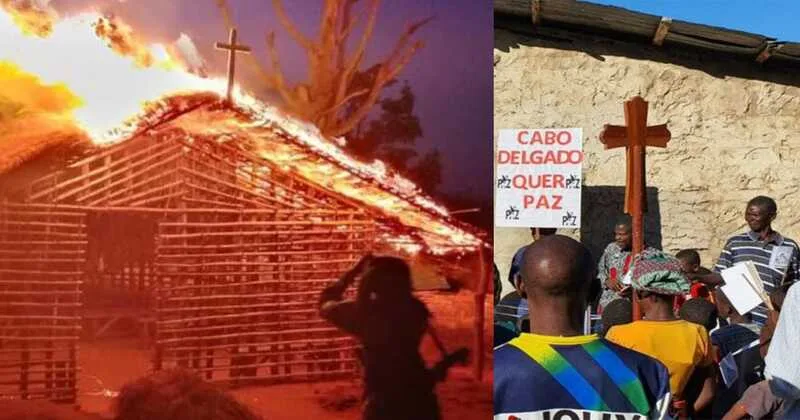
In a renewed wave of extremist violence, ISIS-affiliated militants have killed more than 30 Christians and destroyed at least seven churches in northern Mozambique over recent weeks, forcing over 50,000 residents to flee their homes in the Chiure district. The attacks, marked by extreme brutality and mass displacement, underscore the growing reach of Islamist militancy in the region and the mounting persecution of Christians.
The Islamic State Mozambique Province (ISMP), an affiliate of the global terror network, claimed responsibility for the assaults in the provinces of Cabo Delgado and Nampula. The group released a series of 20 photographs online, depicting gruesome scenes of beheadings, shootings and arson against Christian civilians and local communities. The releases were accompanied by statements celebrating the killings as part of the group’s ongoing campaign to establish an Islamic caliphate in Mozambique.
According to the Middle East Media Research Institute (MEMRI), ISMP issued multiple communiques acknowledging responsibility for specific incidents across northern Mozambique in late September. On September 25, the group claimed it had executed two Christians in Chiure-Velho village. The following day, a Christian man was shot dead in a separate attack. On September 28, militants killed four Christians in Macomia town, and another beheading occurred in the same district a day later. Recent assaults also included the burning of churches in Nacocha, Nacussa, Minhanha and Nakioto villages, where more than 100 homes were reduced to ashes.
Though Mozambique is a predominantly Christian nation, its northern provinces have a Muslim majority, making Christian communities particularly vulnerable to extremist targeting. ISMP, active in six districts of the country, has been expanding southward from its stronghold in Cabo Delgado, an area already scarred by years of insurgency and displacement.
Multiple terror attacks against numerous villages , displacing 50,000 across Northern Mozambique by isis (ISMP) which resulted in shootings and around 30 beheadings along with burning churches & stealing property.
Where are the university students?
Where is the mainstream media? pic.twitter.com/lMPuJrmDto— Cold957 (@cold957) October 8, 2025
The Mozambican government has intensified its counterinsurgency measures through renewed military cooperation with Rwanda. On August 27, the two countries reaffirmed their defense partnership under the Status of Forces Agreement, allowing Rwandan troops to continue supporting operations in Cabo Delgado. The Rwandan Defense Force, deployed since 2021, has played a critical role in repelling Islamist insurgents and reclaiming captured territories. The ongoing conflict has taken a devastating human toll. Since 2017, more than 6,000 people have been killed in the violence, and over a million residents have been displaced, according to international humanitarian assessments. Despite government efforts, attacks continue to erupt sporadically, destabilizing communities and hampering reconstruction.
Open Doors, a global Christian advocacy organization, reports that ISMP views Christians as “symbols of resistance,” prompting their deliberate targeting in the group’s violent campaigns. In 2024, the militants launched a campaign dubbed Kill Them Wherever You Find Them, intensifying attacks against Christian settlements. The Open Doors World Watch List 2025 ranks Mozambique as the 37th most dangerous country in the world to be a Christian, up from 39th the previous year. The report notes a sharp escalation in violence against religious institutions, with around 100 churches and Christian buildings attacked or closed in the past year, compared to just 10 the year before. The organisation highlights the particular vulnerability of youth workers, who are often targeted for opposing recruitment efforts by extremist groups. Converts from Islam to Christianity face persecution from their own families, including forced divorces, loss of inheritance rights, and denial of child custody.
Mozambique: Islamic terrorists screaming ‘Allahu akbar’ raid village, set homes on fire, BEHEAD 50 people
The jihadis turned a football pitch in a village into an “execution ground”, where they decapitated and chopped bodies
56.1% of the population are Christian, 17.9% Muslim pic.twitter.com/QCHcxtA7G0
— Amy Mek (@AmyMek) November 11, 2020
In the latest spate of violence, ISMP militants also attacked Churches and beheaded about 30 people Christians, in acts of terror that have shaken entire community. A survivor recounted that armed men stormed his neighborhood during the night, killing four residents and abducting four others, including a woman and her two daughters. Such incidents reflect the indiscriminate brutality of the militants and the growing insecurity across northern Mozambique.
Mozambique, a country rich in natural gas reserves, has witnessed repeated attacks by Islamist militants over the past decade. The insurgency first gained major international attention in 2017 and escalated in 2019 with the assault on the port city of Palma, which left dozens dead and thousands displaced. The violence has severely disrupted gas exploration and development projects, undermining one of the nation’s most promising economic sectors. The continuing insurgency has prompted several international organizations to issue travel warnings, particularly advising against non-essential travel to Mozambique’s northern provinces. British citizens have been identified as among those most at risk in the conflict zones.
Despite intensified security cooperation and foreign military support, Mozambique’s struggle against ISIS-linked militancy remains far from over. The persistence of violence in Cabo Delgado and surrounding areas highlights the deepening humanitarian crisis in the region and the urgent need for coordinated regional and international responses.













Comments