On the auspicious occasion of Vijayadashmi in 1925, a quiet revolution was born in Nagpur. Founded by Dr. Keshav Baliram Hedgewar, the Rashtriya Swayamsevak Sangh (RSS) was established with a clear vision: to forge a new path for national renewal based on timeless cultural values. As the organization marks its centenary on Vijayadashmi, October 2, 2025, it stands as a testament to a journey of discipline, sacrifice, and unwavering dedication. What began as a small flame of service and character-building has grown into a powerful national movement, shaping countless lives and influencing the trajectory of modern India. This century-long yatra is more than just a history of growth, it is the story of a civilization reclaiming its spirit, a society striving for unity, and a nation marching confidently into the future.
On Vijayadashami, 27 September 1925, Dr. Keshav Baliram Hedgewar, a physician and freedom fighter from Nagpur, founded the Rashtriya Swayamsevak Sangh (RSS). The choice of day was deeply symbolic. Vijayadashami, also known as Dussehra, marks the triumph of Dharma over Adharma, of Ram over Ravan, of Shakti over arrogance. By selecting this day, Hedgewar anchored the organisation in the civilisational memory of renewal, victory, and unity.
For him, the struggle for freedom from colonial rule was only part of India’s challenge; the deeper task lay in reviving the cultural, moral, and spiritual unity of Hindus. The RSS was conceived as that instrument-a disciplined brotherhood of swayamsevaks, trained to live and die for the nation.
The Founding Vision- Hindu Unity as National Survival
Hedgewar’s core observation was simple: a divided Hindu society had enabled centuries of conquest and subjugation. Caste barriers, ritual fragmentation, and regional divisions had weakened the collective strength of Hindus.
Thus, Hindu unity was not optional, it was existential. Without overcoming divisions, political freedom would remain hollow. His response was the shakha: a daily gathering where physical drills, group activities, patriotic songs, and discussions created bonds of discipline, character, and fraternity.
Through the shakha, Hedgewar planted the seed of a Hindu Rashtra not a theocracy, but a civilisation rooted in Dharma, where Hindus assumed moral responsibility for all communities in Bharat.
The Rise, Bans, and Resilience of the RSS
The RSS’s journey across a century has been marked by suspicion, bans, and resurgence:
- Colonial suspicion (1925–1947)- The British kept a wary eye on the RSS, especially after it grew rapidly in the 1930s and 40s.
- Ban after Gandhi’s assassination (1948)- Though the Sangh was cleared of involvement, the organisation was banned, forcing introspection and restructuring.
- Emergency (1975–1977) – Thousands of swayamsevaks were jailed, but their disciplined resistance won admiration and legitimacy.
- Post-Emergency expansion (1980s–1990s)- The Sangh’s network flourished in education, labour, tribal welfare, and socio-political spheres.
- 21st century influence- Today, as it enters its centenary, the RSS is recognised as one of the most influential socio-cultural movements in India’s modern history.
Its resilience comes from a unique strength- an unbroken chain of Sarsanghchalaks who gave continuity, adaptability, and discipline.
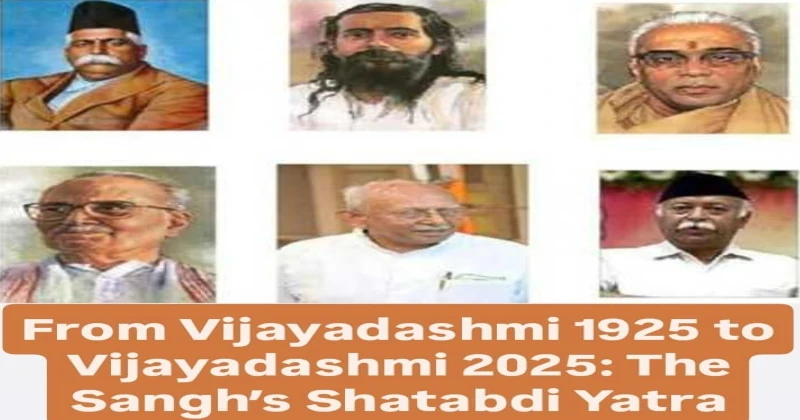
The Legacy of the Sarsanghchalaks
- Dr. K. B. Hedgewar (1925–1940): Founder and visionary; created the shakha system; instilled discipline and service.
- M. S. Golwalkar (1940–1973): Expanded organisational strength; gave ideological clarity; articulated cultural nationalism.
- M. D. Deoras (1973–1994): Moderniser and reformer; launched movements against untouchability; broadened social outreach.
- Rajendra Singh (1994–2000): Symbolised humility and continuity; expanded service activities.
- K. S. Sudarshan (2000–2009): Advocated Swadeshi in an era of globalisation; asserted cultural pride.
- Mohan Bhagwat (2009–present): Interprets Hindutva inclusively; emphasises samajik samrasta (social harmony) and dialogue; prepared the Sangh for its centenary. Each leader not only preserved Hedgewar’s vision but also adapted it to contemporary challenges.
Hindu Nationalism- Beyond Politics, Towards a Civilisational Ethos
The RSS has often been misunderstood as a political body, yet it has consistently projected itself as a cultural organisation. Hindu Nationalism, as articulated by the Sangh, is not about exclusion but about affirming India’s civilisational identity. It insists that Bharat is not merely a territorial state but a cultural nation where diversity thrives under a unifying dharmic ethos.
This worldview rejects colonial categories of caste and creed as divisive tools. The Sangh’s internal reform movements from Deoras’s call to eradicate untouchability to Bhagwat’s outreach across communities illustrate a commitment to integration. Its social service wings, from Seva Bharati to educational initiatives, aim to embody the principle of Vasudhaiva Kutumbakam (the world is one family).
At its core, RSS’s Hindu nationalism rests on three principles:
- Cultural unity: India is a civilisational nation defined not merely by geography but by Dharma.
- Inclusivity: Hindus, as cultural trustees, must embrace all i.e. Sikhs, Jains, Buddhists, tribals, and even those who may not identify as Hindu but share the civilisational ethos.
- Service before politics: The RSS insists it is a cultural organisation, with politics left to affiliated wings, but its cultural work inevitably shapes politics. Hindu nationalism emerged as a counter to colonial fragmentation, missionary aggression, and internal disunity. It was less about exclusion, more about integration reclaiming self-confidence.
Panch Parivartan – Sangh’s Vision for the 21st Century
- Social Harmony (Samajik Samrasta): Building bridges of unity, goodwill, and love among different sections of society to strengthen national integration.
- Family Enlightenment (Kutumb Prabodhan): Reviving the role of the family as the foundation of values, culture, and nation-building in the modern era.
- Environmental Protection (Paryavaran Sanrakshan): Preserving nature by considering Earth as the Mother, promoting sustainable living, and protecting ecological balance.
- Swadeshi Way of Life (Swadeshi Vichar): Encouraging indigenous industries, local products, and self-reliance to empower the nation economically and culturally.
- Civic Duty & Awareness (Samajik Jagrukta aur Nagrik Kartavya): Inspiring responsible citizenship, collective discipline, and active participation in building a strong and self-confident Bharat. These changes ensure that the Sangh is not merely preserving tradition but reforming it to meet modern needs.
Character-Building as Nation-Building: The Shakha Model
Every Sarsanghchalak has stressed the same truth:- nation-building begins with the individual. The Sangh’s shakha is its greatest innovation, a daily school of discipline, patriotism, teamwork, and dharmic consciousness.
Here, swayamsevaks learn to live beyond self, to respect diversity, and to act in unity. From ordinary citizens to Prime Ministers, countless leaders have acknowledged the shakha’s influence in shaping their sense of service.
For the Sangh, character-building is not preparation for politics but for life. A society of disciplined, selfless men and women is the strongest guarantee of a resilient nation.
RSS at 100- The Brotherhood and the Nation
From its quiet inception on Vijayadashmi in 1925 to its centenary celebration in 2025, the Rashtriya Swayamsevak Sangh (RSS) has undertaken a remarkable century-long journey. What began as a small gathering focused on character-building and national renewal has evolved into a global socio-cultural movement. The Sangh’s resilience through bans, political scrutiny, and social change is a testament to its core philosophy:- that a nation’s strength lies in the unity and selflessness of its people.
The legacy of its Sarsanghchalaks, each of whom adapted the founding vision to their times, highlights the organization’s unique ability to maintain continuity while embracing reform. As it steps into its second century, the RSS’s focus on Panch Parivartan-social harmony, family values, environmental protection, self-reliance, and civic duty, demonstrates a commitment to addressing the complexities of modern India. The Sangh’s vision of Hindu Rashtra is presented not as a political or theocratic state, but as a civilizational ethos rooted in Dharma, unity, and service. This centennial marks not just the passage of time, but the culmination of a movement that has sought to transform society one individual at a time, solidifying its place as one of the most significant forces in modern Indian history.