Zorawar Singh: The Dogra General who conquered Leh
June 9, 2026
  • Read Ecopy
  • Circulation
  • Advertise
  • Careers
  • About Us
  • Contact Us
Android AppiPhone AppArattai
Organiser
  • ‌
  • Bharat
    • Assam
    • Bihar
    • Chhattisgarh
    • Jharkhand
    • Maharashtra
    • View All States
  • World
    • Asia
    • Europe
    • North America
    • South America
    • Africa
    • Australia
  • Editorial
  • International
  • Opinion
  • RSS @ 100
  • More
    • Op Sindoor
    • Analysis
    • Sports
    • Defence
    • Politics
    • Business
    • Economy
    • Culture
    • Special Report
    • Sci & Tech
    • Entertainment
    • G20
    • Azadi Ka Amrit Mahotsav
    • Vocal4Local
    • Web Stories
    • Education
    • Employment
    • Books
    • Interviews
    • Travel
    • Law
    • Health
    • Obituary
  • Subscribe
    • Subscribe Print Edition
    • Subscribe Ecopy
    • Read Ecopy
  • ‌
  • Bharat
    • Assam
    • Bihar
    • Chhattisgarh
    • Jharkhand
    • Maharashtra
    • View All States
  • World
    • Asia
    • Europe
    • North America
    • South America
    • Africa
    • Australia
  • Editorial
  • International
  • Opinion
  • RSS @ 100
  • More
    • Op Sindoor
    • Analysis
    • Sports
    • Defence
    • Politics
    • Business
    • Economy
    • Culture
    • Special Report
    • Sci & Tech
    • Entertainment
    • G20
    • Azadi Ka Amrit Mahotsav
    • Vocal4Local
    • Web Stories
    • Education
    • Employment
    • Books
    • Interviews
    • Travel
    • Law
    • Health
    • Obituary
  • Subscribe
    • Subscribe Print Edition
    • Subscribe Ecopy
    • Read Ecopy
Organiser
  • Home
  • Bharat
  • World
  • Operation Sindoor
  • Editorial
  • Analysis
  • Opinion
  • Culture
  • Defence
  • International Edition
  • RSS @ 100
  • Magazine
  • Read Ecopy
Home Bharat

Zorawar Singh: The Dogra General who conquered Leh and secured northern frontier of Bharat

Ladakh was a part of the larger Tibetan empire before it was brought under the Sikh suzerainty by Dogra General Zorawar Singh Kalhuria who hailed from Himachal. Between 1834 and December 19841, the Dogra army remained in firm control of Leh and beyond when its westwards expansion was halted by a defeat to a Tibetan army

WEBDESKSant Kumar SharmaWEBDESKandSant Kumar Sharma
Sep 26, 2025, 10:58 pm IST
in Bharat, India, Ladakh
Follow on Google News
Representative image

Representative image

FacebookTwitterWhatsAppTelegramEmail

A Short History of Jammu Raj, From Earliest Times to 1846 AD, by Sukhdev Singh Charak, gives details regarding Ladakh’s inclusion by General Zorawar Singh into Maharaja Gulab Singh’s territories. On June 17, 1822, Maharaja Ranjit Singh anointed Gulab Singh, one of his generals and a feudatory, as Raja of Jammu, in Akhnoor on the banks of the Chenab river. At that time, the powerful Khalsa Durbar was run from Lahore and Kashmir was under the Sikh kingdom.

This closed the way for Gulab Singh to expand towards Kashmir as he could not have taken any part of it. It was not possible for him to expand his kingdom towards Punjab either as that too was under Maharaja Ranjit Singh. The Dogra dynasty founder ruled vast Kishtwar which in turn was connected via Padder to Padum in Zanskar (Kargil/Ladakh region). This narrow strip of the Jammu region gave him a chance to move towards Leh town.

The Leh city was then capital of the Ladakh region and the king’s seat who controlled lucrative pashmina trade. This was identified by Gulab Singh as a possible area which could be subjugated and control of the pashmina trade taken into hands to bring revenue for the Dogra kingdom. Accordingly, he confabulated with General Zorawar Singh, his sharpest and most accomplished military commander and gave him the task of conquering Ladakh.

It was in 1834 only, 12 years after becoming Raja of Jammu that Gulab Singh could gather enough arms, soldiers and money to enable Zorawar Singh to launch a campaign aimed at faraway Ladakh. Before him, no king or general from the Indian plains, or among the Arabs, or Mughals, had ventured out so far to the northern territories covered with snow. Kashmir was almost the end of inhabitable world for them as beyond snow covered peaks it was too bleak for them all. Weather beyond tolerable for men from plains and not adapted to walking or living in these high Himalayas.

Also Read: Did Sonam Wangchuk, Congress fuel the Ladakh violence, despite government pledge to address aspirations of people

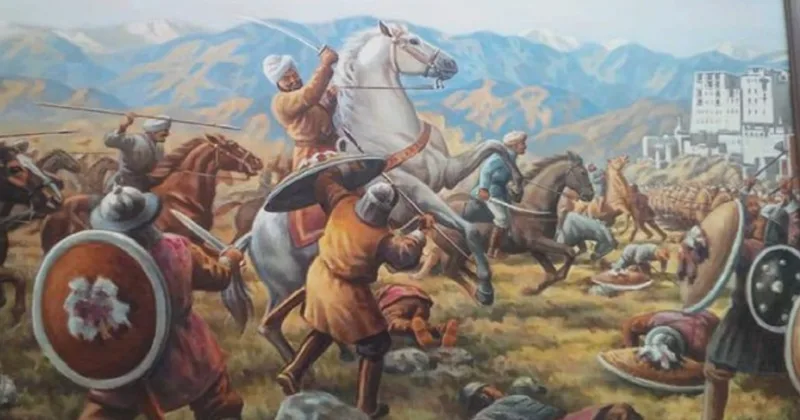
Yet, Gulab Singh’s ambitions were unbounded, unwilling to accept challenges of terrain, weather or imagination. Spurred on by indomitable spirit, courageous soldiers, carrying modern guns and riding mountain horses, the Dogra army under Zorawar Singh marched on to Ladakh. It was the only unit from the Indian mainland which has captured a Chinese standard (flag) in a battle till date. The descendants of the battalion which Zorawar Singh led during victories on Ladakh are today organised as 4th Jammu & Kashmir Rifles (4th JAKRIF).

The Fateh Shibji Paltan, part of General Zorawar Singh’s Dogra forces, captured the Mantalai Flag from combined Chinese and Tibetan troops at the Battle of Dogpacha on May 30, 1841. From 1834 to 1841, these Dogra troops became adept in living in hostile Ladakhi terrain and conquered new frontiers. This significant victory during the Dogra invasion of Western Tibet resulted in the routing of 1,500 enemy troops and the capture of the Chinese standard, which is now the most prized possession of the 4th Jammu & Kashmir Rifles (JAK Rif). The captured flag, which features a flying tiger, is known as the only Chinese flag ever captured by an Indian unit.

May 30th every year is now celebrated as Mantalai Day to commemorate the victory of Zorawar Singh’s troops in 1841. Seven years earlier, in 1834, his troops had defeated the king of Ladakh and made it a part of Dogra ruled areas. The captured Chinese standard is a proud possession displayed at Dogra Regimental centre.

In 1834, the Dogra army led to Zorawar Singh used cannons to breach the thick mud walls of the Leh Palace  where the Ladakhi king lived. Detailed description of the cannons used for the first time in this area is not available. But it can be safely assumed that for the local Ladakhis to resist the Dogra soldiers armed with cannons, matchlocks, swords, spears and cavalry must have been very daunting, as also unnerving.

From the autumn of 1834 to 1841, the Dogras ruled vast Ladakh areas from their firm base as also bulk of their troops in Leh. Getting more ambitious by repeated successes, Zorawar Singh pressed further and farther into western Tibet territories. It was during these forward forays that he met his match in the battle in December 1841 that the Tibetans overpowered his troops and beheaded the Dogra military commander who had annexed Ladakh for Gulab Singh.

Zorawar Singh’s killing was avenged by the Dogra troops as Gulab Singh sent battle hardened Dogra troops with more weapons and back-up to take back areas won by the Tibetans. The Chushul valley was the battleground where heavy losses were inflicted on Tibetan troops. The Treaty of Chushul of 1842 is by virtue to which the Ladakh territory came to be included in Dogra kingdom. A little over a century after this momentous event, Gulab Singh’s descendant Maharaja Hari Singh, whose birthday was celebrated on September 23, acceded his state to India.

It is the sweat and blood of Dogra soldiers that made Ladakh a part of modern India. No other princely state other than that the Dogra dynasty, which ruled from March 1846 to October 1947, can claim to have expanded the territories of modern India. That too, many years before Gulab Singh became a full-fledged sovereign due to twists and turns favouring him. When his military commander Zorawar Singh conquered Ladakh and many small principalities in that area over years, it was conveyed to Maharaja Ranjit Singh as a victory of his forces.

The Treaty of Chushul was a peace treaty signed on September 17, 1842, by the Dogra Raja Gulab Singh (notionally under under the Sikh Empire) and the Tibetan government (under the Qing Dynasty) that ended the Dogra–Tibetan War (1841–1842). Maharaja Ranjit Singh, who had established the Lahore Durbar, and to whom Gulab Singh remain loyal till last, had died in June 1839. An internecine war between different Sikh chieftains thereafter undermined Lahore Durbar’s hold over all territories it held. The Chushul Treaty reaffirmed traditional boundaries, maintained the status quo, and fostered eternal friendship and trade between the two powers, establishing a lasting peace along the borders of Ladakh and Tibet.


Topics: Sukhdev Singh CharakDograMaharaja Gulab SinghJammuZorawar Singh
ShareTweetSendShareSend
✮ Subscribe Organiser YouTube Channel. ✮
✮ Join Organiser's WhatsApp channel for Nationalist views beyond the news. ✮
Previous News

Gurupooja and Bharat Mata are part of the nation blood and thought: Kerala Governor Arlekar

Next News

Odisha: PM Modi to unveil Rs 60,000-crore rail, telecom, education and healthcare projects on September 27

Related News

Conservative British MP Bob Blackman

Conservative British MP Bob Blackman says whole of J&K should be reunited with India, terms Pak occupation illegal

Union Home Minister Amit Shah taking stock of the situation in Jammu and Kashmir

J&K: Amit Shah takes stock of damaged infrastructure in Jammu province, assures all help to rebuild everything

Visuals from CHC Katara where bodies and injured people have been brought [ANI/ Photo]

5 killed, ten injured in landslide near Vaishno Devi shrine; heavy rains disrupt trains, traffic in Jammu

Image for representational purpose only, courtesy opendemocracy

Over 50 Pakistani drones shot down by Indian air defence array across LoC, IB: Sources

Tawi Aarti marks cultural resurgence in Jammu, heralds new era of spiritual and civic revival

Jammu Terror Attacks: Shifting centre of gravity

Load More

Latest News

Union Defence Minister Rajnath Singh

Uttar Pradesh: Defence land goes green; Rajnath Singh clears 250 MW solar project in Sitapur

Afghanistan Foreign Minister Amir Khan Muttaqi and External Affairs Minister Dr. S. Jaishankar(File Photo)

India extends gratis long-term business visas to Afghan traders; Slams Pakistan for “trade & transit terrorism”

How Modi's Zero-tolerance doctrine reshaped India's anti-terror policy (This is an AI generated image)

Twelve Years of Modi Government and the rise of India’s zero-tolerance doctrine against terrorism

Press Conference organised by Janjati Suraksha Manch at the Press Club, Ranchi, National Convener Dr Raj Kishore Hansda

Success of Janjati Sanskritik Samagam symbolises unity and cultural pride: Dr Raj Kishore Hansda

India delivered a historic performance at the inaugural World Yogasana Championships, finishing at the top of the medal tally with an astounding 114 medals, including 102 golds

World Yogasana Championships: India scripts historic triumph with 114 medals and 102 gold medal wins

Protest erupts in POJK

Why is PoJK protesting? JAAC ban, anti-Pakistan slogans and public anger against Pakistan Army — Read here

India slams Pakistan over its Fatna al Hindustan narrative

India tears Pakistan at UN over ‘Fitna al Hindustan’ narrative; Exposes Islamabad as an ‘organised factory of hate’

India's Permanent Representative to United Nations Ambassador Harish Parvathaneni

India & Afghanistan are “civilisational states”: Indian Envoy at UN reaffirms health, education & humanitarian aid

Bulldozer action on houses linked to drug traffickers in Rourkela's Meenapada area

Odisha: Major crackdown on drug traffickers in Rourkela; Bulldozers demolish houses of Farida, Imran & other accused

Prime Minister Narendra Modi with Agri Minister Shivraj Singh Chouhan

India’s Agricultural Revolution: Rising output, record procurement and expanding farmer support since 2014

Load More
  • Privacy
  • Terms
  • Cookie Policy
  • Refund and Cancellation
  • Delivery and Shipping

© Bharat Prakashan (Delhi) Limited.
Tech-enabled by Ananthapuri Technologies

  • Home
  • Search Organiser
  • Bharat
    • Assam
    • Bihar
    • Chhattisgarh
    • Jharkhand
    • Maharashtra
    • View All States
  • World
    • Asia
    • Africa
    • North America
    • South America
    • Europe
    • Australia
  • Editorial
  • Operation Sindoor
  • Opinion
  • Analysis
  • Defence
  • Culture
  • Sports
  • Business
  • RSS @ 100
  • Entertainment
  • More ..
    • Sci & Tech
    • Vocal4Local
    • Special Report
    • Education
    • Employment
    • Books
    • Interviews
    • Travel
    • Health
    • Politics
    • Law
    • Economy
    • Obituary
  • Subscribe Magazine
  • Read Ecopy
  • Advertise
  • Circulation
  • Careers
  • About Us
  • Contact Us
  • Policies & Terms
    • Privacy Policy
    • Cookie Policy
    • Refund and Cancellation
    • Terms of Use

© Bharat Prakashan (Delhi) Limited.
Tech-enabled by Ananthapuri Technologies