सुवर्णाकर्षण विघ्न राजो
पादाम्बुजो गौर वर्ण वसन धरो
Muthuswamy Dikshitar in his kriti in Raga Gaula “Sri Mahaganapatiravatu mam”
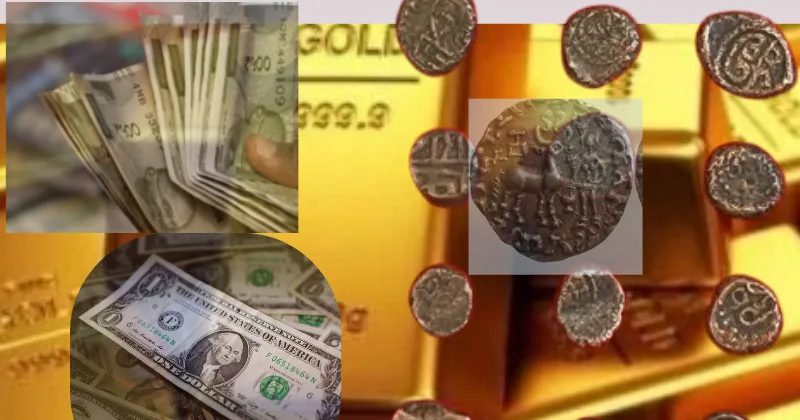
From the karshapana silver coins of Panini’s Ashtadhyayi to the rupyapana of the Mauryas, the bills of exchange of the Dutch and British that facilitated trade, the gold backed dollar of Bretton-Woods, the fiat currency of today, the invisible money on our phones circulating via UPI and possibly cryptocurrency and central bank digital currencies of tomorrow, the history of money has moved lockstep with that of civilization. Bhārat was one of the first societies that issued metallic punched currency called karshapana whose value was determined by the weight of the metal. However, this meant that the value of goods and services in circulation was capped by the amount of metal that had been mined up until that point. At some point, a fiscal genius in ancient Bhārat would have suggested to his king that issuing fiat currency (value determined by what was punched marked on its face) was the silver bullet to the janapada’s currency woes. Thus, the rupyapana was born, a standardized currency by its weight in silver whose value was determined on the basis of its “face value” (rupa).
The ability to issue fiat currency (a technology steadily adopted by the world in the years that followed) was a powerful moment in human civilization. It ensured that trade and economic growth would not be constrained by monetary barriers. However, fiat currency created two major concerns for the political class. First, it incentivized wasteful expenditure as money could be created out of thin air. A silver coin with a face value of 10 could be altered to a face value of 100 overnight on the king’s decree. This was the beginning of inflation that has consumed many empires since times immemorial. Second, it further intertwined politics and economics. As the currency value was determined by imperial decree, and implicitly in the trust that the citizenry had in the abilities of the emperor to rule his kingdom properly, its acceptance came to determine the boundaries of the empire—a vote of confidence in the ruler. The ability to issue currency and control its status as legal tender came to determine power and not vice-versa.
The above arrangement continued as long as production remained closely linked to control of land. However, the Industrial Revolution in Europe upended this belief. It was an inflection point in human history which ensured that production quantity was no longer determined by the ownership of land. At best, the latter became one of the many factors of production that determined industrial output. The rapid rise in incomes in Europe necessitated a consumer class that demanded high quality goods from faraway lands in Asia. With the Bosphorus straits choked by the high tariffs of the Ottomans, the Europeans (particularly the Portuguese, Dutch and English) turbocharged trade by pooling portions of capital from the new found wealth of their citizenry. Over time this resulted in the creation of the first banks and joint stock companies (modern corporations). The Industrial Revolution and oceanic trade midwifed the creation of the modern financialized society where credit supply is usually in excess of the goods and services produced.
Monetary systems have nevertheless always looked at a natural resource that is unmatched in terms of what is probably an unimpeachable benchmark for the value of any currency however it might have been issued. We refer, of course, to metallic gold. This unique metal has many chemical characteristics that have raised it to the level of the ultimate monetary standard. It is scarce and yet the pure metal is easily extractable from its ores. It is practically immune to any kind of deterioration, whether this be of a chemical or physical nature. It is very heavy and this means it can be stored in a compact form. Currencies were linked to the price of gold, the so-called gold standard, because gold was something the value of which no one could be in any doubt. It was not a question that all the people would demand gold metal up till the value of the currency they held. It was enough that the kingdom, state or empire was economically strong enough to link its currency to the value of gold metal.
Pre-Betton Woods, the modern world had its own version of the ancient karshapana system. However, as cycles of time repeat, the gold standard was abandoned to pave way for a global fiat US dollar that lubricated international trade. The political, military and economic hegemonic status of the US ensured that the fiat US dollar system was widely adopted by many countries. Over the last 50 years, it also led to the economic development of many countries like China, Korea and India that were mired in poverty a couple of generations ago. In reality, it was the domestic economics of the US that dictated the international supply of the US dollar. The core idea of the fiat system was that the USA would run small budget deficits to supply the world with US dollars that would be required for trading between countries. Over the years, however, excessive domestic spending by the US government has resulted in its racking up a debt of $35 trillion, far in excess of its GDP. In the initial years of its debt fueled spending, the US was able to manufacture demand for its debt by agreements with oil producing nations of the Middle East and export oriented economies of East Asia. However, this ability has waned steadily over the years.
The US of today is largely a consumerist society that does not produce enough goods to export to the rest of the world. Nations of the world expend natural and human resources in production, most of it for the US consumer. However, there is very little that they can purchase from the US given the lack of production capabilities of the latter combined with the lack of price competitiveness of American goods for global trade. As a result, most of these trade surpluses were parked in US treasuries with the underlying assumption that it would be a “risk-free” investment, “risk free” to the extent that the US economy was strong enough. As the US debt ballooned, this “risk-free” investment was compromised as also the status of the fiat US dollar as the reserve currency of the world for two reasons. First, the increase in US debt caused inflation that devalued the long-dated treasuries that many countries have been holding as safe assets. The assumption was that these debt securities would preserve their value until expiry (usually 10 years or more). As this is now called into question, it also disincentivizes future buyers of US dollar treasuries. Second, as the global reserves of the US dollar recede, it could diminish its usage as a trade currency. As of today, the US dollar dominates global trade accounting for 80% or more of export invoicing in all regions of the world (except Europe). However, in a rapidly changing world, the primacy of the dollar is not going to remain unquestionable. To summarise, the trust that other countries hold in the US economy has gradually declined and with it the feeling of reliability of the US dollar as the reserve currency of the world. We are now very far from the US dollar being linked in any way with the absolute touchstone—gold.