





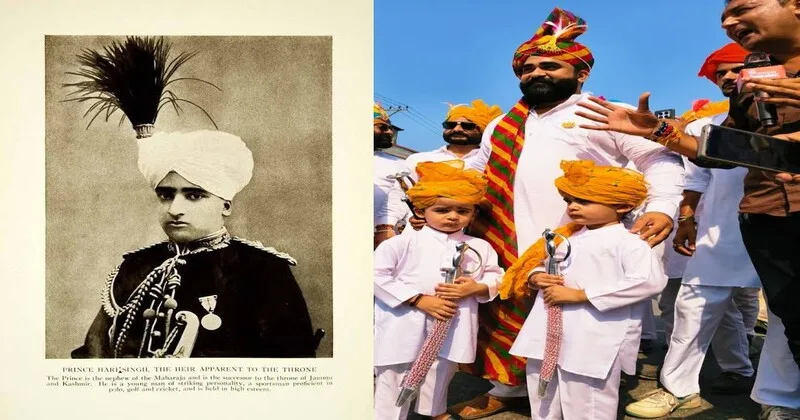
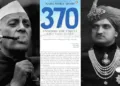
Till some years ago, Maharaja Hari Singh’s birthday on September 23 was not a public holiday in J& Kashmir. The political dispensations in power for successive years and decades made all-out efforts to belittle the late Maharaja who had acceded his princely state to India. In an unfortunate turn of events, the king who had stood firmly for India was exiled from his beloved land in 1949. He never returned alive and died young aged only 66 at faraway Bombay due to conspiracies hatched against him by Jawaharlal Nehru and his fried Sheikh Abdullah.
Things changed and after the abrogation of Article 370, Maharaja Hari Singh birthday is a holiday now. Thanks to a strike organised by Yuva Rajput Sabha, the government restored his birth anniversary date as a day of public celebrations some years ago. Throughout the Jammu region on Tuesday, dozens of functions was organised in honour of the late Maharaja, a staunch nationalist who gave his all to the Indian nation. The biggest celebration was in Jammu city itself in which hundreds of bikes and cars participated in a rally which culminated at the Tawi bridge where his statue has been installed. Reports of celebrations were received from Vijaypur, Samba, Jandrah, Bishnah, Ramgarh, Akhnoor and several other places.
At most places, the rallies and celebrations were organised by local committees who organised bhandaras and speeches were made extolling the virtues of the late Maharaja.
Decades ago, “Chhote Miyan” was an affectionate title given to Yuvraj Hari Singh in his childhood, when he was the young heir to the throne of Jammu and Kashmir. In Dogra courtly and aristocratic culture, the term literally meant “The Little Lord” or “The Young Master”—a phrase at once respectful and endearing, reserved for a prince, Juhaib Khan wrote in his Facebook post.
Today marks the 130th birth anniversary of Maharaja Hari Singh Jamwal. Shortly after ascending the golden throne of the Dogra Dynasty, a conspiracy was orchestrated to dethrone him due to his decision to remove the Union Jack, the flag of Britain, from his Jammu residence. Earlier, at the 1930 Round Table Conference in which Indian Princes were present in London, he had said: “I am an Indian first and a ruler last.” This embarrassed his hosts who realised that this Indian Prince was not willing to kowtow to them at all and they thereafter started looking for opportunities to destabilise him.
At the conference, Maharaja Hari Singh advocated for India’s independence from British clutches. He said that India after becoming independent should have equal status within the British Commonwealth. He was aware of the potential fault-lines in his own kindom and emphasized the communal harmony that prevailed in his state. However, his nationalist stance of being an Indian first and foremost angered the British and they hatched a conspiracy against him.
Sheikh Mohammad Abdullah, Choudhary Ghulam Abbas and George Edward Campbell then conspired to destabilize Maharaja Hari Singh’s government. The July 13, 1931, uprising was instigated by Abdul Qadeer, an Afghan national working in the service of a British officer. This was outright a British plot to undermine his rule.
The uprising engineered by the Birtish was driven by three main reasons: a) Maharaja’s assertive efforts to gain full control over Gilgit and its surrounding dependencies, b) His powerful speech advocating for Indian freedom at the second Round Table Conference held in London, and c) the British desire to weaken the monarchy and facilitate the appointment of British officers in the State Council. This conspiracy disrupted the communal harmony of the princely state of Jammu, Kashmir, and Tibetadi, as the Maharaja faced opposition from the British and their allies, including Sheikh Abdullah and Nehru.
An Army veteran, Brigadier Anil Gupta (retired), wrote a heartfelt tribute to the Maharaja in these words: On this auspicious day, September 23, 2025, marking the 130th birth anniversary of Maharaja Hari Singh Ji, we pause to honour the last sovereign of the princely state of Jammu and Kashmir. A man whose courage and foresight forever altered the destiny of a nation.
Born in 1895 at the opulent Amar Mahal Palace in Jammu, Hari Singh ascended the gaddi in 1923 following Maharaja Amar Singh’s passing. As a scion of the illustrious Dogra Rajput dynasty, he embodied the timeless virtues of valour, justice, and unyielding resolve that defined generations of Dogra rulers.
Under his rule, he championed progressive reforms: establishing educational institutions like the Prince of Wales College (now Government Gandhi Memorial Science College) in Jammu, advancing women’s education, and modernizing administration to foster unity among the state’s diverse Hindu, Muslim, Sikh, and Buddhist communities. Yet, his era was not without trials—the 1931 agitation in Kashmir tested his mettle, revealing the complexities of governing a multi-ethnic mosaic in a rapidly changing world.
In a decision etched in the annals of valour, Maharaja Hari Singh affixed his signature to the Instrument of Accession on October 26, 1947, irrevocably merging Jammu and Kashmir with India. This act was a calculated embrace of shared heritage and democratic ideals. Hari Singh’s choice was profoundly personal and principled. He rejected overtures from the other side, including a Standstill Agreement that crumbled under the weight of aggression, affirming instead a vision of secularism where every citizen, regardless of faith, could thrive under the Tricolour.
Today, as we reflect on this birthday milestone, let us remember Maharaja Hari Singh ji for his legacy Ekta hi bal hai—unity is our greatest strength. Jai Hind.











Comments