





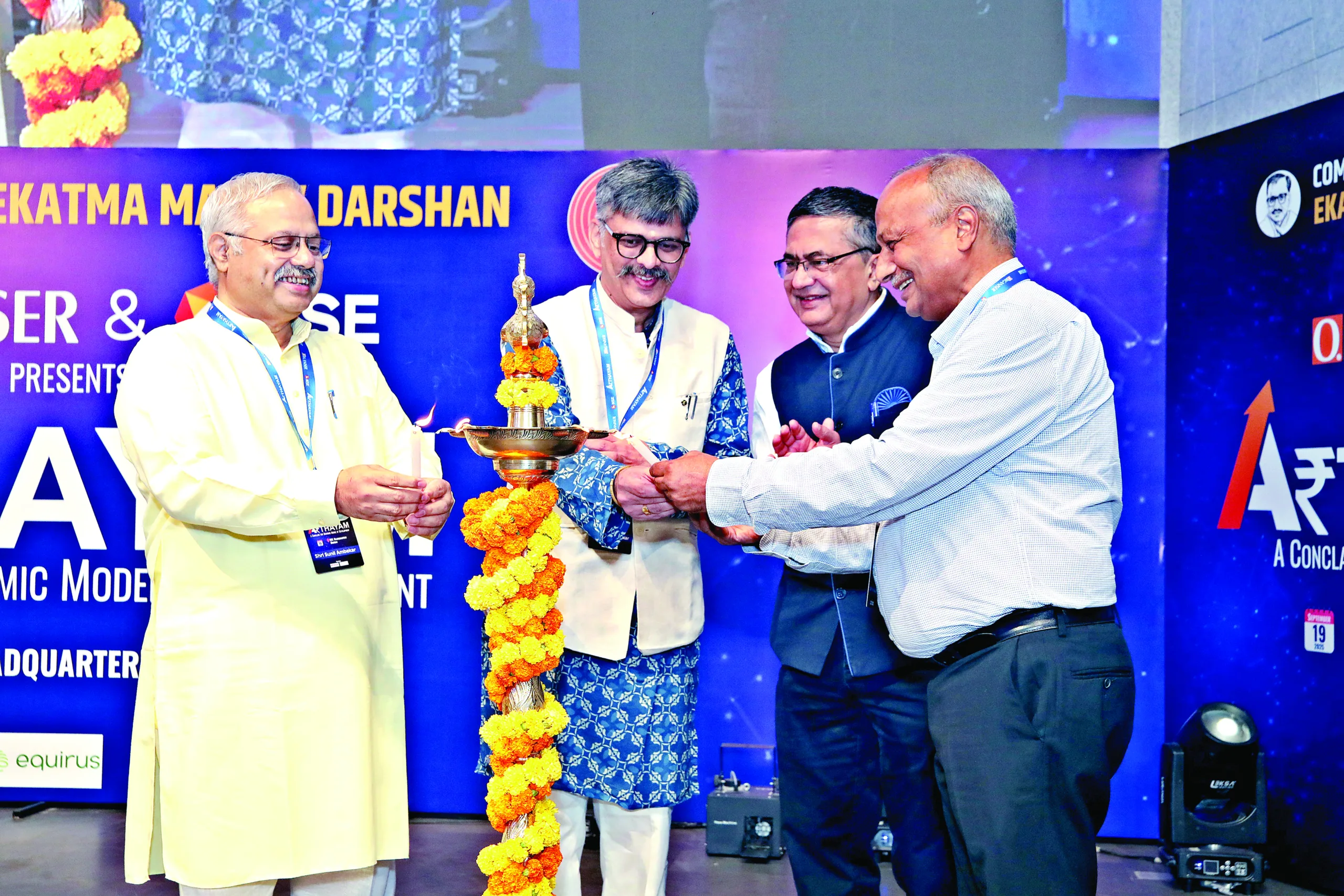
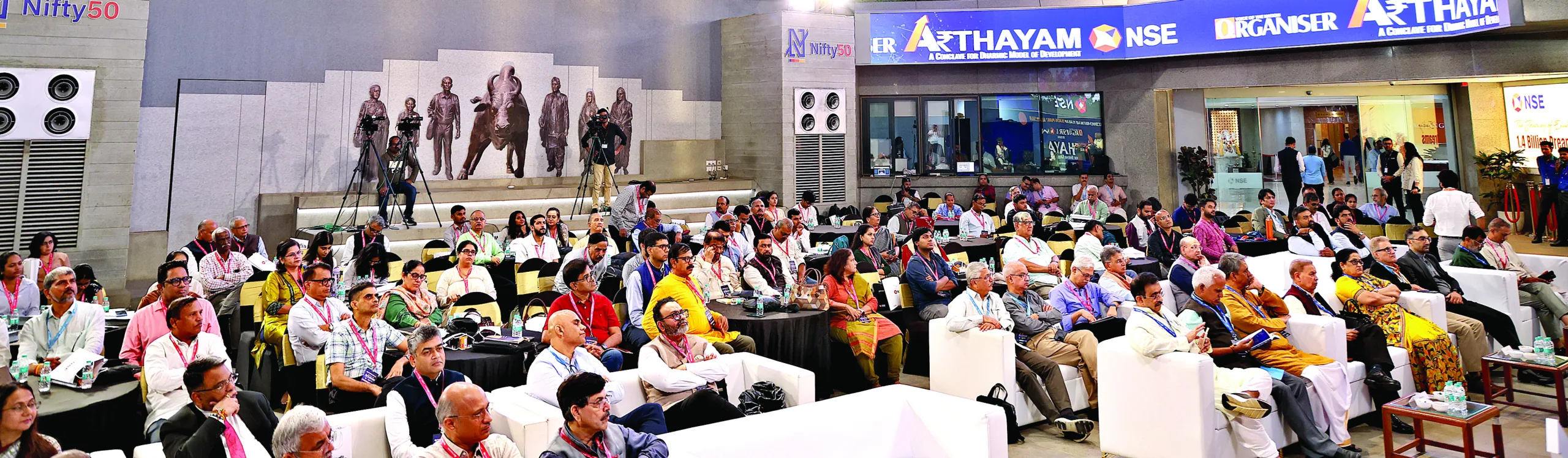
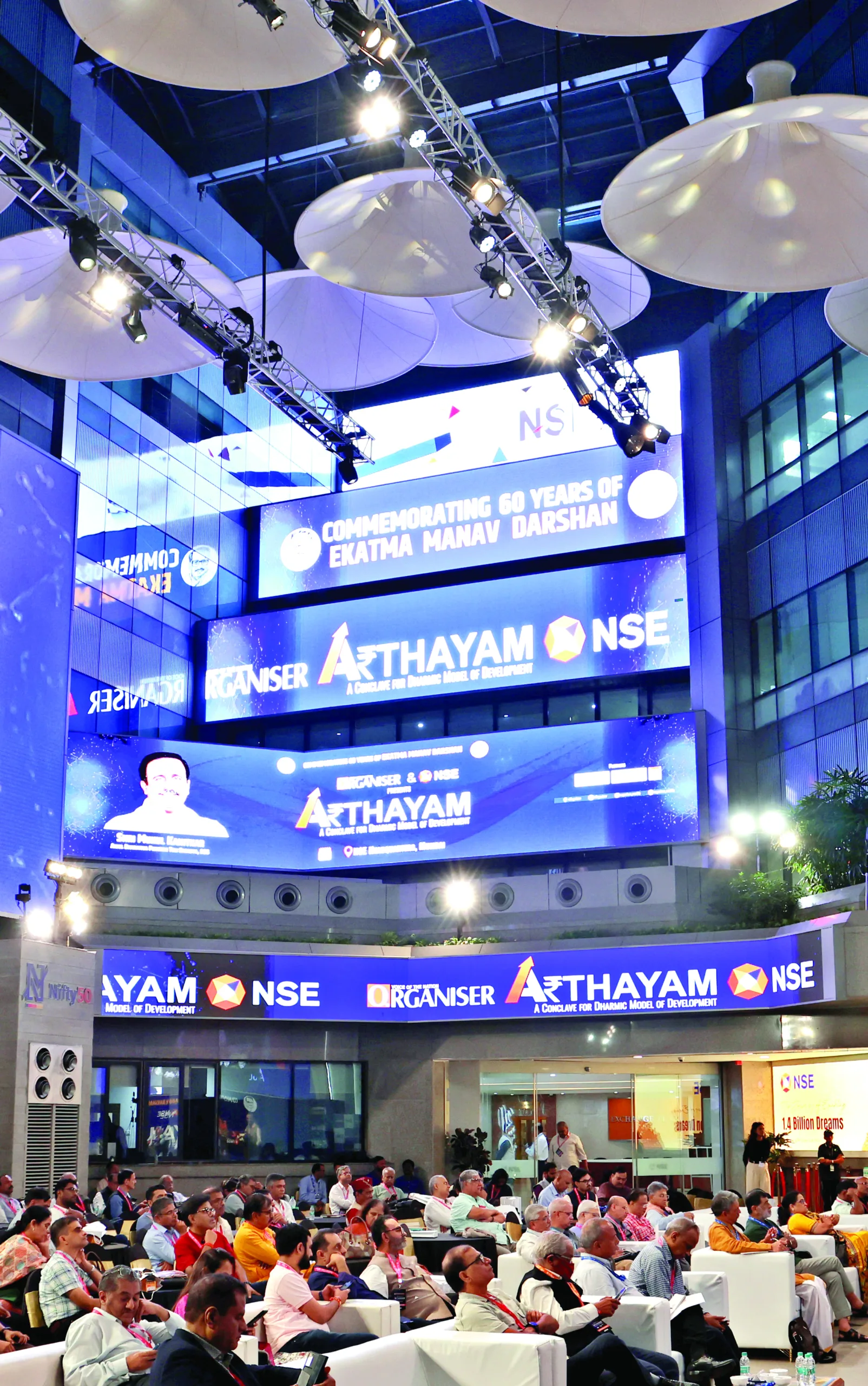
Organiser and NSE jointly hosted a day-long event titled “Arthayam: A Conclave for Dharmic Model of Development” at the NSE Headquarters in Mumbai on September 19th. The conclave marked 60 years of Ekatma Manav Darshan, the timeless philosophy propounded by Pandit Deendayal Upadhyaya Ji.
The event focused on sustainable and inclusive development rooted in Dharma, Nature, and Culture. As Bharat scales new heights in the global economy, the deliberations assumed great significance in evolving an indigenous developmental framework.
The conclave brought together eminent thinkers, policymakers, economists, and industry leaders, and was divided into six thematic sessions – exploring the idea of Ekatma Manav Darshan, its policy applications, and the road ahead.
Dharma Means Fairness
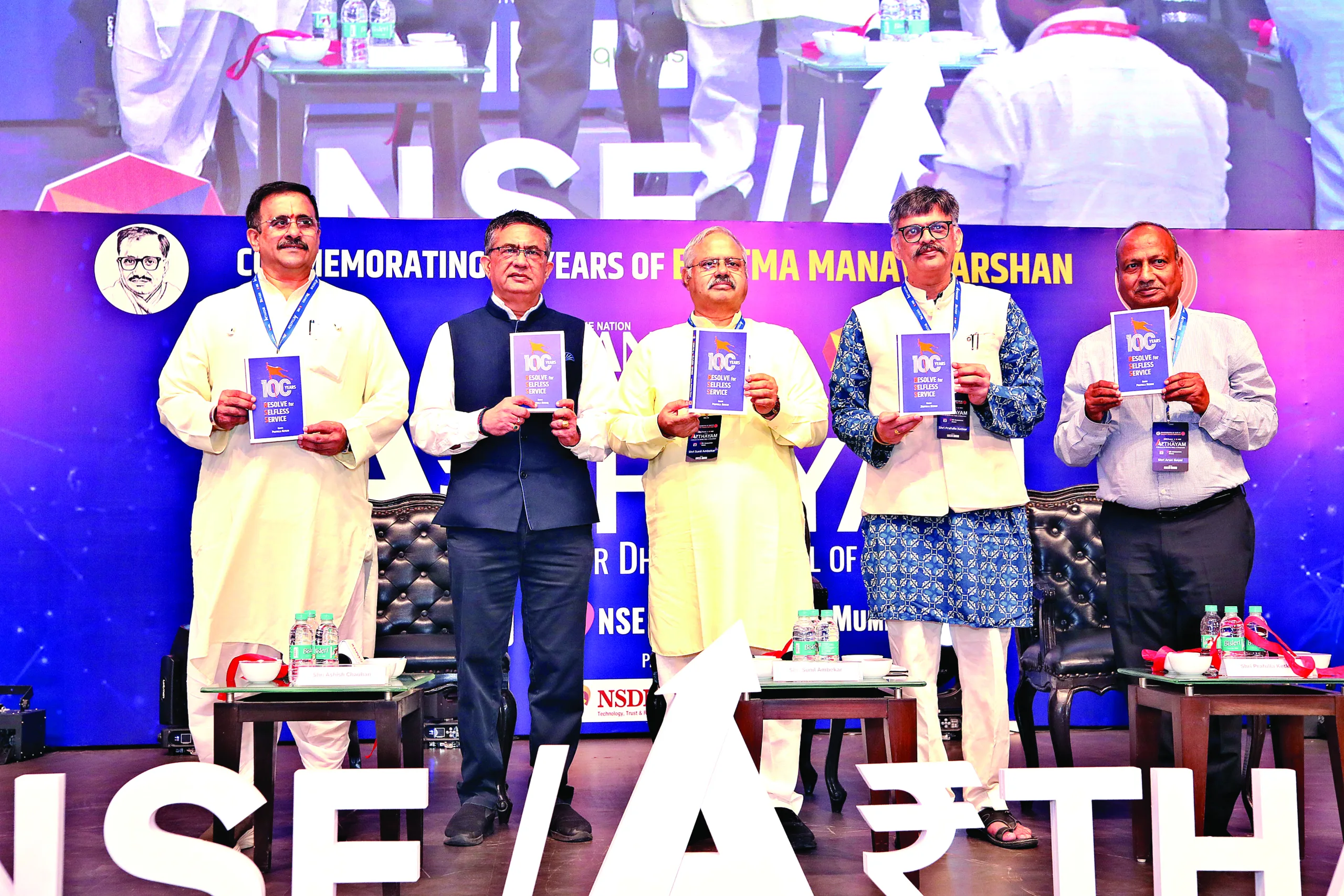
The inaugural session was graced by Sunil Ambekar Ji, Akhil Bharatiya Prachar Pramukh of the Rashtriya Swayamsevak Sangh (RSS), and Ashish Chauhan Ji, MD & CEO of the National Stock Exchange, with Prafulla Ketkar Ji, Editor of Organiser, moderating the proceedings. The session also witnessed the launch of Organiser Weekly’s special commemorative book on 100 Years of RSS.
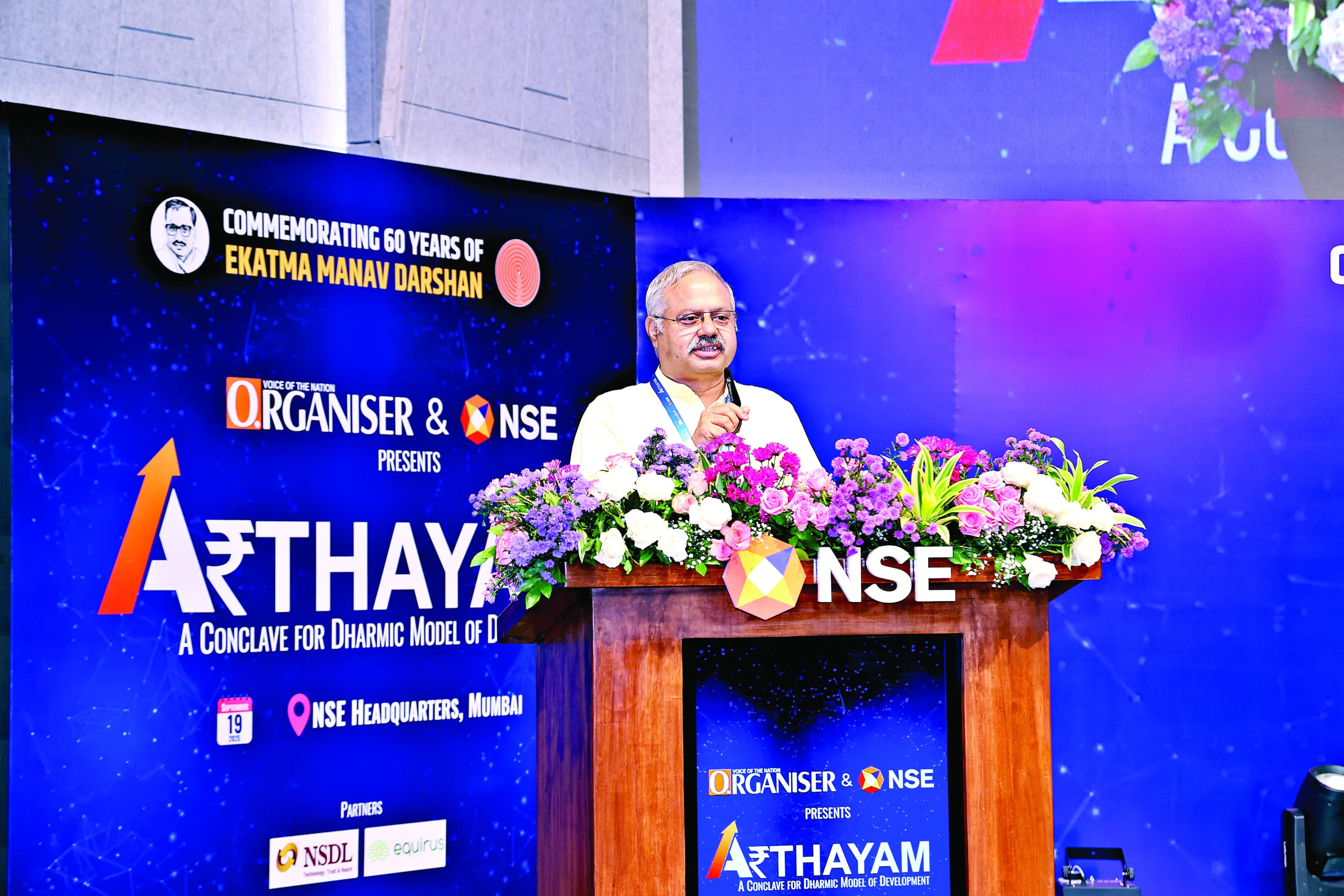
Delivering his keynote address, Sunil Ambekar Ji linked economic growth to Dharma and inclusivity, cautioning that economic models must not be exclusionary. “Only that economy can be called Dharmic which includes all and excludes none. The policies we see today are shaped around this aspiration of Bharat. But going forward, we need to consciously weave Dharma into policymaking, with fairness as the central principle. An economy that leaves even a single man behind is flawed and requires revision,” he added.
“Dharma means fairness. In terms if Arth, Dharma means fairness. Equal opportunities for all to grow and rise, without others proving out to be hurdles. Removing every blockade and opening the path for all, this is the biggest role Dharma plays in terms of Arth. The same has been written in vedas, puranas and Ramayan,” he added.
Expanding on the Dharmic principle of fairness, he said, “If someone wants to start a business, those earning must help, as it is their Dharma. But equally, those receiving must earn it with dignity, otherwise it becomes Adharma. That is how Dharma should be conceptualised in the economy.”
Ambekar also stressed that Bharat must view modernity in its own terms.
“When we speak of Swadeshi, foreigners often ask what it means. Swadeshi means contributing to your own nation first. In Bharat’s economic thinking, decentralised production and technological development are key. Unlike the West, where economy and culture are often kept apart, Bharat always saw them as interlinked. Due to colonial rule, our economic voice was suppressed, but today, we have regained the agency to shape not just our economy but also global economic affairs. The question now is, will we continue to follow the old diktats or will we shift towards our Dharmic parampara?”
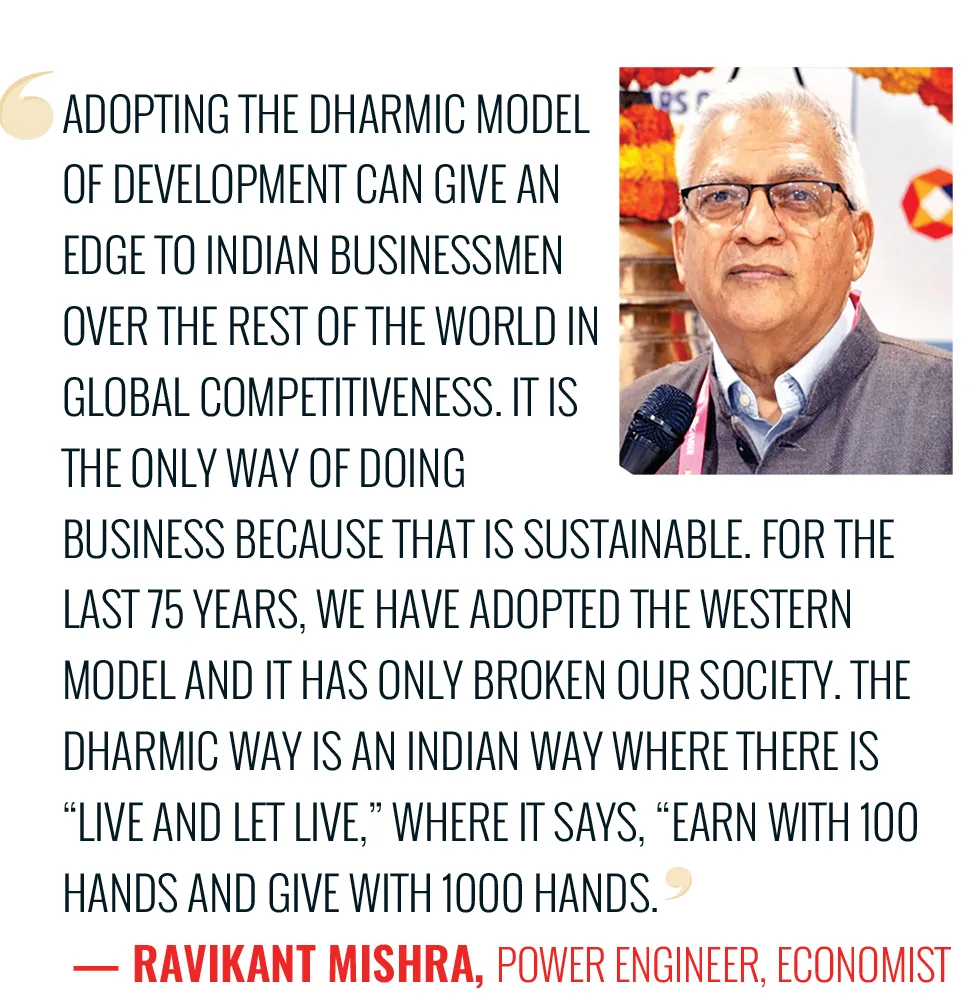
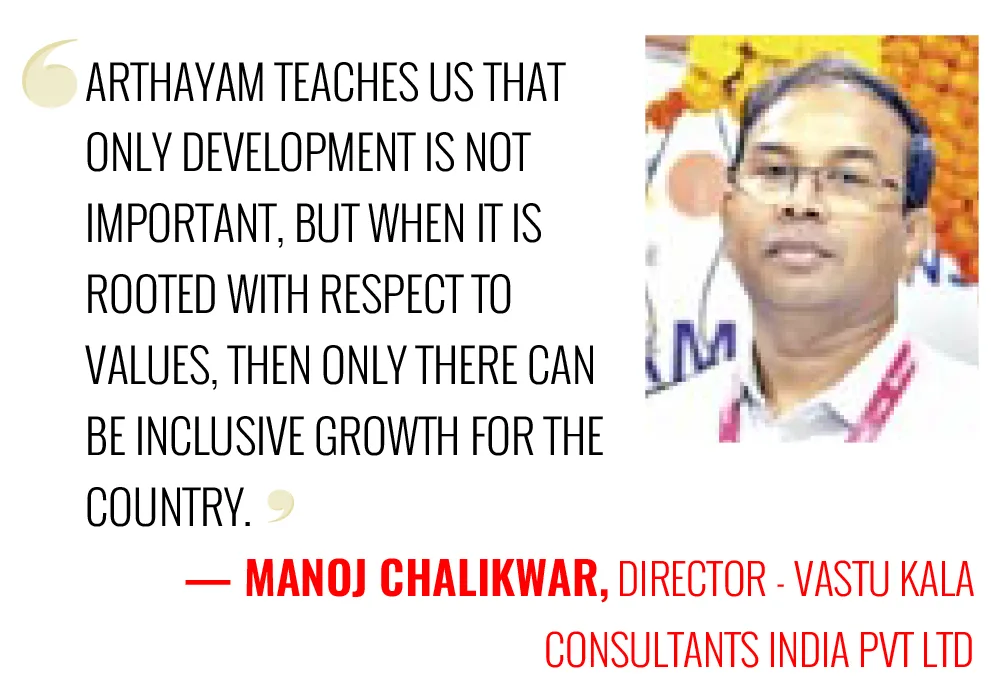
Welcoming the gathering, Ashish Chauhan said, “It is not just an incident but a historic moment to deliberate on Pt. Deendayal Upadhyay Ji’s vision. Without NSE, we cannot become Vishwa Guru. Today, NSE has mobilised funds worth Rs 68 lakh crore and has five crore investors, which shows that Bharat is on the right track. Our objective remains to make all our people a part of this journey. We are enabling 1.4 billion dreams. Built by Bharat, for Bharat, and dedicated to Bharat, this is the spirit driving our markets.”
Chauhan emphasised that Bharat’s rise as the fourth-largest economy in the world demands a rethinking of financial systems in the light of Integral Humanist Paradigm.
“The dialogue we have started here reflects Deendayal Ji’s idea of framing public policy so that the last person in the queue is benefited. His thought of all-round progress is even more relevant today. With PM Modi carrying forward the vision of Swadeshi, Arthayam becomes an opportunity to churn out ideas and achieve the goal of Viksit Bharat 2047.”
Reflecting on the roots of the conclave, Prafulla Ketkar Ji said, “Just before Independence, when nationalist thought was sidelined, Organiser was born in Delhi with the blessings of Pt. Deendayal Upadhyaya Ji. Some questioned whether a capital market could align with Swadeshi thought, but as Ashish Ji rightly puts it, we are not rejecting markets, we are adapting and running them. This conclave, held around Deendayal Ji’s birth anniversary on September 25, becomes even more significant in today’s geopolitical and geo-economic turbulence.”
He reminded the audience that Deendayal Ji critically examined both Capitalism and Communism during the Cold War and offered a uniquely Bharatiya alternative through Ekatma Manav Darshan. Quoting Deendayal Ji, Ketkar said: “Jo jo Swadeshi hai usko Yugankul karna hai, jo videshi hai usko Deshankul karna hai.”
He stressed, “Deendayal Ji insisted on the Indianisation of ideas. Today’s deliberation must therefore be seen as part of a larger churning in a post-turbulent, multipolar world.”
Integral thought: Not Arrested by Context
The second session, themed “Ekatma Manav Darshan: Eternal Yet Contemporary”, brought together three eminent thinkers to reaffirm that Bharat’s march towards Viksit Bharat 2047 must be grounded in Dharma, Swadeshi, and Atmanirbharta.
S. Gurumurthy, noted economist and Editor of Thuglak, described Integral Humanist Paradigm as “a subject of reverence for him born out of his involvement with the Swadeshi Jagran Manch and deep study of Indian society and civilisation.”
Drawing parallels with Gandhi Ji’s Hind Swaraj, he said, “Integral Humanist Paradigm is not arrested by context. Colonialism ended, socialism faded, and capitalism dominates but will also pass. Deendayal Ji went beyond context to offer an eternal framework. His greatest contribution was to think beyond time-bound ideologies so future generations could inherit a vision not tethered to immediate circumstances.”
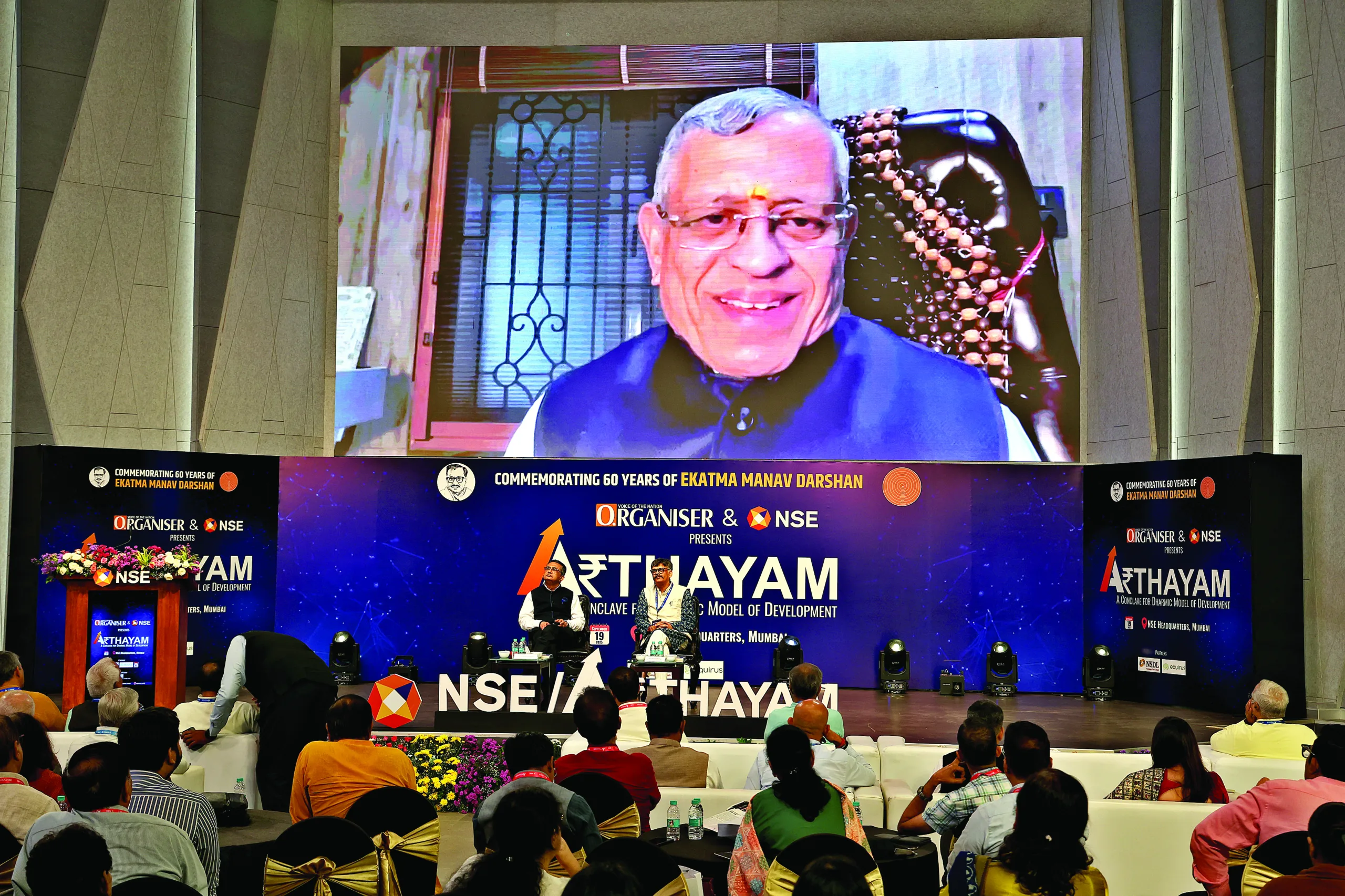
He described Dharma as the real social capital of Bharat, saying: “Intellectual capital belongs to those with knowledge, financial capital to those with money. But social capital, which is built on shared values, is ignored because it cannot be monetised. Bharat thrives because its society is built on shared duties, this is Dharma. Deendayal Ji’s entire discourse integrated man, society, nature, and civilisation.”
Gurumurthy explained that Integral Humanist Paradigm rests on the triad of Vyakti (individual), Samashti (collective), and Parmeshti (the cosmic whole).
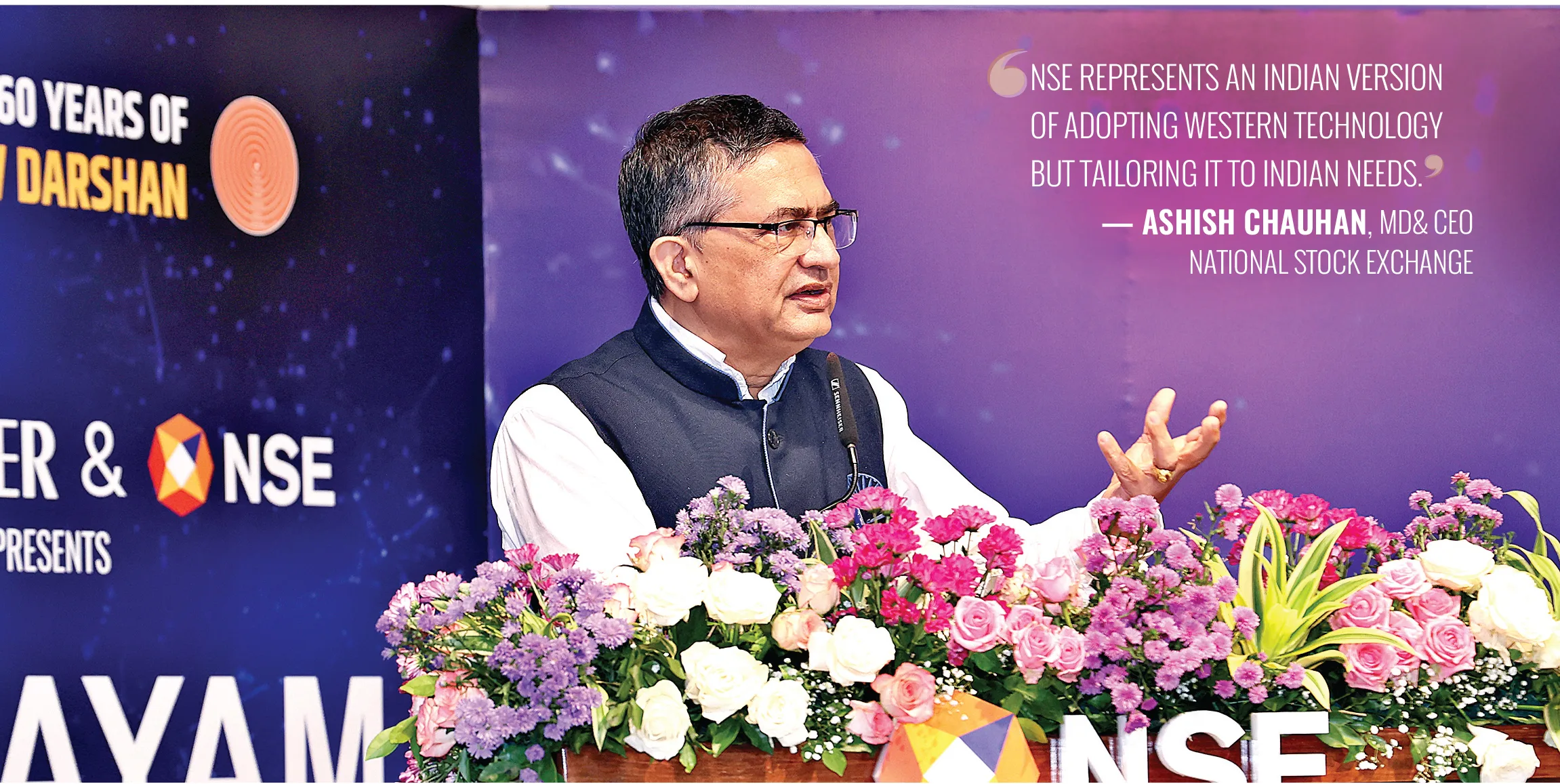
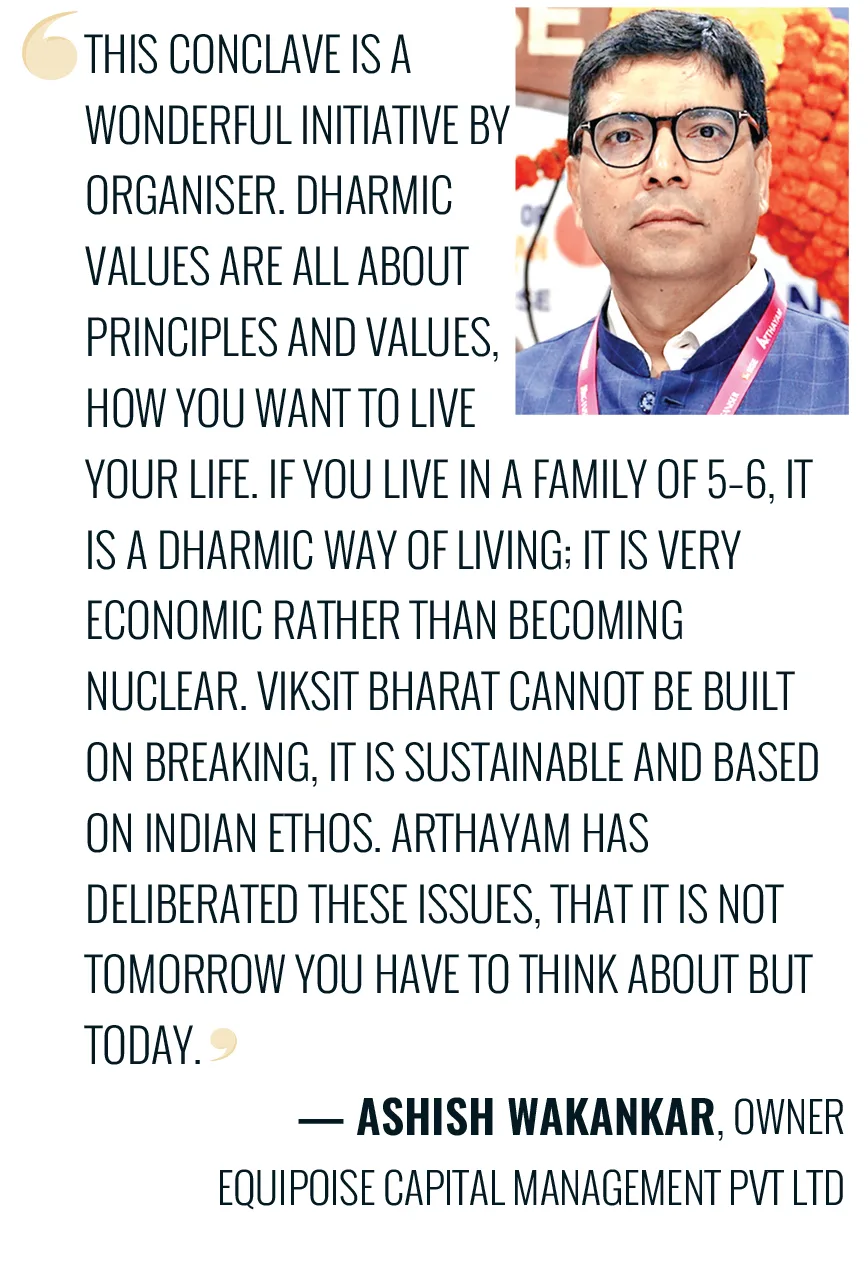
Ashish Chauhan Ji, while reflecting on the resilience of Indian democracy and its markets, said, “Social capital is ultimately trust. The stock market works because people trust strangers with their money. This is nothing new to Bharat; we always had guilds, caste-based structures, and trading sanghas where people pooled resources and shared wealth. The modern stock exchange is a continuation of this ethos.” He also emphasised the power of India’s youthful demography: “The societies that grow are the ones with young populations. Japan and China are ageing; Europe and the US are also ageing. But for the next 50 years, India will remain young. That is why wealth creation in the future belongs to Bharat.”
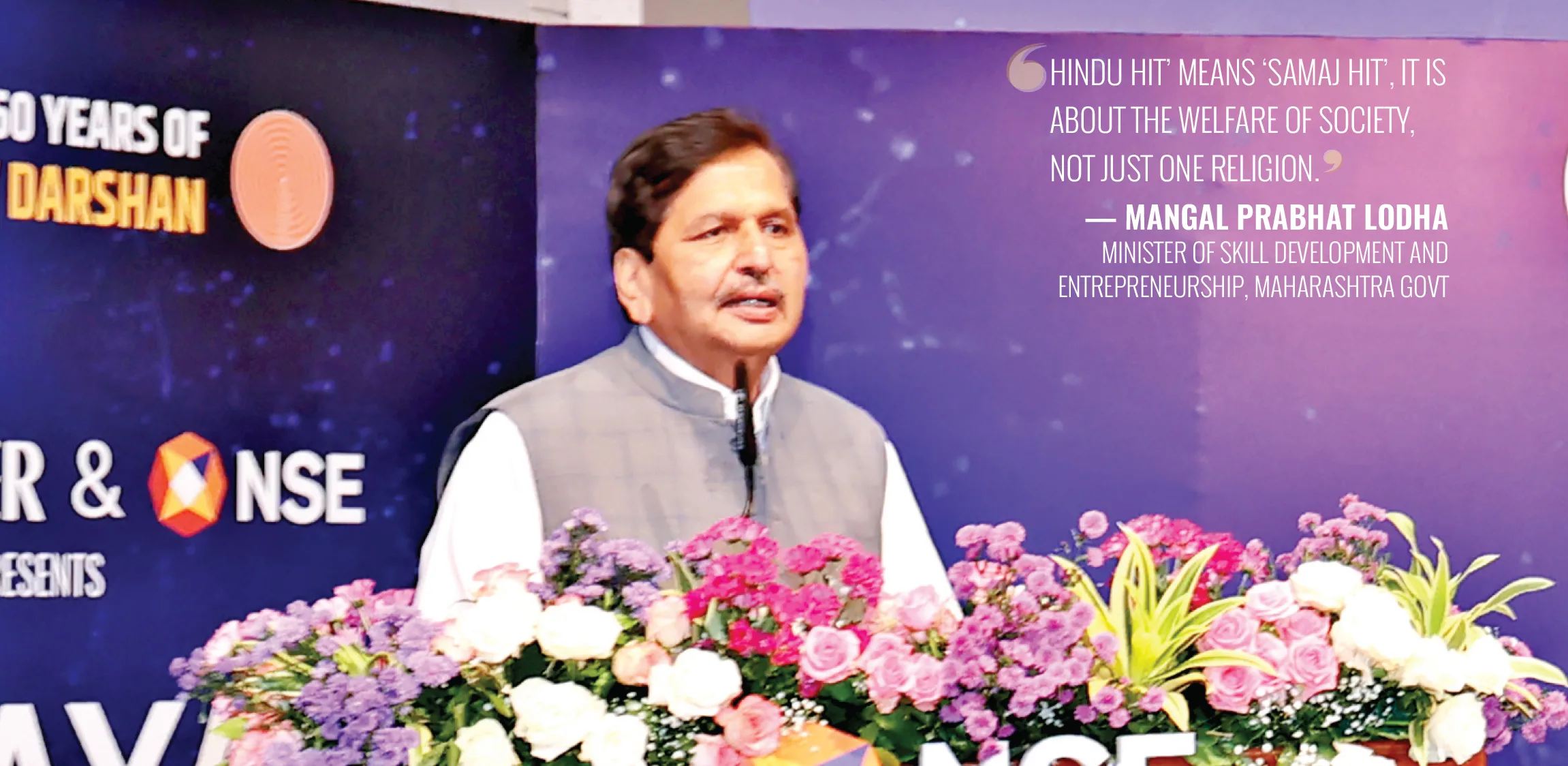
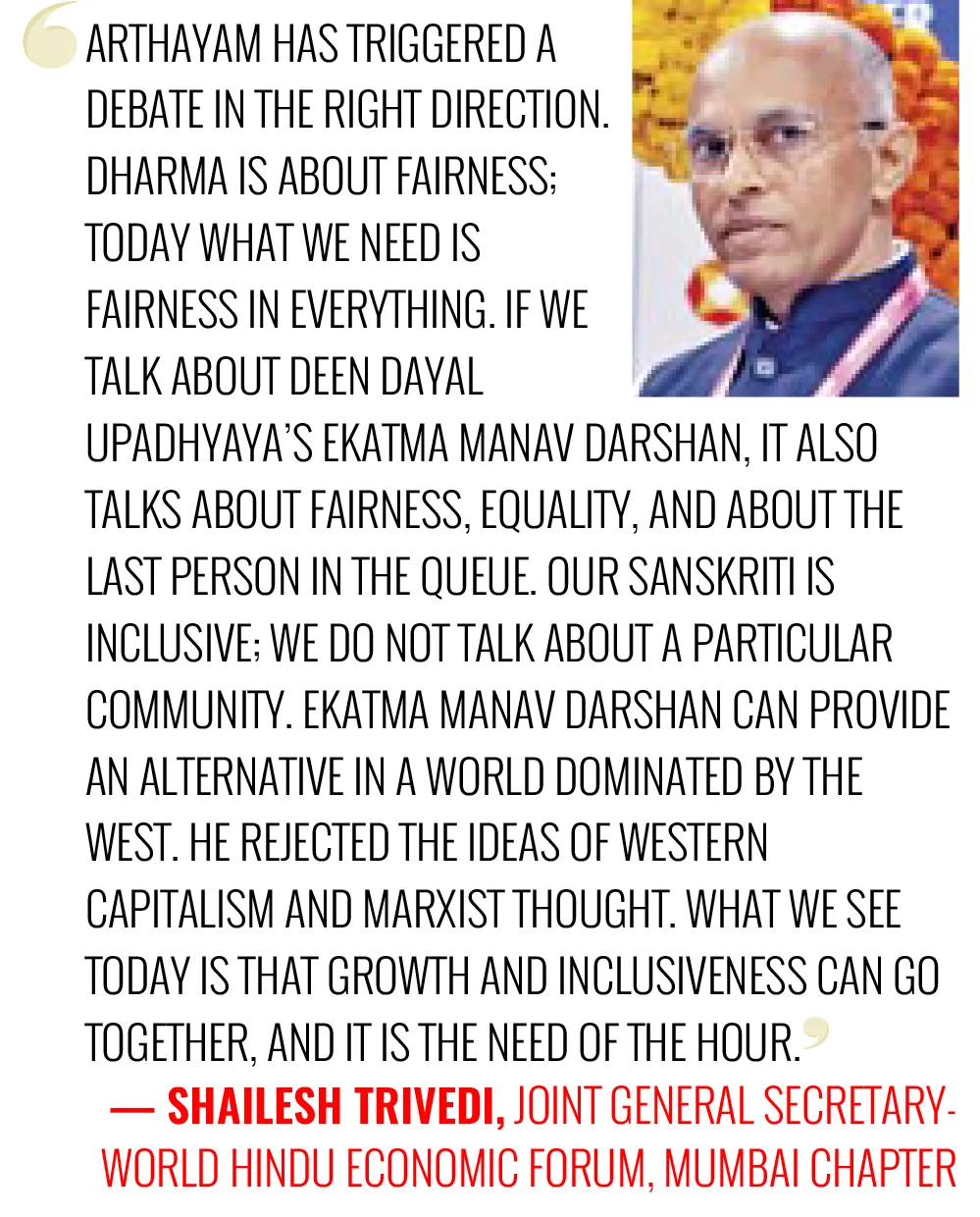
Mangal Prabhat Lodha, Maharashtra’s Minister of Skill Development and Entrepreneurship, underlined the civilisational wisdom in Deendayal Ji’s vision, saying: “At a time when Bharat was swaying between capitalism and socialism, Deendayal Upadhyaya Ji showed us the right path. Others spoke of individual-centric models, but this was rooted in family and society.”
He added, “Bharat was once the golden bird. Our temples, gaushalas, and social institutions reflected collective prosperity. Krishi was not merely an economic model but the backbone of our civilisational GDP. Every household was productive. For Bharat to rise again, every citizen must be empowered through self-employment and meaningful work.”
Tariffs: Blessing in Disguise
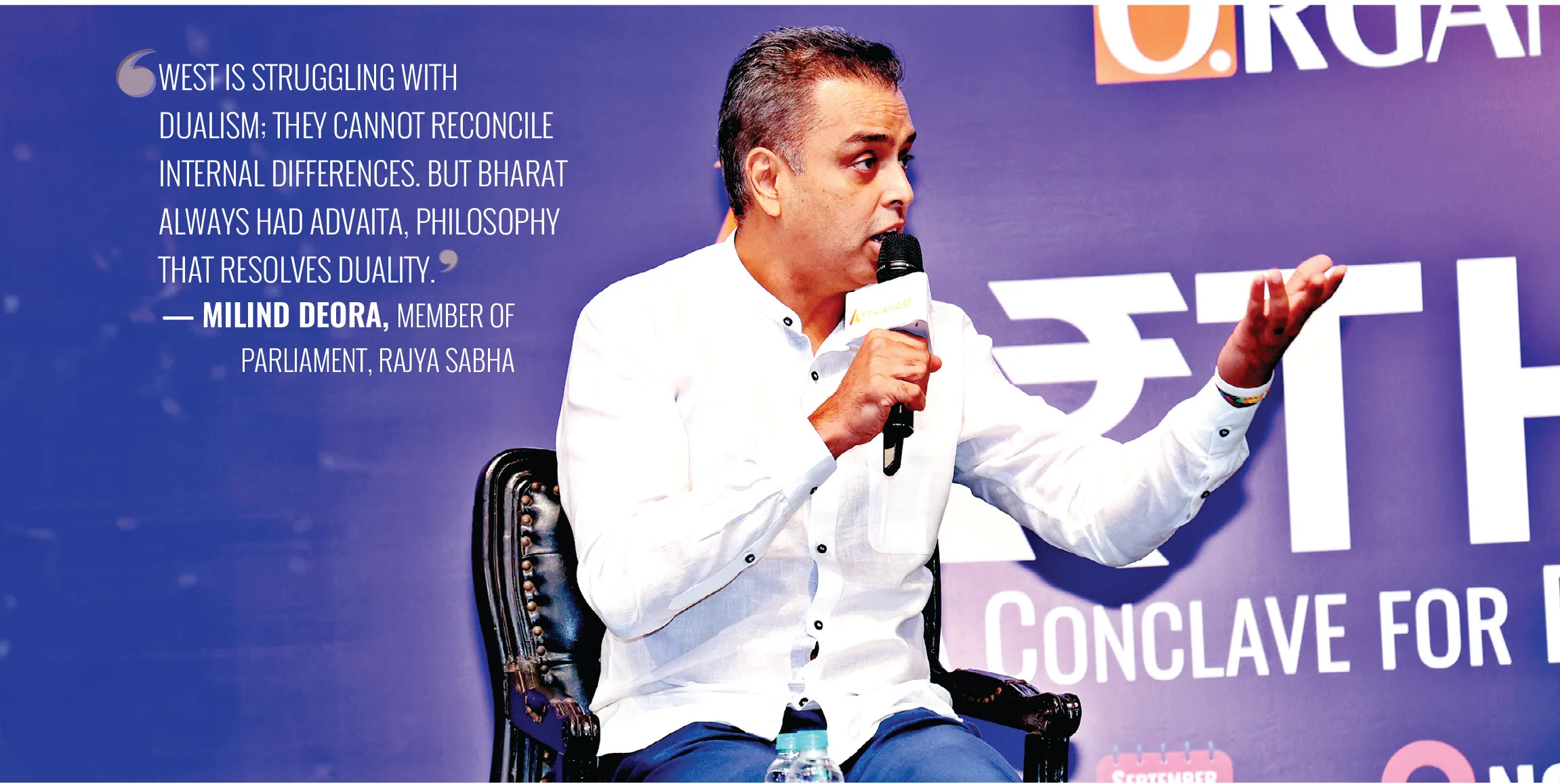
One of the most engaging sessions of the day unfolded as a candid Q&A with Milind Deora, Member of Parliament (Rajya Sabha) on the theme “Democracy and Diplomacy in the Turbulent World.”
Deora brought a mix of policy insights, personal experiences, and cultural reflections, offering a grounded yet forward-looking perspective on India’s place in today’s shifting global order.
The session began with a question on Deora’s earlier remark that tariffs could be a “blessing in disguise” and how India should position itself in today’s world. Drawing from his travels to Africa, Southeast Asia, and South America, Deora noted:“Whether it is Papua New Guinea, Brazil, or Colombia, every single country is tired of the Chinese model. They want India to offer them an alternative.”
On fiscal federalism, Deora warned that India cannot afford complacency and drew a comparison: “The United States has a debt-to-GDP ratio of 120 percent; India has 80 percent. Yes, our GDP is doing well. But how do we increase revenue while respecting federalism? That is the real question.”
He stressed that while reforms such as creating a unified market are important, India must strike a delicate balance between raising revenue, empowering states, and ensuring capital formation: “This is where politics meets economics and where prudence becomes most necessary.”
Deora welcomed the Government’s move to open the mining sector and encourage recycling of rare earths used in solar panels and wind turbines:
“With the right push, India can become a global hub in rare earth extraction and recycling,” he said, underlining how such policies directly tie into job creation and global competitiveness.
The discussion then shifted to America’s approach post-Operation Sindoor and its continuing engagement
with Pakistan.
Deora was forthright: “Tariffs are nothing but Dadagiri. I must credit the Prime Minister, 100 out of 100 marks for standing firm in the face of what could have been a major threat.”
He explained that America’s foreign policy is increasingly shaped by domestic compulsions: “Whether it is Republican or Democrat, shocks will keep coming. India needs a long-term strategy to weather them.”
At the same time, he credited the Modi Government for “holding the Indian brand with pride on the world stage.”
According to him, this ability to project national confidence has strengthened India’s diplomatic standing.
The final question centred on India’s vision for 2047 in a world where democracies appear increasingly fragile. Here, Deora became most philosophical:“We should never be ashamed of our model. The West is struggling with dualism, they cannot reconcile internal differences. But India has always had Advaita, the philosophy that resolves duality. That unseen sword is what saves us.”
Money Matters Trust: Foundation for Finance
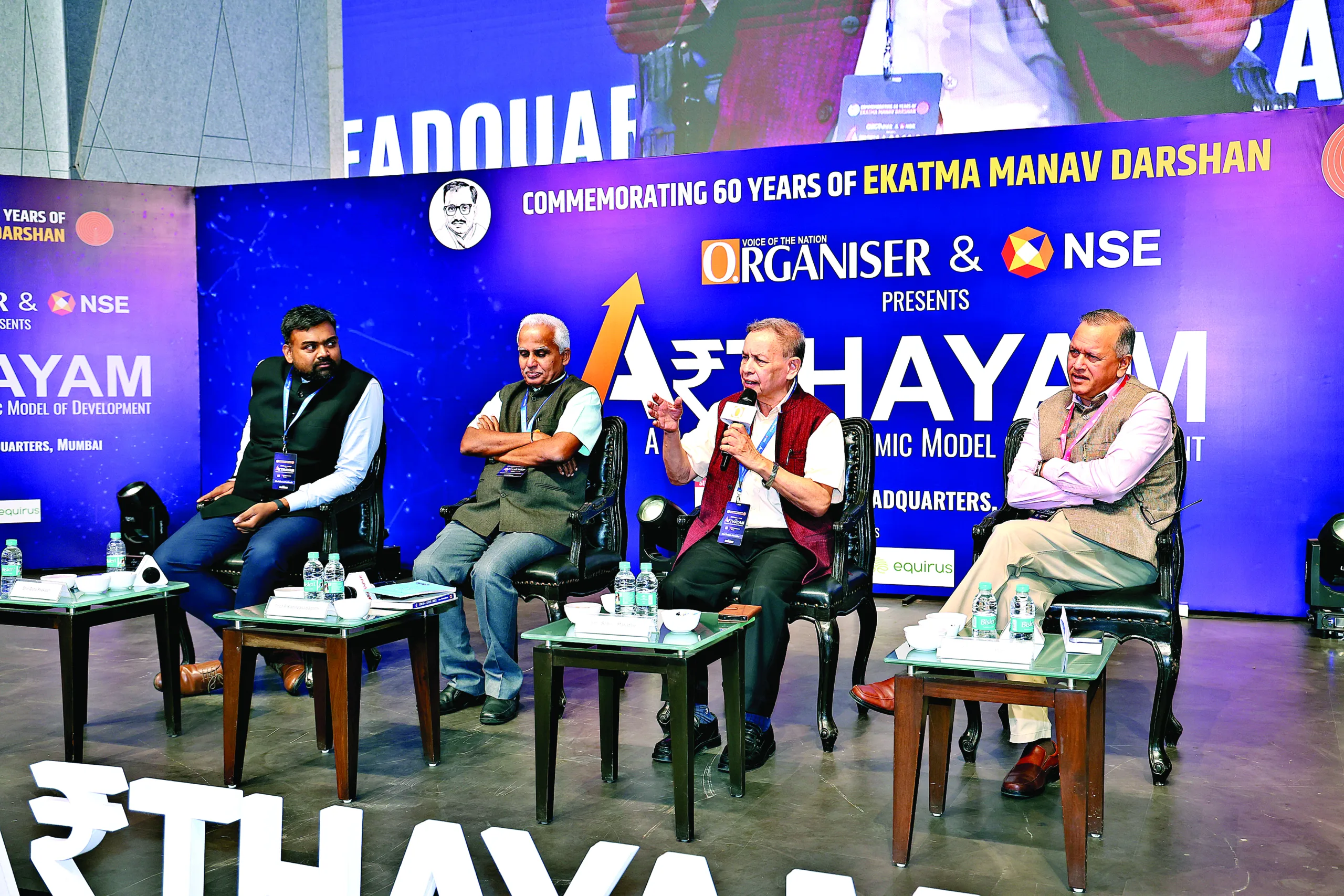
This session brought together eminent financial thinkers – Prof. P. Kanagasabhapathi, Mrugank M. Paranjape, and Satish Marathe to examine how India’s financial culture, savings habits, and cooperative systems reflect the deep interdependence of society, economy, and spirituality.
Prof. P. Kanagasabhapathi, Economist and Former Chairman of ICSSR, drew attention to the uniqueness of Bharat’s financial traditions, arguing that economic behaviour in India cannot be explained solely through institutions or abstract theories.
“Institutions and units don’t work in India; it is the trust system that works. That’s how I came to work around Deendayal Upadhyaya Ji’s philosophy,” he recalled from his field studies.
He noted that India’s savings culture demonstrates this trust-based model: “Even today, more than 94 percent of families put money into houses, gold, or land, while only about 5 percent invest in the stock market. This behaviour may appear conservative, but it reflects deep trust in tangible and culturally safe assets.”
Kanagasabhapathi stressed that this orientation has been the bedrock of India’s economic resilience: “Seventy years ago, we were a poor economy. Today we are among the most proficient economies. Why? Because of our strong fundamentals, our Sanatan culture, our families, our societies.”
Mrugank M. Paranjape, Director of State Bank of India, linked financial inclusion directly to the principles of Ekatma Manav Darshan. He emphasised that modern policies like Swadeshi and Atmanirbharta should be seen as expressions of Bharat’s civilisational philosophy, not temporary economic strategies.
“What we have done in the last three years with Jan Dhan, Aadhaar, and Mobile (JAM) is revolutionary. It has made financial inclusion almost a fundamental right. Today, whether I go shopping or transfer money, I can do everything on my phone.”
Satish Marathe, Founder Member of Sahakar Bharati and Director at the Reserve Bank of India, shed light on the neglected yet vital rural economy.
He underscored that more than half of India’s MSMEs are located in rural areas and yet remain underserved by mainstream financial systems.
“India’s cooperative movement is the largest in the world, yet for years we looked at cooperatives as service societies rather than economic enterprises. That is why we demanded and finally got a dedicated Ministry.”
Marathe noted that rural income patterns have shifted dramatically: “It is not just agriculture anymore. Activities from small manufacturing to services need structured financial support. If we align our cooperative institutions with modern systems, the rural economy will become the backbone of India’s growth story.”
Beyond Romanticism – Building Brand Bharat
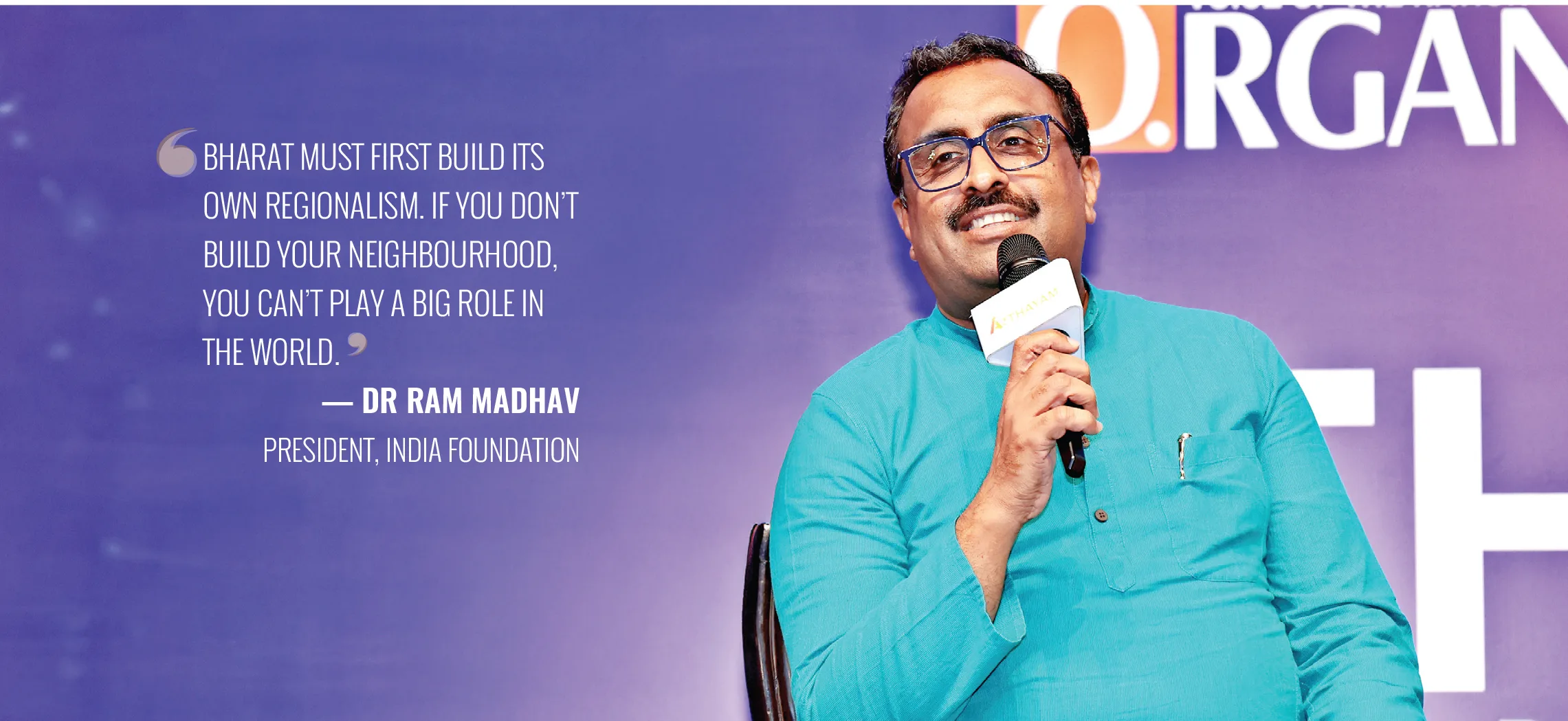
Invited to revisit themes from his books – Hindutva Paradigm (rooted in Pandit Deendayal Upadhyaya’s Integral Humanist Paradigm) and The New World: 21st Century Global Order and India – President of India Foundation, Dr Ram Madhav said the real task is not romanticising the past but reframing it for the present.
“We are very proud and very silent,” he said, recalling Swami Vivekananda’s warning about cultural pride coupled with societal lethargy. “Our wisdom is great; our application is weak.”
He cited the World Economic Forum’s call for “stakeholder capitalism” as a repackaging of what Indian thought has long articulated as Dharma – duties to people, community, nation and environment. “We never articulated it in a manner relevant to present times,” he argued. “The failure is not of Indian thought, but of translation into models.”
Pushing for Indianised governance, Madhav stressed that both Deendayal ji’s and Gandhi ji’s envisioned a consensus-centric, decentralised democracy. Ancient republican traditions and the Buddhist sangha, he said, offer precedents for consultative decision-making.
“What we call decentralisation is mostly decentralisation of funding, not of planning,” he noted, urging devolution of funds, functions and functionaries to local bodies. He referenced a Jammu & Kashmir initiative that attempted precisely that, and called for scaling and refinement.
The broader point: without designing operable Indian models, in democracy, urban governance, or service delivery, imported habits will continue to dominate, often misfitting Indian realities.
Turning to geopolitics, Madhav said the post-war “globalism” anchored in the UN system is losing salience; the 21st century will be defined by regional multilateralism – BRICS, SCO, ASEAN, the EU, the African Union and others. “Bharat must first build its own regionalism,” he cautioned, arguing that a westward gaze has kept Bharat from fully cultivating civilisationally close partners, notably Indonesia, where Indic heritage is palpable. “If you don’t build your neighbourhood, you can’t play a big role in the world.”
He warned that the emerging debate on civilizational states—a naturally Indian arena – is being shaped by others, pointing to China’s “Global Civilisations Initiative.” Bharat, he said, should be the convener and norm-setter in this discourse.
On technology, Madhav flagged the absence of philosophical oversight over AI, robotics and quantum advances. He noted the Vatican’s 2021 “Rome Call for AI Ethics” as a rare attempt to set guardrails.
“Who is intervening today? Elon Musk and Sundar Pichai are deciding how we should live. No philosopher is around,” he remarked. The imperative, he argued, is for Bharat to lead in codifying tech ethics grounded in civilisational values –“make sure man is supreme” and to convene the global conversation.
Madhav welcomed the Prime Minister’s ambitious $10-trillion economic target but stressed that achieving it would require deep structural reforms rather than just incremental growth. He emphasised that the bureaucracy must be overhauled to move beyond the existing transfer-driven generalist system and instead entrench domain expertise while making lateral entry truly meaningful.
He was blunt about Bharat’s R&D deficit, urging corporates to step up. “We must stop only catching up. Bullet trains and metros are necessary, but some of us must think ahead of the curve – build what the world doesn’t yet know it needs.”
Dr Ram Madhav challenged the comfort of civilisational pride without practice and mapped a route from ideas to institutions: Indian models of democracy and governance, empowered local bodies, regional leadership, heavy R&D investment, ethical guardrails for deep tech, and a Kumbh-anchored climate forum.
Bharat, he suggested, already owns the moral vocabulary the world seeks – Dharma, consensus, stewardship, human dignity. The task now is to engineer these into systems that deliver prosperity, equity and security at scale. Only then can Bharat move from celebrating the past to designing the future – not as a follower, but as a model-maker for the world.
Ekatma Darshan in Action: Beyond Philosophy
Commemorating 60 years of Pandit Deendayal Upadhyaya Ji’s philosophy of Ekatma Manav Darshan, the panel featuring Atul Jain, Gajanan Dange, Varsha Parchure, and Prof. Shashikala reflected on how this vision is not merely a theory but a lived reality in Bharat’s grassroots practices.
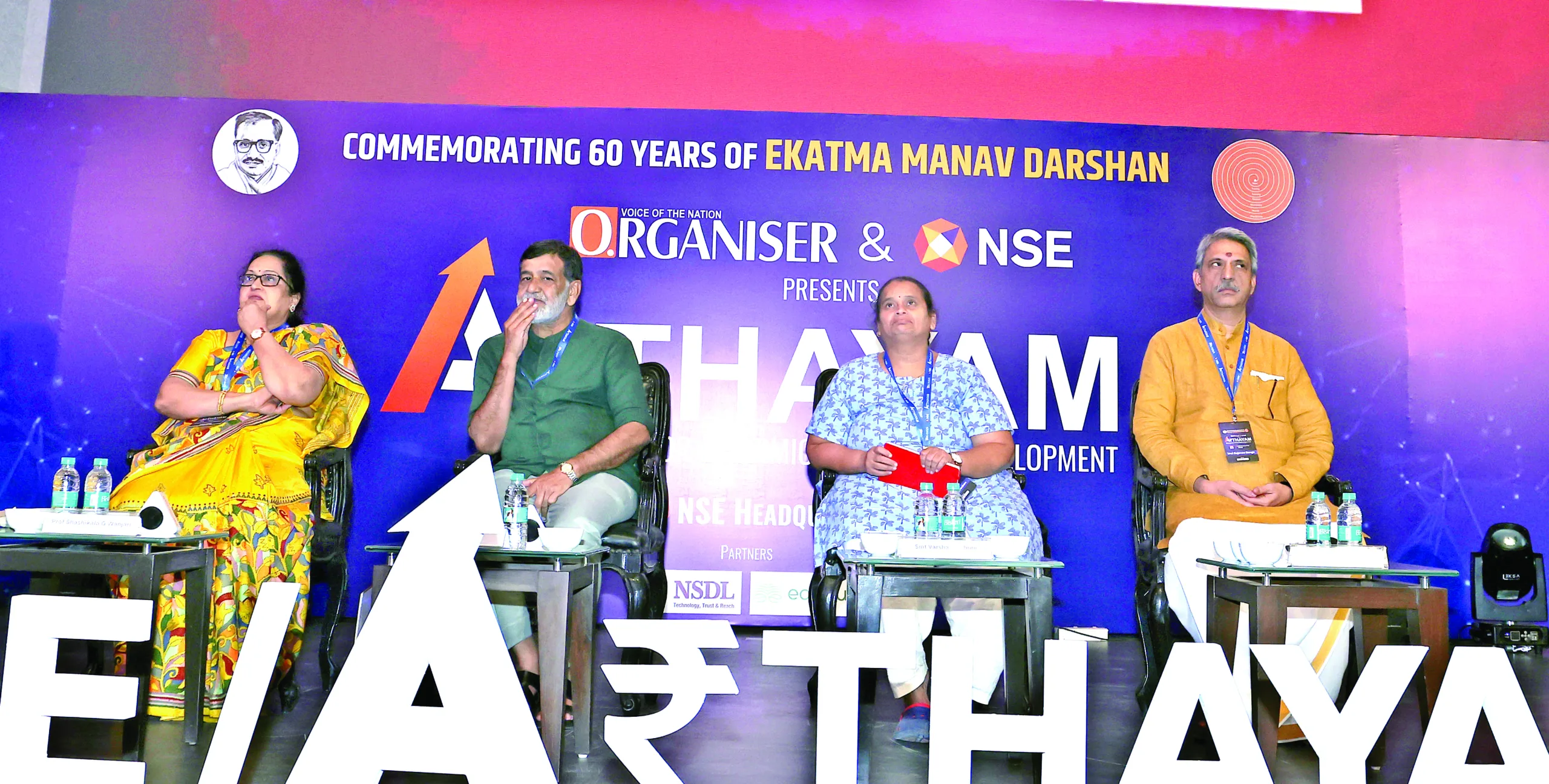
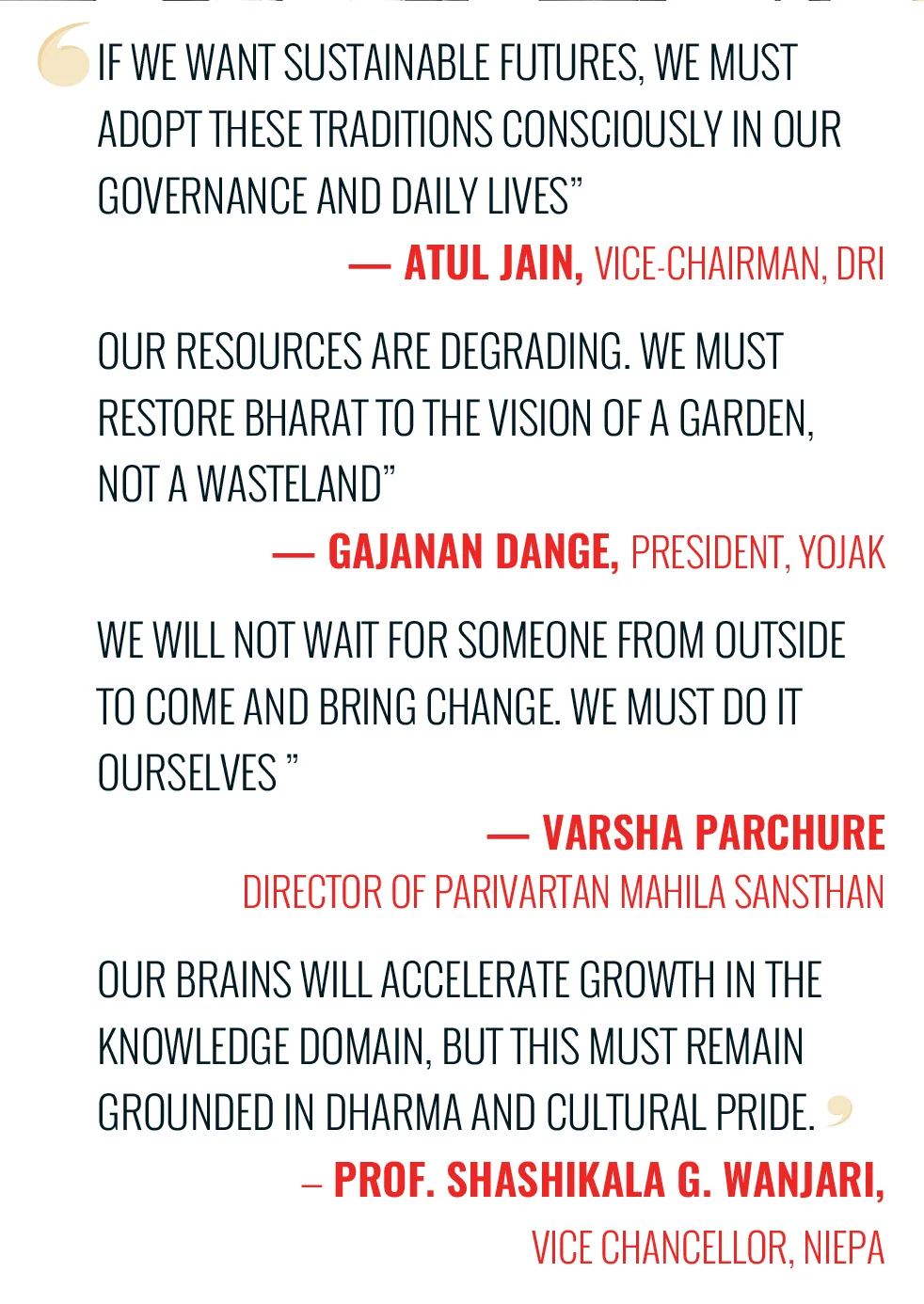
Atul Jain, Vice-Chairman of Deendayal Research Institute, noted that traditional water conservation systems, temple tanks, sacred groves, and village ponds were civilisational expressions of harmony between humans and nature.
“If we want sustainable futures, we must adopt these traditions consciously in our governance and daily lives.”
Gajanan Dange, President of YOJAK, painted a stark picture of village transformations over the last seventy years, warning of the social consequences of distressed migration: “Where migration has not happened, stories of resilience emerge. But where it has, we see painful results… Their sisters and daughters go to big cities, and when they return, they come back with children whose fathers are unknown. The village then struggles with how to give them dignity and space.”
He pointed to the ICAR Natural Resource Index, describing its findings as alarming: “Our resources are degrading. Our systems are collapsing. We must restore Bharat to the vision of a garden, not a wasteland.”
Varsha Parchure Ji, Director of Parivartan Mahila Sansthan, focused on grassroots transformation and reverse migration, sharing her four-pronged model for holistic community revival:
- Shikshan ka prachar aur prasar – spreading education rooted in values
- Vyakti ka vikas, samaj ka vikas – aligning individual development with community growth
- Sangathan – building organisational strength
- Sahkarita and participation – fostering cooperative spirit
“Ground-level work is tough. We need to drag people back to vision-based ideas and action. I work at the micro level, changing people’s thinking first.”
Prof. Shashikala G. Wanjari, Vice Chancellor of NIEPA, linked Deendayal Ji’s philosophy to the National Education Policy (NEP) 2020: “When we are rethinking Deendayal Ji’s philosophy, we must see how it is reflected in NEP 2020. It enables holistic development of body, mind, intellect, and soul and fosters self-reliance.”
She listed four pillars of the NEP vision that resonate with Integral Humanist Paradigm:
- Education rooted in the Indian ethos
- Curriculum that instils respect for duties and constitutional values
- Deep bonding with roles and responsibilities in society
- A strong sense of pride in being Indian
“Our brains will accelerate growth in the knowledge domain, but this must remain grounded in Dharma and cultural pride.”
Dharma – the life mission of Bharat
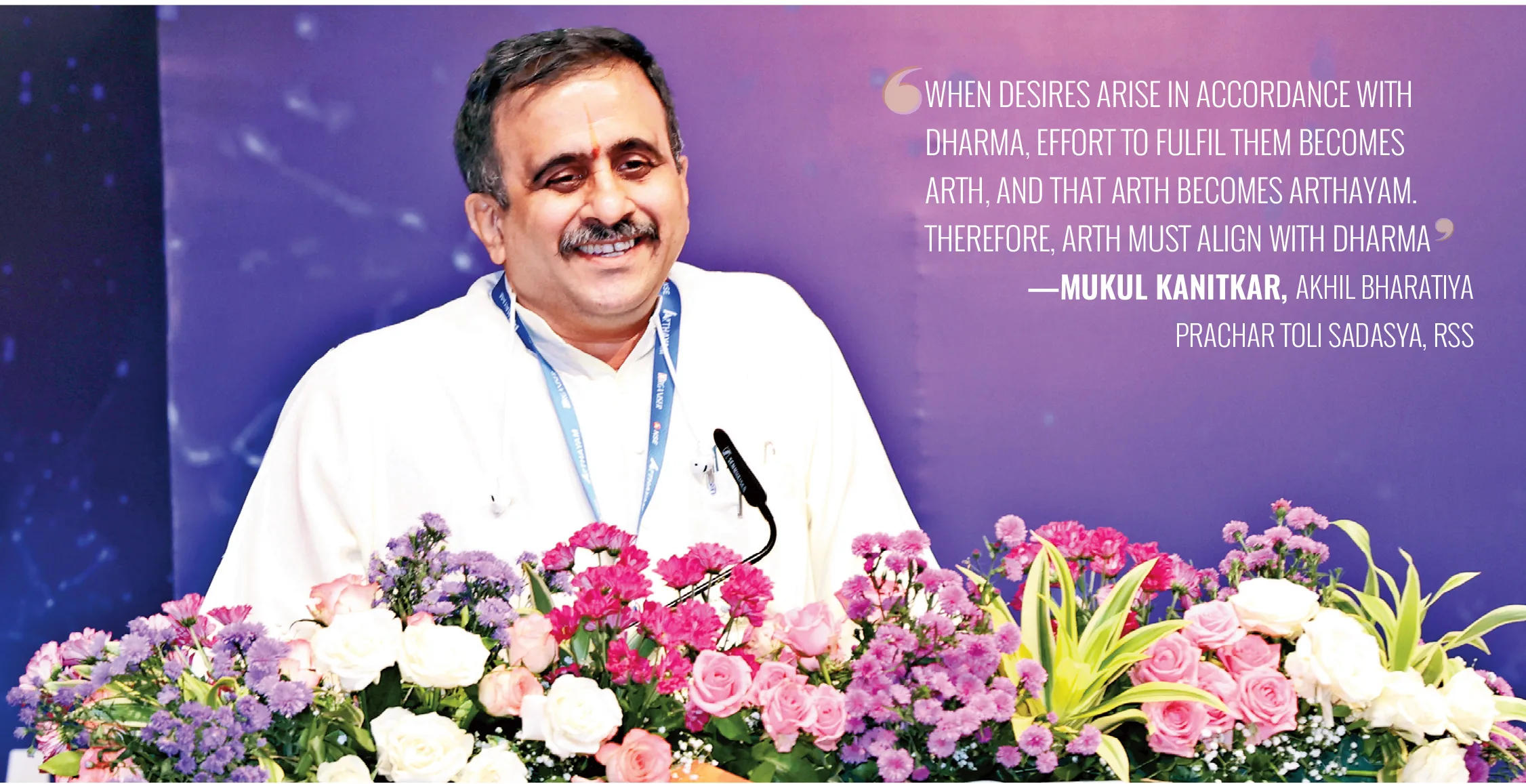
At the valedictory session, Mukul Kanitkar, Akhil Bharatiya Prachar Toli Sadasya of RSS, remarked: “That the ideas of Ekatma Manav Darshan and Pandit Deendayal Upadhyaya are being discussed in the office of NSE itself shows that Bharat is changing, awakening, returning to its roots and preparing to guide the world.”
He reminded that when Sangh sent Deendayal Ji into politics, it was with the conviction that for neeti (policy) to be meaningful, it must stand on the firm foundation of darshan (vision).
Explaining the concept of Arthayam, he said: “Arth means Parakram, arth also means upadan (production)… Pandit Deendayal Upadhyaya called this dimension of life Arthayam, the economic dimension of existence.”
He added: “Sukh has its root in Dharma. Dharma has its root in Arth. Arth has its root in rajya. Rajya rests on indra vijay… Without winning over the self, no sukh can be attained.”
He underlined that this is why Bharat’s task is to show the path to the world: “One born in this land (Bharat) is an ‘agrajanma’… Taking birth in this land itself is a privilege, Dharma automatically comes to you here through sanskar.”
“While understanding Ekatma Manav Darshan, we have to realise that Bharat’s vision itself is a scientific, natural, organic (Angangi), where one part is connected to the other, and the entire creation is interlinked. That is why, after sowing a seed, you cannot pull it out of the tree; it will grow naturally, and for that, we must wait patiently. Bharat will become Viksit when it works according to its Dharma, for which Bharat has a divine mission. This nation was created through the tapasya of the rishis, and by following that path, like a seed, it will develop in an organic manner, not by imposing an artificial design. A policy based on Ekatma Manav Darshan will therefore be natural and organic in essence,” he said.
Mukul Kanitkar emphasised that prosperity and traditions have always existed in Bharat. “In Bharat, no transformation takes place suddenly, nor does it happen in the form of a revolution. In Bharat, prosperity and traditions have always existed. Some Ganrajyas functioned through the chatur varna vyavastha, in some, every citizen had the right to vote, while in others, a consensus system was used. In Magadh alone, there were 17 different types of political systems. Bharat was never governed by a single model; the idea of “one size fits all” is a Western concept. Here, the model of one place does not necessarily work in another because the system is organic (Jaivik).
Therefore, only direction can be provided, policies can be framed, but rigid templates or fixed parameters
cannot be imposed”, he said.
The event concluded with Arun Goyal, Managing Director of Bharat Prakashan (Delhi) Limited, extending gratitude to speakers for their insightful contributions and analysis that broadened the discussion. Ekatma Manav Darshan resonating at NSE was an unbelievable experience for all those who attended the event. A darshan, known by many, however, neglected for years, found reinstatement at the very place where it was first propounded.













Comments