





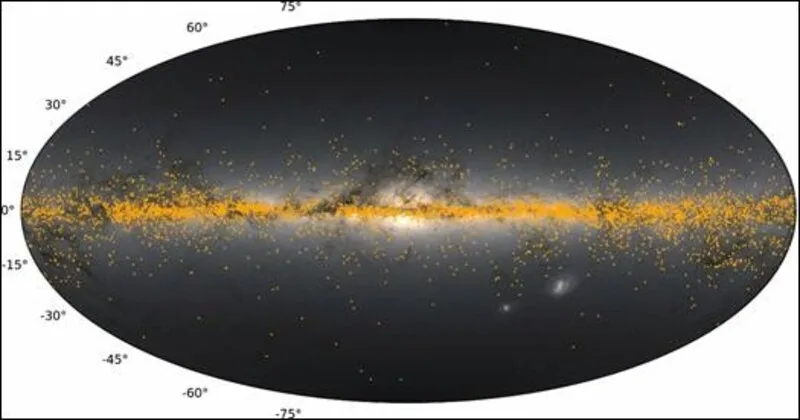
Each time we gaze up at the nighttime sky, the Milky Way amaze us with its vast river of stars. But what we see is a limited vision. Much of our galaxy is hidden behind unseen curtain of cosmic dust or particles that is dim, scattered and reedify starlight. For astronomers this dust is both obstacle and pathfinder. It hides stars from sight but shows the areas where new stars are created. It has recently been that Indian researchers have made a great leap towards uncovering this secret, mapping the dust with precision and providing the world with a more accurate insight into our galaxy.
The Indian Scientific Effort
This achievement is made possible because of an institute, Aryabhata Research Institute of Observational Sciences (ARIES) in Nainital an autonomous institute under the Department of Science and Technology (DST), Government of India. Led by Dr. YC. Joshi, the team used data from over 6,000-star clusters to chart the distribution of interstellar dust across the Milky Way’s galactic plane.
Open clusters are the stellar groups that formed together from the same molecular clouds, are good tracers for research. They lie near the galactic disk the tight, flat plane of our Galaxy where gas and dust are dense. By measuring how starlight from the clusters is filtered and reddened, the researchers constructed an extensive dust map that can act as a cosmic compass for astronomers everywhere.
The research uncovered an interesting pattern. Dust within the Milky Way is not uniformly distributed. Rather it exists in a narrow, wavy sheet, tilted slightly relative to the central galactic plane. This sheet is known as the “reddening plane,” that moves up and down in a wave-like fashion throughout the Galaxy.
The results also indicated regional variation. The densest region of dust lies in the Galactic longitude direction of 41° and the lowest region around 221°. Interestingly our Sun itself is situated around 50 light-years above this dusty layer.
Why Cosmic Dust Matters
To the naked eye, cosmic dust would appear to be an inconvenience just something that dim our line of sight. But the truth is that dust is the raw material of creation. It is in these thick clouds that new stars and planets form. Mapping dust is then not just a matter of clearing obstacles in astronomy observations, but also of locating the nurseries of stars in the future.
For Indian scientists, the study brings sharper insight into the process of star formation within our Galaxy. It also introduces important corrections for astronomers worldwide. Unless dust is taken into account, the measurement of star brightness, distance and even the discovery of remote galaxies can be deceptive. This study gives the world a clear perspective with which to look at the universe.
India has been gradually gaining its position as an international leader in space and astrophysics. From the satellite Aryabhata (1975) to recent achievements such as Chandrayaan-3 landing on the moon and the Aditya-L1 solar mission, India has shown that its engineers and scientists can contribute meaningfully to human’s knowledge about space.
This dust-mapping research is a perfect fit for revealing how Indian institutions are not only being part of, but also initiatives to solve key cosmic mysteries. DST involvement confirms the government focus on promoting high-value research that puts India at the center of international partnerships.
A Global Collaboration in the Making
The research is not only an Indian success, but it is also linked with global initiatives. Information from the European Space Agency Gaia mission played a pivotal role in the identification of open clusters and the examination of their characteristics. Missions such as Gaia’s subsequent data release and the Vera C. Rubin Observatory Legacy Survey of Space and Time (LSST) will augment this work in the future, allowing astronomers to construct a three-dimensional picture of the Milky Way dusty framework.
By combining home-grown scientific expertise and local support with global streams of data, India becomes an astrophysics bridge-builder in the contemporary era. This approach reflects the wider philosophy under which India space program operates with global science their exists national pride.
The research also shows how dynamic and evolved the Galaxy actually is. Dust layers are thicker at the Galactic center and thinner elsewhere, which suggests turbulent processes shaping our Galaxy. These types of details will be precious for future explorations, whether they include examining stellar populations, searching for habitable exoplanets or looking into faraway galaxies. Future missions such as India proposed X-ray and ultraviolet observatories will also find benefits in these results, since precise dust maps are crucial to calibrating their instruments.
Connecting the Cosmos to Culture
For India, the pursuit of knowing the stars has never been simply scientific. From Vedic chants to Aryabhata computations, the universe has been intrinsic part of our cultural imagination. Today institutions such as ARIES take their share in international astrophysics, they are only carrying on this civilisational conversation with the cosmos. Charting the Milky Way dust is not a matter of formulae and telescopes, but also of humanity timeless endeavour to peer beyond the seen and to understand the unseen.
The mapping of the Milky Way hidden dust layers is a reminder that science progresses by examining what the naked eye can’t see. For India this finding is a national pride. Unveiling the Galaxy’s unseen shroud has lit the way to further discoveries and it firmly places India among the stars both figuratively and literally.
As the globe gears up for more profound cosmic exploration, this research is proof that India will not be playing a peripheral but a central role. With each such innovation, our country reestablishes itself as a power of knowledge, not only adding to its own development but to human mankind collective search by comprehending the universe that we inhabit.












Comments