





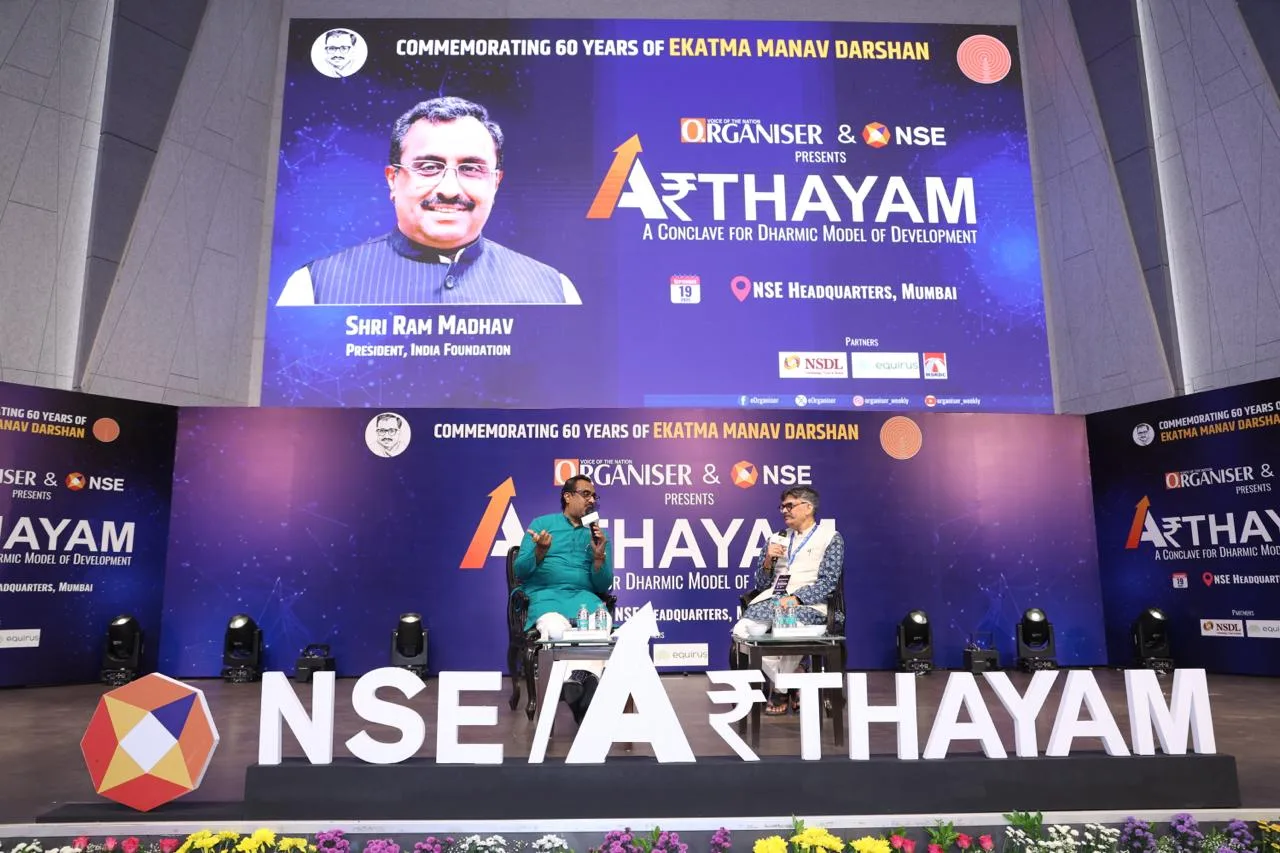
Invited to revisit themes from his books, Hindutva Paradigm (rooted in Pandit Deendayal Upadhyaya’s Integral Humanism) and The New World: 21st Century Global Order and India, President of India Foundation, Dr Ram Madhav said the real task is not romanticising the past but reframing it for the present.
“We are very proud and very silent,” he said, recalling Swami Vivekananda’s warning about cultural pride coupled with societal lethargy. “Our wisdom is great; our application is weak.”
He cited the World Economic Forum’s call for “stakeholder capitalism” as a repackaging of what Indian thought has long articulated as dharma, duties to people, community, nation, and environment. “We never articulated it in a manner relevant to present times,” he argued. “The failure is not of Indian thought, but of translation into models.”
Indian democracy beyond Westminster: Models, not mantras
Pushing for Indianised governance, Madhav stressed that both Deendayal ji’s and Gandhi ji’s envisioned a consensus-centric, decentralised democracy. Ancient republican traditions and the Buddhist sangha, he said, offer precedents for consultative decision-making.
“What we call decentralisation is mostly decentralisation of funding, not of planning,” he noted, urging devolution of funds, functions and functionaries to local bodies. He referenced a Jammu & Kashmir initiative that attempted precisely that, and called for scaling and refinement.
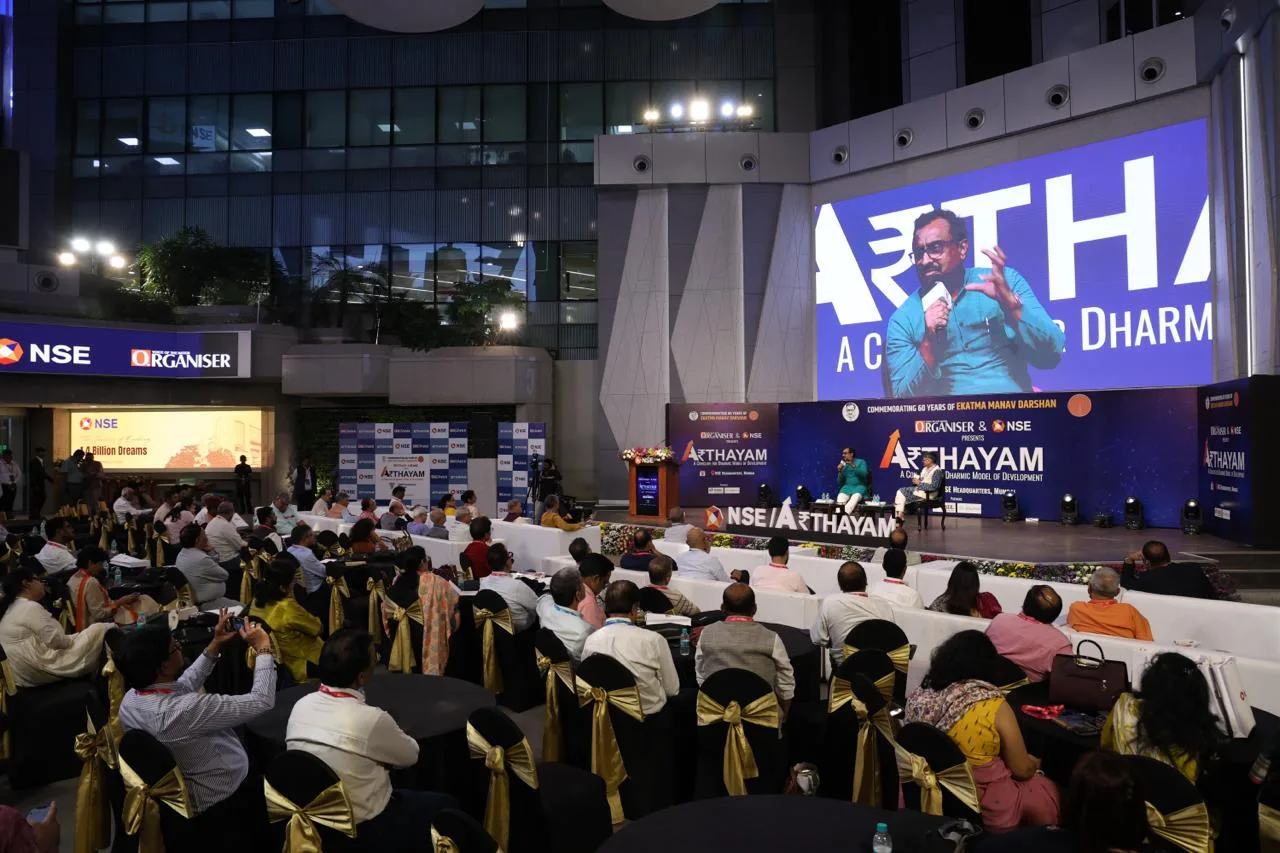
The broader point: without designing operable Indian models, in democracy, urban governance, or service delivery, imported habits will continue to dominate, often misfitting Indian realities.
The world after UN-style globalism: Build regionalism to lead
Turning to geopolitics, Madhav said the post-war “globalism” anchored in the UN system is losing salience; the 21st century will be defined by regional multilateralism – BRICS, SCO, ASEAN, the EU, the African Union and others.
“Bharat must first build its own regionalism,” he cautioned, arguing that a westward gaze has kept Bharat from fully cultivating civilisationally close partners, notably Indonesia, where Indic heritage is palpable. “If you don’t build your neighbourhood, you can’t play a big role in the world.”
He warned that the emerging debate on civilisational states—a naturally Indian arena is being shaped by others, pointing to China’s “Global Civilisations Initiative.” Bharat, he said, should be the convener and norm-setter in this discourse.
Deep tech, metahumans and the ethics vacuum
On technology, Madhav flagged the absence of philosophical oversight over AI, robotics and quantum advances. He noted the Vatican’s 2021 “Rome Call for AI Ethics” as a rare attempt to set guardrails.
“Who is intervening today? Elon Musk and Sundar Pichai are deciding how we should live. No philosopher is around,” he remarked. The imperative, he argued, is for Bharat to lead in codifying tech ethics grounded in civilisational values – “make sure man is supreme” and to convene the global conversation.
Climate leadership through Kumbh
Madhav proposed that Bharat host a global climate summit at every Kumbh, drawing on the mela’s millennia-old role as a forum for knowledge and ethical engagement with nature – rivers, water, and human-environment balance.
“Why should those who created the ecological crisis keep dictating the solutions?” he asked, calling for Bharat to turn the Kumbh into a recurring ideas platform on sustainability.
Economy, economy, economy: A $10-trillion ambition needs reform
Madhav welcomed the Prime Minister’s ambitious $10-trillion economic target but stressed that achieving it would require deep structural reforms rather than just incremental growth. He emphasised that the bureaucracy must be overhauled to move beyond the existing transfer-driven generalist system and instead entrench domain expertise while making lateral entry truly meaningful. Simultaneously, he called for comprehensive judicial and regulatory reforms to remove systemic frictions that stifle entrepreneurial energy and to ensure time-bound adjudication of cases. Equally crucial, he said, is the need for genuine decentralisation – empowering local units not merely with funds but also with actual planning authority and the autonomy to shape their own development priorities, while evaluating outcomes directly at the community level.
He was blunt about Bharat’s R&D deficit, urging corporates to step up. One global firm, he noted, can outspend Bharat’s national research tab; meanwhile, vital areas like critical-minerals processing remain bottlenecked by technological dependence.
“We must stop only catching up. Bullet trains and metros are necessary, but some of us must think ahead of the curve – build what the world doesn’t yet know it needs.”
Temples as social institutions: A five-function framework
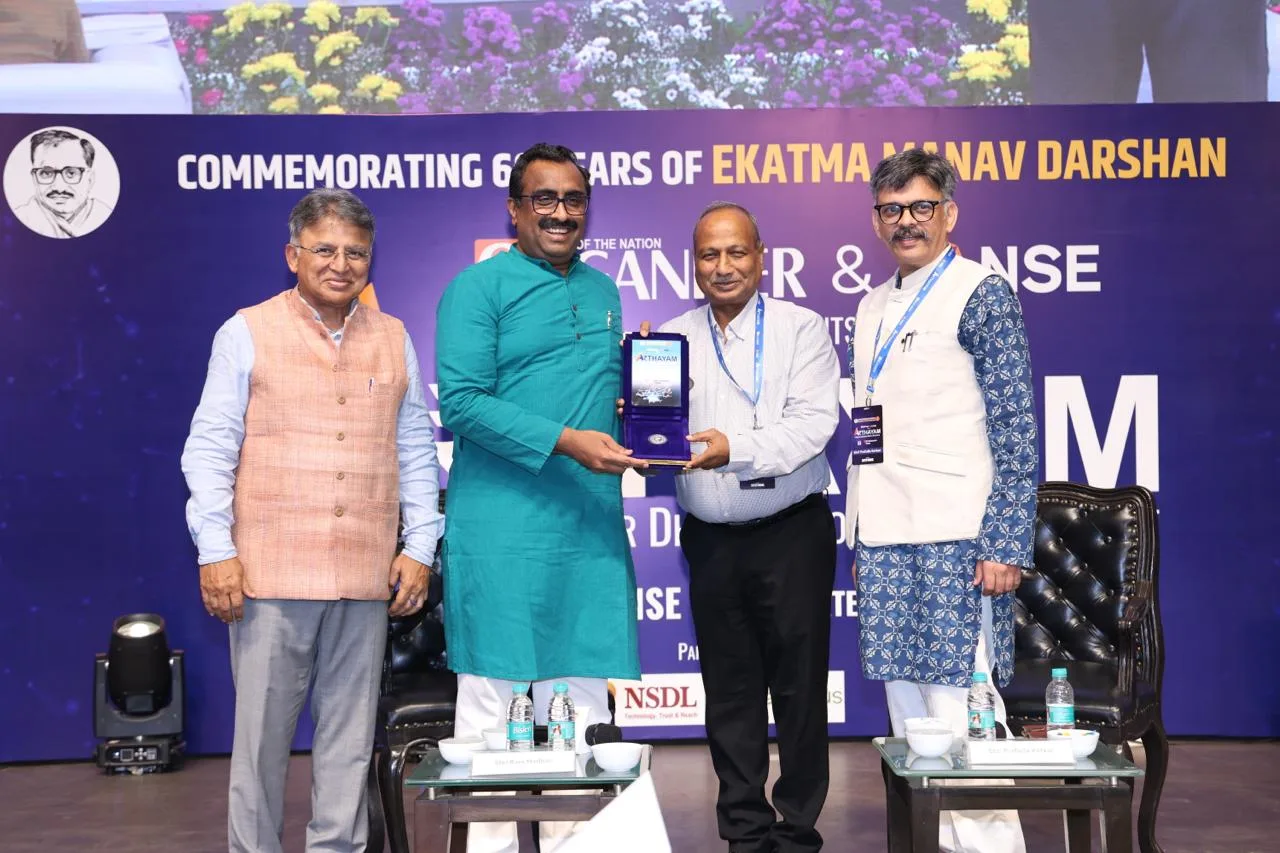
Extending decentralisation into social infrastructure, Madhav proposed returning temple management to communities through a model with accountability, assigning five public functions that can reduce state burden while reviving tradition – Food security (annadāna), Primary education, Basic healthcare (Ayurveda/local systems), Protection of arts and culinary heritage and Spirituality and values education
“Give powers and responsibility to institutions people trust,” he said. “You will see wonder.”
Dr Ram Madhav challenged the comfort of civilisational pride without practice and mapped a route from ideas to institutions: Indian models of democracy and governance, empowered local bodies, regional leadership, heavy R&D investment, ethical guardrails for deep tech, and a Kumbh-anchored climate forum.
Bharat, he suggested, already owns the moral vocabulary the world seeks – dharma, consensus, stewardship, human dignity. The task now is to engineer these into systems that deliver prosperity, equity and security at scale. Only then can Bharat move from celebrating the past to designing the future – not as a follower, but as a model-maker for the world.












Comments