





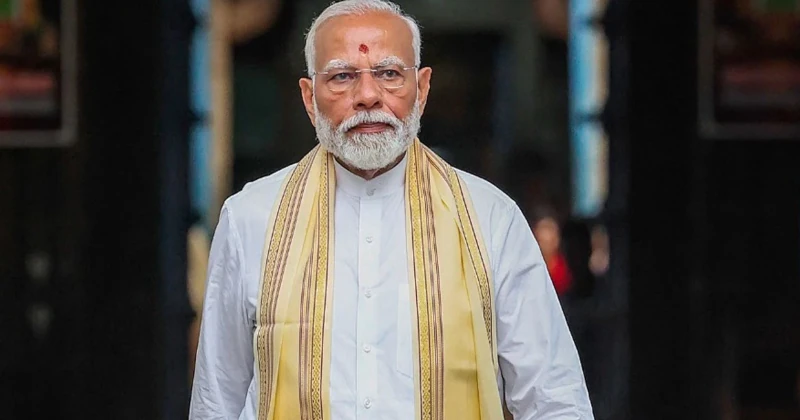
When history records the 21st century, one name will tower above all as the leader who altered Bharat’s destiny Narendra Damodardas Modi. As he turns 75 today, the journey of a tea-seller’s son from Vadnagar to the Prime Minister who redefined Bharat’s global stature is not just a story of political triumph but a saga of civilisation’s resurgence.
This Diamond Jubilee is more than a personal milestone. It is a reflection of Bharat’s transformation—from a nation once plagued by corruption, indecision, and lack of vision to a confident Vishwaguru, respected by the world and rooted in its ancient civilisation.
Born in a poor family in Vadnagar, PM Modi’s childhood was shaped by deprivation but illuminated by dreams larger than life. While other children sought comfort and play, young Narendra was restless with questions about society, nation, and destiny.
Vadnagar, once a flourishing centre of Buddhist scholarship, left its imprint on him. The spiritual vibrations of the land, coupled with his early reading of Swami Vivekananda, instilled in him the idea that Bharat was destined to be a Jagat Guru. He dreamt of a nation rooted in Dharma yet modern in its aspirations.
His family’s hardships made him sensitive to poverty. The sight of his mother cooking on a smoky stove etched itself in his mind years later inspiring the Ujjwala Yojana, which freed millions of women from the curse of smoke-filled kitchens.
At 17, PM Modi left home, embarking on a two-year spiritual journey across Bharat. From the Himalayas to the Ramakrishna Mission, from Buddhist centres to ashrams, he absorbed the wisdom of Bharat’s civilisational mosaic.
Returning with clarity of purpose, he joined the Rashtriya Swayamsevak Sangh (RSS). It was here that Narendra Modi found his discipline, philosophy, and platform for service. His mentors—Balasaheb Deoras, Rajju Bhaiya, Eknath Ranade, Anantrao Kale, and K.K. Shastri—left lasting impressions.
- From Balasaheb Deoras, he learnt crisis management during the 1979 Morbi dam disaster.
- From K.K. Shastri, he imbibed the Karmayogi ideal of ceaseless work without expectation.
- From Deendayal Upadhyaya’s Integral Humanism, he drew his socio-political philosophy.
Life as a Pracharak was hard—4:30 a.m. wake-ups, endless travel, minimal possessions, no holidays. But it forged in him an unbreakable discipline. Even today, at 75, he sleeps barely four hours, works 18–20 hours daily, and adjusts time zones instantly on foreign tours.
PM Modi’s political career took a decisive turn after the devastating Gujarat earthquake of 2001. Sent from Delhi as BJP’s relief coordinator, his organisational skills shone. Soon after, he was appointed Chief Minister of Gujarat.
His tenure in Gujarat transformed the state into a model of governance, infrastructure, and industry. The Vibrant Gujarat summits attracted global investment, while his disaster management skills set new benchmarks. By 2014, PM Modi’s image as a strong, decisive leader with a people-first approach had captured the national imagination.
When Modi became Prime Minister in 2014, he promised “Minimum Government, Maximum Governance.” Within months, the bureaucratic culture of Delhi changed.
Where once ministers and officers enjoyed foreign holidays and short working hours, now weekends were spent in the Northeast, in villages, and with the people. PM Modi made it clear: governance is not a privilege but a 24×7 responsibility. Former Finance Minister Arun Jaitley once noted: “When Atal ji was PM, I would leave North Block by sunset. Under PM Modi, I leave only after 9 pm.” The transformation was systemic.
Unlike many leaders, PM Modi’s schemes stemmed directly from lived experience:
- Ujjwala Yojana → Inspired by his mother’s struggles at the stove.
- Jan Dhan Yojana → Born from his understanding of poverty and the need for banking access.
- Beti Bachao, Beti Padhao → Shaped by his respect for women and concern over declining sex ratios.
- Free Ration Scheme → A response to hunger during Covid, benefiting over 80 crore people.
Women in particular became PM Modi’s strongest silent supporters. As he said after the Bihar elections: “These women are my silent voters.”
For PM Modi, birthdays have always been occasions of service, not celebration. But since his mother Hiraba’s passing in 2022, his birthdays have carried an emotional void.
On his 74th birthday in Odisha, while launching the Subhadra Yojana, he recalled how a tribal mother fed him kheer, evoking memories of his own mother feeding him jaggery on every birthday. “This experience,” he said, “is the true capital of my life.”
PM Modi redefined governance by converting schemes into movements:
- Swachh Bharat Abhiyan (2014) – Every child, every citizen joined hands. Toilets, cleanliness, and sanitation became household discussions.
- International Yoga Day – From 35,000 people on Rajpath in 2015 to 23 crore globally by 2023, Yoga became Bharat’s global gift.
- Har Ghar Tiranga (2022) – Patriotism turned into a household celebration.
Under PM Modi, Bharat experienced a civilisational reawakening:
- Ram Mandir in Ayodhya (2024) – Realisation of a centuries-old dream.
- Kashi Vishwanath Corridor & Mahakaal Lok – Fusion of spiritual sanctity with modern amenities.
- PRASAD & Swadesh Darshan – Reviving pilgrimage circuits across faiths.
- Repatriation of Antiquities – 642 artefacts brought back since 2014, compared to 13 before.
- New Parliament House – With the Sengol, symbolising Dharma and democracy.
These were not just projects but symbols of pride, confidence, and unity.
From the Gujarat earthquake to floods in Assam, from Covid to international evacuations in Ukraine and Sudan, PM Modi has always been the first responder. His governance is not just policy-driven but deeply humanitarian, rooted in empathy for the suffering.
PM Modi reshaped Bharat’s global image.
- Wherever he went, diaspora events—from Madison Square Garden to Wembley showcased Bharat’s new pride.
- His hug-diplomacy and equal-footed engagement conveyed strength: “No one can put their hand on India’s shoulder in condescension.”
- From G20 to BRICS, from QUAD to SCO, PM Modi positioned Bharat as a global power, unafraid of tariffs, sanctions, or intimidation.
Diaspora members now know a single tweet to MEA ensures help a transformation in state responsiveness.
At 75, PM Modi’s discipline remains legendary. Waking at 4:30 a.m., practicing Yoga, meditating, and working 18–20 hours daily, he maintains stamina greater than leaders half his age. He never celebrates birthdays. Instead, the BJP marks the day with Seva Saptah health camps, nutrition drives, and welfare activities. This year, 75,000 health camps were launched for women and children.
PM Modi’s Diamond Jubilee is not just a personal celebration but a reflection of Bharat’s transformation:
- From poverty alleviation to women’s empowerment.
- From cultural revival to global leadership.
- From bureaucratic inertia to 24×7 governance.
- From schemes on paper to people’s movements.
This is not merely governance it is a civilisational renaissance. From the railway station at Vadnagar to the G20 Summit in Delhi, Narendra Modi’s life is proof that vision, discipline, and service can remake nations. His 75 years are not a closing chapter but a foundation for the future.











Comments