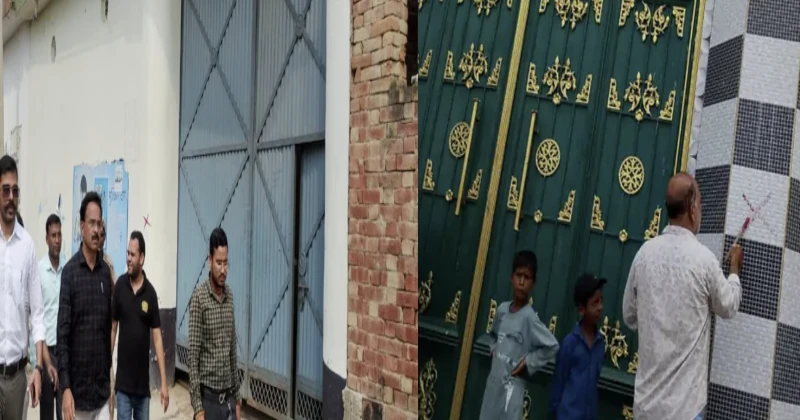
The Sambhal district administration has unearthed multiple cases of unlawful occupation involving a mosque, madrasa, marriage hall, and even a village pond. The encroachments, allegedly facilitated by the Mutawalli (caretaker) of the local madrasa and mosque committees, have sparked widespread concern, with the administration giving a week’s ultimatum to clear the sites or face demolition.
The revelation came during action under Section 67 of the UP Revenue Code, which empowers authorities to investigate and act against illegal encroachments on government and village society land. Acting on complaints, Tehsildar Dhirendra Pratap Singh and Naib Tehsildar Deepak Jurail, accompanied by a full team from the Revenue Department, visited Salempur Salar (alias Hajipur) in the Echouda Kamboh police station area and Raya Buzurg in the Asmoli police station area.
The probe in Salempur Salar revealed that a madrasa had been illegally built on 0.154 hectares of government land, while a mosque had occupied 439 square meters of village society land. Local testimonies confirmed that the madrasa committee had long been aware of the illegal nature of the construction but continued to expand operations.
In Raya Buzurg, the administration found even more disturbing evidence of encroachment. A marriage hall was constructed on land belonging to the village pond, an area designated as public property and essential to the ecological balance of the settlement. Alongside this, a mosque had been built on nearly one and a half bighas of government land, raising questions about systematic land grabbing in the name of religious and community structures.
The investigation further revealed that the Mutawalli himself had encroached on pond land to construct a private residence, effectively converting public land into personal property. This revelation has intensified demands for strict accountability and possible criminal proceedings against those responsible.
After confirming the encroachments, the administration marked the mosque, madrasa, and marriage hall with red paint, a standard step before demolition. The Tehsildar categorically warned that the encroachers must remove the illegal structures by September 20, failing which the Revenue Department would take direct action and raze the constructions.
Speaking to the media, Tehsildar Dhirendra Pratap Singh said, “Government and pond land cannot be allowed to be usurped under any pretext. These encroachments have been marked, and notices have been served. If they are not cleared within the given timeframe, the administration will take strict action.”
The presence of senior officials including Lekhpals Sparsh Gupta and Rahul Dhariwal underscore the sensitivity of the operation. Sources indicate that security forces may be deployed on September 20 to ensure there is no law-and-order breakdown when the ultimatum ends.
The Sambhal controversy is centered on the Mughal-era Shahi Jama Masjid in Sambhal, Uttar Pradesh, with claims that it was built on the ruins of an ancient Hindu temple called Hari Mandir.
Since then Sambhal issue from the past one year has been round the corner. The issue was reignited in November 2024, when a court-ordered survey of the disputed mosque premises uncovered evidence supporting Hindu claims. This triggered violent clashes orchestrated by Islamists, in which several Hindus lost their lives, many were injured, and widespread unrest followed.
Despite the violence faced by Hindus, the Supreme Court has ordered a status quo, and the matter remains under judicial scrutiny, with Hindu organisations demanding justice and the restoration of the original temple.