Indian researchers unlock spin control for future quantum
August 25, 2026
  • Read Ecopy
  • Circulation
  • Advertise
  • Careers
  • About Us
  • Contact Us
Android AppiPhone AppArattai
Organiser
  • ‌
  • Bharat
    • Assam
    • Bihar
    • Chhattisgarh
    • Jharkhand
    • Maharashtra
    • View All States
  • World
    • Asia
    • Europe
    • North America
    • South America
    • Africa
    • Australia
  • Editorial
  • International
  • Opinion
  • RSS @ 100
  • More
    • Op Sindoor
    • Analysis
    • Sports
    • Defence
    • Politics
    • Business
    • Economy
    • Culture
    • Special Report
    • Sci & Tech
    • Entertainment
    • G20
    • Azadi Ka Amrit Mahotsav
    • Vocal4Local
    • Web Stories
    • Education
    • Employment
    • Books
    • Interviews
    • Travel
    • Law
    • Health
    • Obituary
  • Subscribe
    • Subscribe Print Edition
    • Subscribe Ecopy
    • Read Ecopy
  • ‌
  • Bharat
    • Assam
    • Bihar
    • Chhattisgarh
    • Jharkhand
    • Maharashtra
    • View All States
  • World
    • Asia
    • Europe
    • North America
    • South America
    • Africa
    • Australia
  • Editorial
  • International
  • Opinion
  • RSS @ 100
  • More
    • Op Sindoor
    • Analysis
    • Sports
    • Defence
    • Politics
    • Business
    • Economy
    • Culture
    • Special Report
    • Sci & Tech
    • Entertainment
    • G20
    • Azadi Ka Amrit Mahotsav
    • Vocal4Local
    • Web Stories
    • Education
    • Employment
    • Books
    • Interviews
    • Travel
    • Law
    • Health
    • Obituary
  • Subscribe
    • Subscribe Print Edition
    • Subscribe Ecopy
    • Read Ecopy
Organiser
  • Home
  • Bharat
  • World
  • Operation Sindoor
  • Editorial
  • Analysis
  • Opinion
  • Culture
  • Defence
  • International Edition
  • RSS @ 100
  • Magazine
  • Read Ecopy
Home Bharat

From Biology to Quantum Tech: Indian researchers unlock spin control for future quantum and spintronic devices

Cholesterol, often linked to heart disease, has found a surprising role in quantum science. Indian researchers have demonstrated its potential to control electron spin, opening doors for sustainable, energy-efficient spintronic devices and positioning India at the forefront of advanced nanotechnology

Vivek KumarVivek Kumar
Sep 10, 2025, 10:00 pm IST
inBharat, Sci & Tech
Follow on Google News
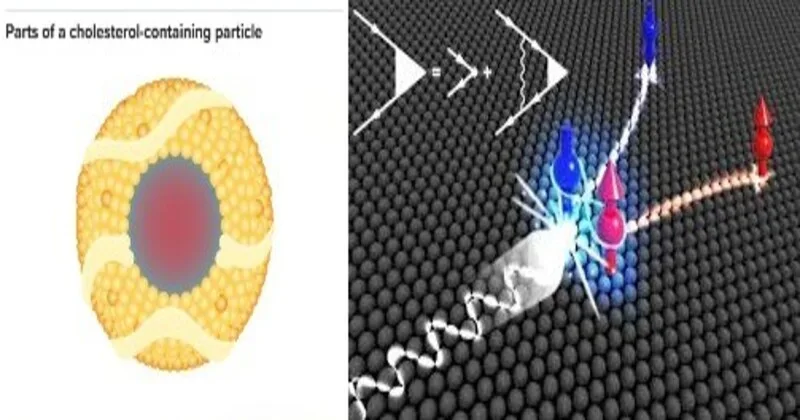
Representative Image of Cholesterol and Electron Spin to aid Quantum Devices

Representative Image of Cholesterol and Electron Spin to aid Quantum Devices

Facebook
Twitter
WhatsAppTelegramEmail

Cholesterol is usually referred as a villain of heart diseases. However, outside of the human system this fat-like molecule has finally made an entry in the field of quantum science. A new development reveals that cholesterol can be utilized to manipulate the spin of electrons, a quantum property that is not seen through eyes. But crucial for the development of next-generation spintronic devices and energy-efficient solutions.

Researchers from the Institute of Nano Science and Technology (INST), Mohali an autonomous institute under the Department of Science and Technology (DST), have presented cholesterol-based nanomaterials as an ideal platform for construction of future quantum technologies based on spintronic materials.

The importance comes from the inherent handedness (chirality) of cholesterol and its molecular flexibility which enable it to be controlled with precision. Based on these characteristics the team of researchers headed by Dr. Amit Kumar Mondal has demonstrated that cholesterol can be mixed with metal ions to produce nanomaterials that can control the spin of electrons a crucial aspect of future electronics.

Also Read: PRATUSH Mission: India leaps into early universe exploration

In their experiments, the researchers showed that the pairing of cholesterol with various metal ions allowed the fabrication of nanomaterials capable of selectively filtering electron spins. Interestingly, both spin directions could be manipulated in the same system. With a minor chemical adjustment or by adding an achiral chemical probe, the transmission of spin information could be adjusted.

The findings of the experiment have been published recently in Chemistry of Materials, will pave the way for a chemical tweak strategy to control spin. It is both powerful and effective technique for enabling spin information to be controlled with great accuracy. It is an important step toward creating biomaterials for advanced quantum and spin technologies.

Spin-based materials can sort molecules with high accuracy, which has direct applications in energy-efficient memory chips, cleaner technology solutions and bioelectronic devices. In an age inclined towards sustainability, such breakthroughs could be instrumental in bringing the energy footprint of computing and data storage down.

Why This Research Matters for India and the World

For India this success signals its rising capability in high-end nanoscience and quantum work. By employing a common biological molecule such as cholesterol, Indian scientists have shown the potential of ordinary chemicals to be used as building blocks for high-technology purposes. This fits into national missions in Aatmanirbhar Bharat, where scientific innovation is regarded as a source of self-reliance in advanced technology.

At a global level this study is in line with the current endeavour of spintronics, a technology that transcends classical electronics. Traditional electronics use electron charge, whereas spintronics employs electrons’ spin orientation, allowing for swifter, compact and less energy-consuming devices. Such innovations could be used in future quantum computers, highly sensitive sensors and environmentally friendly data centers.

What is particularly innovative about this work is its biological nature. Spintronic materials tend to need rare, complex or costly compounds. By demonstrating that cholesterol a ubiquitous natural molecule can be utilized, the INST team opens an environmentally friendly and scalable route for spin-based materials.

The breakthrough of the INST research is in proving dual spin control in a single device a problem that has now constrained spintronics theory. The idea that electron spin orientations can be controlled through simple chemical modification renders the method flexible and versatile.

The innovation may hasten the development of:

·       Energy-saving memory chips for lowering digital storage energy requirements.

·       Bioelectronic devices that couple natural molecules to electronic devices.

·       Greener technologies that lower the dependence on heavy metals and hazardous    substances.

Cholesterol unexpected path from a compound having health implications to a quantum material represents the new directions of scientific inquiry. With India going all out in this direction, the research holds hope not just for national development but also for world advancement in green and energy-saving technologies


Topics: Aatmanirbhar BharatINSTInstitute of Nano Science and Technology
Share
Tweet
SendShareSend
✮ Subscribe Organiser YouTube Channel. ✮
✮ Join Organiser's WhatsApp channel for Nationalist views beyond the news. ✮
Previous News

Cabinet approves two major infra projects in Bihar, Rs 7616 crore outlay earmarked

Next News

Chhattisgarh: Maoist carrying 8 lakh bounty neutralised in encounter

Related News

MQ-9B Sea Guardians to Boost Indian Navy’s Maritime Surveillance Across Indian Ocean

Atmanirbhar Defence Push: Indian Navy gets 2 MQ-9B Sea Guardians as Defence Ministry signs Rs 1,943-crore deal

Kawa UAV successfully conducts the maiden flight of Divyastra Mk3, India’s indigenous jet-powered loitering munition

Kawa UAV successfully conducts maiden flight of jet-powered ‘Divyastra Mk3’ loitering munition

DRDO's seven flagship programmes reflect India's expanding indigenous defence ecosystem and its drive towards strategic self-reliance

DRDO lists seven indigenous defence technologies that place India among the world’s advanced military powers

India's new MPMS aims to make the country a global mobile manufacturing leader by combining incentives, localisation and innovation

How Indian Mobile Phone Manufacturing Scheme positions New Delhi to outcompete the world’s rival manufacturing models

AgriBio 2.0 aims to build a self-reliant, climate-resilient agricultural future through biotechnology

NITI Aayog’s AgriBio 2.0: How biotechnology and climate-resilient crops will transform Indian agriculture

(Source: PIB)

India commissions indigenous warships, strengthens multi-layered maritime defence under Aatmanirbhar Bharat

Load More

Latest News

AI Generated Representative Image

Dimagi Naxals Exposed: The covert ideological network threatening Bharat’s sovereign unity

UPTET 2026 Result to be announced soon (This image is generated by AI)

UPTET Result 2026: UPESSC holds a crucial meeting; Check paper 1 and paper 2 scorecard date, passing marks

AI Generated Representative Image

A message to Gen-Z: Distinguish between Bharatiya and western cultural ideologies

Keralam: Muslim youth participate in Onam celebrations despite Islamic fundamentalist opposition

Union Minister HD Kumaraswamy and Karnataka Chief Minister DK Shivakumar

Karnataka: CM Shivakumar to hijack NICE project via benami firms; Minister Kumaraswamy vows to expose with evidence

Supreme Court rejects rape convict Tarun Tejpal’s exemption plea; Orders to surrender within two weeks

Representative Image

Indian Application to US Universities Fall: H-1B hiccup, rising costs, Trump policies hit demand; A risk to US economy?

Free travel in UP on Raksha Bandhan

UP Raksha Bandhan 2026: Women, one companion can travel free by bus from August 27 night

Allahabad HC Rejects Hijab Plea, Says Uniform Rules Cannot Be Changed for Individual Demands

‘Uniform Means Uniform’: Allahabad High Court dismisses Muslim girl’s plea to wear Hijab with school uniform

Huge Arms Cache Recovered from Concealed Maoist Dump in Sundargarh

Odisha: AK-47, IED among huge arms cache recovered from concealed Maoist dump in Sundargarh

Load More
  • Privacy
  • Terms
  • Cookie Policy
  • Refund and Cancellation
  • Delivery and Shipping

© Bharat Prakashan (Delhi) Limited.
Tech-enabled by Ananthapuri Technologies

  • Home
  • Search Organiser
  • Bharat
    • Assam
    • Bihar
    • Chhattisgarh
    • Jharkhand
    • Maharashtra
    • View All States
  • World
    • Asia
    • Africa
    • North America
    • South America
    • Europe
    • Australia
  • Editorial
  • Operation Sindoor
  • Opinion
  • Analysis
  • Defence
  • Culture
  • Sports
  • Business
  • RSS @ 100
  • Entertainment
  • More ..
    • Sci & Tech
    • Vocal4Local
    • Special Report
    • Education
    • Employment
    • Books
    • Interviews
    • Travel
    • Health
    • Politics
    • Law
    • Economy
    • Obituary
  • Subscribe Magazine
  • Read Ecopy
  • Advertise
  • Circulation
  • Careers
  • About Us
  • Contact Us
  • Policies & Terms
    • Privacy Policy
    • Cookie Policy
    • Refund and Cancellation
    • Terms of Use

© Bharat Prakashan (Delhi) Limited.
Tech-enabled by Ananthapuri Technologies