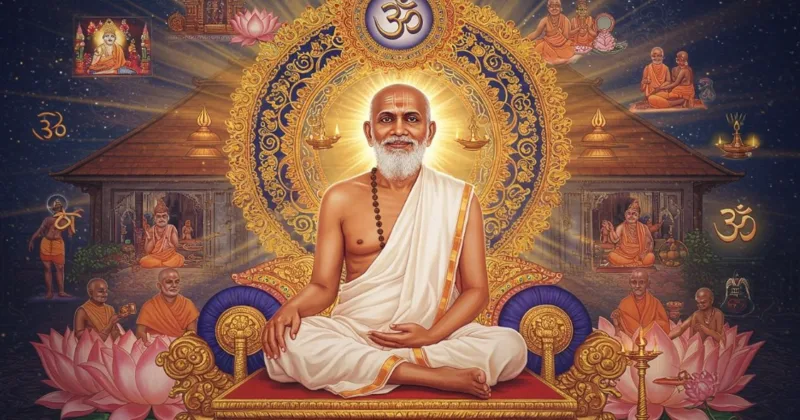
SREE Narayana Guruji was a revered sant, philosopher, visionary, poet, social reformer and a spiritual leader. He was born in Chempazhanthy, a small village in Kerala, on August 20, 1856. He belonged to the Ezhava caste. He hailed from a respected family within his own community, yet he had to endure the social restrictions imposed on supposedly lower castes, such as prohibition against temple entry and access to education.
He was ‘initiated into the traditional formal education Ezhuthinirithal by Chempazhanthi Pillai, a local schoolmaster and a village officer’. He diligently pursued education under the guidance of his father, Madan Asan, a teacher and a farmer, and his uncle, Krishnan Vidya, who was an eminent Ayurvedic physician and a Sanskrit scholar. Even as a child, his spiritual inclination was quite evident as he would sit for hours in meditation and showed a keen interest in poetry, reasoning, reading religious texts and learning Sanskrit. As a child, he used to assist his father in tutoring and his uncle in the practice of Ayurveda. He spent his spare time composing hymns and singing them in the presence of God and in the devotional practices at the temple.
At the age of 21, he was sent to a famous scholar, Kummampilli Raman Pillai Asan, where he was taught Sanskrit, poetry, drama, literary criticism and logical rhetoric. He also studied the Vedas and the Upanishads there and started teaching at a nearby school.
The Spiritual Awakening
As per K P K Ganesh’s book “Sree Narayana Guru: A Spiritual Leader,” Guru Ji experienced a profound spiritual awakening that led him to renounce worldly attachments. In a search for knowledge and enlightenment, he travelled extensively across Kerala. His interactions with different spiritual leaders and observations of the social injustices that existed in the society enhanced his determination to bring change.
In pursuit of truth, his interest in the religious scriptures profoundly impacted him. It initiated him on the path of a spiritual journey and enlightenment. Thus, he became committed to reforming society and working towards the upliftment of the neglected and the underprivileged. All through his life, he emphasised equality, self-respect, education, spiritual growth and the oneness of humanity. His principles were revolutionary for his time and still continue to resonate even today.
Narayana Guruji’s activism is centered on the principle of fundamental equality of all human beings regardless of caste or religion. His slogan “One Caste, One Religion, One God for All” (Oru Jathi, Oru Matham, Oru Daivam, Manushyanu) promoted universal brotherhood and challenged the caste barriers. He actively opposed the caste system and toiled to establish social equality. Guruji believed that societal injustices should not be used as a foundation to incite violence or to convert people. For him, the inherent dignity of all individuals was of utmost importance. His teachings motivated the marginalised community to claim for their rights and dignity.
On Education and Equality
Narayana Guruji always recognised the importance of education as a tool for the empowerment and upliftment of the society. He established schools and institutions for the enlightenment and awareness among the marginalised communities. He opined that education was the key to both personal and social emancipation and only it will eradicate ignorance and superstitions, which are often used as tools for caste discrimination. His inclination for education not only empowered individuals but also challenged the intellectual monopoly of the upper castes. His focus on education was instrumental in instilling self-confidence and improving literacy rates among the downtrodden and enabling them to engage in the society firmly.
He did not merely preach but set example through his actions. He consecrated many temples accessible to all castes. He built a temple dedicated to Lord Shiva in Aruvippuram in 1888, allowing all people to worship freely, thereby defying all caste restrictions prevalent at the time. This act symbolised his commitment to inclusivity. In another temple, he placed mirrors instead of idols to symbolise that divinity dwells within every individual.
He is also known to have established Sri Sarada Mutt in 1912 in Sivagiri, Kerala, dedicated to Goddess Saraswati (Sarada). This temple became a major spiritual and educational center. Omkaram Temple in Varkala, Kerala was established to focus on the universal symbol “Om” instead of a deity, promoting the idea of universal spirituality.
Under his guidance, Karamukku Temple-Kerala, Kalavamkodam Temple-Kerala and Sivagiri Math at Varkala were also constructed in the dignity of Bhagwan Shiva. Murikkumpuzha Temple-Kerala and Kumaranalloor Temple-Kerala were established to challenge caste restrictions in worship and to promote his ideals of “one caste, one religion, and one God.” Narayana Guruji extended his reforms beyond Kerala by consecrating Kanchipuram Temple in Tamil Nadu and Mangalore Temple in Karnataka which follow his teachings of equality and universal brotherhood.
All through his life Guruji worked towards unifying various castes which had been historically divided. He enabled solidarity among lower castes by fostering a sense of community (Samudayam). By fostering such community feelings, he countered the divisive practices that had been perpetuated by the caste system. This unity was crucial in advocating for rights and recognition. His fundamental message of one God for all struck against the barriers of caste that were so deeply rooted in the society. This ideology fostered the spirit of global brotherhood and oneness and motivated people to transcend the boundaries of caste. His teachings inspired social movements aimed at the abolition of caste discrimination and brought the society closer to being an ideal egalitarian society.
He encouraged inter- dining and inter-caste marriages to break caste barriers. His mantra of “Do not ask caste, do not tell caste, do not think of caste” helped in depleting caste distinctions. It also promoted a sense of closeness among alienated communities. This approach promoted social integration and helped in reducing stigmas associated with inter-caste relationships. Narayana Guruji cautioned against the use of social disparities to instigate religious conversions as it could lead to a strife among different faiths. He organised conferences that focused on nurturing a healthy dialogue among communities. Guruji also advocated for hygiene and cleanliness.
He initiated efforts to promote agriculture and cottage industries and addressed the importance of self- reliance and economic independence as one of the most important component of social empowerment and means for upliftment of the marginalised communities. His emphasis on these values has influenced community development initiatives aimed at improving living standards and fostering dignity among marginalised groups.
A Literary Maestro
Sree Narayana Guruji composed approximately 63 works consisting of devotionals songs, philosophy, proclamations, translations, and prose mainly in Malayalam, Sanskrit, and Tamil languages. Some of his works are Atmopadesha Shatakam, Darshanamala or Garland of Vision, Daivadashakam, Advaita Deepika, Anukampa Dashakam, Swanubhava Geethi, Cit-Jada-Cintanam, Pindanandi, Kundalini Pattu, and Oru Deivam Thandathu Kaalam. His notable performances include translating Thirukural, Ishavasya Upanishad, and Ozhivil Odukkam. His translations made these essential texts accessible to a larger audience. His contribution is not limited to literature only; his writings also serve as foundational stones for social reformation and spiritual awakening in modern times.
A Real Influencer
Narayana Guru continues to influence modern leaders, including MK Gandhi, who struggled against caste discrimination. In 1925, Gandhi visited his ashram, which drastically changed his views on caste, social reforms, and untouchability. As a result of these changes, he began to address caste issues at the same time working towards Bharatiya independence. These changes have greatly improved the national discourse on caste discrimination. Rabindranath Tagore praised Narayana Guruji’s spiritual stature and also admires his idea of universal compassion and religious tolerance. Recently, Pope Francis went on record to emphasise Narayana Guruji’s teachings of promoting human values and respect for nature. His actions inspired movements like the Vaikom Satyagraha, agitating for the rights of lower castes’ access to temples.
Narayan Guruji continues to influence modern leaders, including MK Gandhi, who struggled against caste discrimination. In 1925, Gandhi visited his Ashram
His technique of non-violent activism and reform has inspired numerous social reformers and advocates of equality and justice. His principle of addressing social injustice has not only aided the contemporary movements in Bharat, but also globally. His enduring legacy in serving justice and promoting equality is apparent in the fact that his birthday is celebrated throughout Bharat as Narayana Jayanti. His notion of universal brotherhood and social justice reverberate along with contemporary movements which advocate equality, human rights and dignity for all, thus making his efforts timeless and universal. In “The Depths of Philosophy: Narayana Guru,” RM Aiyer explains how Guruji blended social activism with spirituality. Sree Narayan Guruji’s life acts as a remarkable tale in the history of caste divided Bharat and stands apart as a significant chapter in a nation’s struggle against the discriminatory caste system. Even today, as we continue to rise against inequality and injustice, his vision of a society where all individuals are valued equally and treated with dignity, remains relevant.
The Unifier
Narayana Guruji emphasised on self-respect along with education, community cohesion, religious harmony, and spiritual growth as a means to combat social injustice. He cultivated social change through spirituality while advocating for spiritual altruistic advancement as a means to inspire social change. He balanced material and spiritual interests, urging nurturance of self-integrity alongside social welfare.
He elucidated Vedic philosophy in its true essence. A philosophy that advocates united humanity, bound by respect for one another through religion, culture and civilisation, without any discrimination. His message was straightforward – true spirituality transcends social divisions, and connects one to oneself and all other holy beings, surpassing sociological segregations. Narayana Guruji regarded religion as an element which ought to elevate human character rather than bereave society of compassion or create divisions. He stated that, “Whatever be the religion, it is enough if man becomes good,” and emphasised moralistic advancement over ritualistic practices. In his opinion, the true manifestation of spirituality is in the acknowledgement of the Divine within oneself and the others. Sree Narayana Guruji’s philosophy has played a crucial role in shaping modern Bharatiya society by promoting ideals of equality, education, and social justice. His teachings continue to inspire efforts towards creating a more inclusive society, making him a timeless figure in the ongoing struggle against discrimination and inequality. As contemporary Bharat grapples with issues related to caste and social stratification, Guruji’s vision remains relevant, guiding new generations towards a more equitable future.